Who Owns Your Identity?

- The Promise of Digital ID
- From Possession to Permission
- The 1 AM Problem
- Who Actually Controls Your Identity?
- Why Promote It At All?
- The Direction of Travel
- A Better Model: Identity You Control
- Why This Matters
- The Deeper Distinction
- This Is Not Anti-Technology
- What We’re Building Instead
- The Real Question
- Closing Thought
Andrew G. Stanton - Friday, April 24, 2026
The Promise of Digital ID
Image : 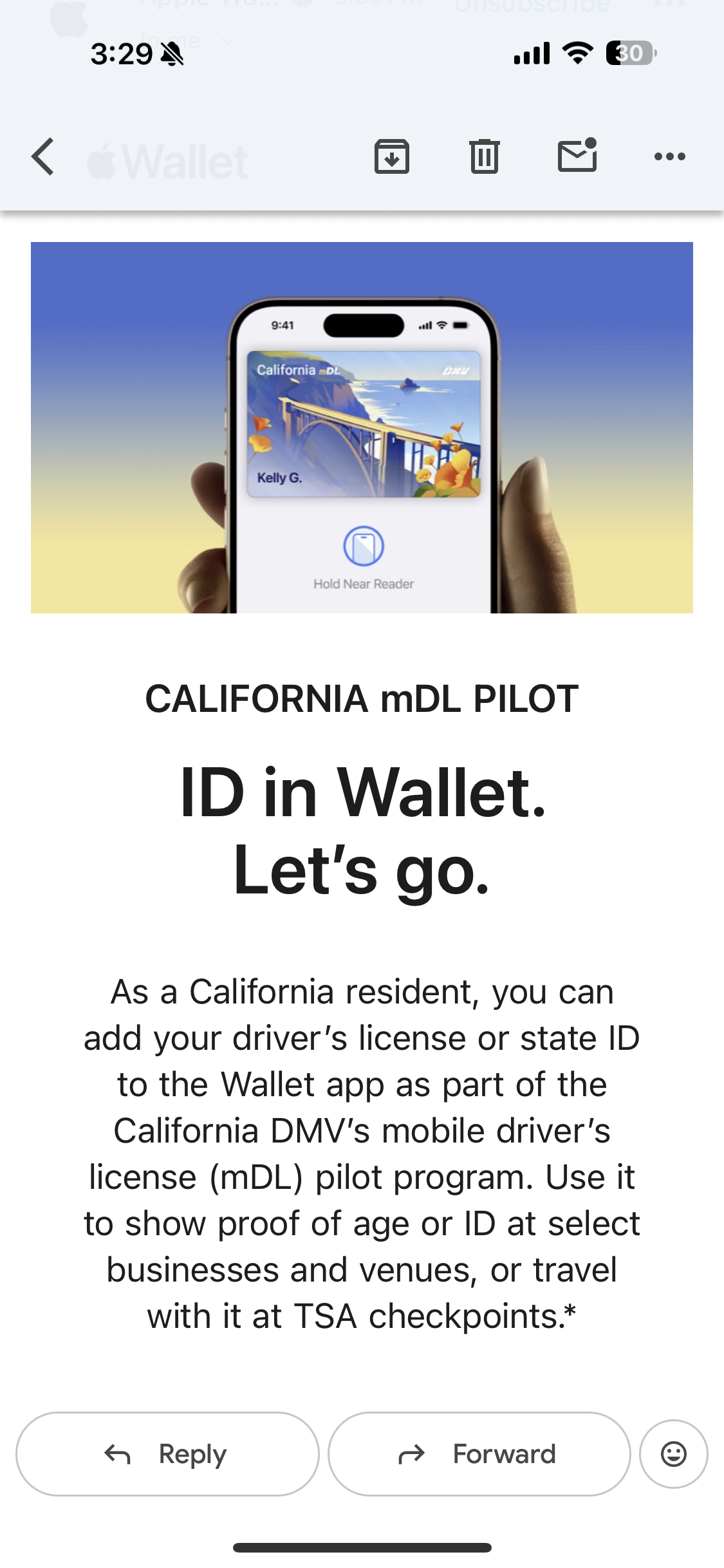
“ID in Wallet. Let’s go.”
It’s clean. It’s simple. It feels inevitable.
California’s digital driver’s license, now available in Apple Wallet, represents what many see as the future:
- No more fumbling for your wallet
- Faster TSA lines
- Seamless verification at venues and checkpoints
From a user experience perspective, it’s hard to argue against it.
When it works, it works beautifully.
But beneath that convenience is a deeper shift—one that most people won’t notice until it matters.
From Possession to Permission
A physical ID is something you have.
You take it out.
You show it.
A human being looks at it.
Even if the system around it fails, the card still exists. It still says what it says.
A digital ID changes that dynamic.
Now:
- Your identity is presented through a device
- Verified by a system
- Interpreted by a policy
If the system can’t verify it, your identity doesn’t just degrade—it can disappear.
A physical ID can fail gracefully.
A digital ID can fail absolutely.
The 1 AM Problem
Imagine this:
You’re at the airport at 1:00 AM.
Your boarding pass is ready.
Your ID is in your phone.
The agent scans it.
“Invalid.”
Now what?
- The system is down
- The reader fails
- The credential didn’t sync
- Your phone glitches
With a physical ID, there’s still something to look at.
With a digital ID, the system becomes the authority.
And if the system says no, there’s often no fallback.
Who Actually Controls Your Identity?
The current model looks like this:
- The state issues your identity
- The platform (Apple) contains it
- The system verifies it
You’re holding the device—but you’re not holding the authority.
That matters more than it seems.
Because it means:
- Your identity can be revoked
- Your access can be conditioned
- Your verification can be denied
Not because you changed—but because the system did.
Why Promote It At All?
To be fair, digital ID solves real problems:
- Faster processing
- Reduced fraud
- Potentially better privacy (selective disclosure)
And it creates something institutions value deeply:
standardized, programmable identity
That’s powerful.
But it optimizes for:
- speed
- scale
- coordination
Not:
- independence
- resilience
- edge cases
The Direction of Travel
This won’t flip to “digital-only” overnight.
Instead, it will move gradually:
- Optional
- Preferred
- Expected
- De facto required
Not because physical IDs are banned—but because they become inconvenient, slower, or second-class.
That’s how systems evolve.
A Better Model: Identity You Control
There’s another way to think about this.
Not:
“a digital version of my driver’s license”
But:
“an identity I control, with credentials I can prove”
In this model:
1. You own your identity
- Not issued by a state
- Not stored in a platform
- Not dependent on a system
It’s a keypair. A root of identity you control.
2. Authorities issue verifiable claims
- The DMV can attest: “This person is licensed to drive”
- A service can attest: “Over 21”
- A jurisdiction can attest: “Resident”
These are signed credentials, not centralized records.
3. You present only what’s needed
- Not your full identity
- Not your address
- Not your ID number
Just:
proof
Why This Matters
This model changes everything.
| Model | Identity Control | Verification |
|---|---|---|
| Physical ID | State | Human judgment |
| Digital ID (Apple/CA) | State + Platform | System validation |
| Self-sovereign | You | Cryptographic proof |
In the first two, identity is something you are given.
In the third, identity is something you hold.
The Deeper Distinction
A digital ID proves:
who you are to a system
A self-sovereign identity proves:
what you can demonstrate, independent of any system
That’s not a small difference.
It’s the difference between:
- being identified
- and being the author
This Is Not Anti-Technology
Digital ID is not the enemy.
It’s an evolution—but an incomplete one.
It takes a physical system and makes it more efficient.
But it doesn’t fundamentally change the relationship between:
- the individual
- the issuer
- and the verifier
What We’re Building Instead
In Continuum (and similar approaches), the goal isn’t to digitize identity.
It’s to separate identity from the system entirely.
- Identity lives with you
- Signing happens locally
- Proofs can be shared selectively
- No central authority is required to validate authorship
This is already true in publishing:
- You sign content
- You publish it anywhere
- The signature proves authorship
The same principle can apply to identity.
The Real Question
This isn’t about Apple.
Or California.
Or even digital ID.
It’s about this:
Do you have an identity…
or do you ask for permission to prove it?
Closing Thought
Digital ID in your phone feels like progress.
And in many ways, it is.
But it also quietly redefines identity as something that must be:
- verified
- approved
- and accepted by a system
There is another path.
One where identity is:
- owned
- signed
- and proven
Not granted.
“A better model isn’t a digital ID in your phone.
It’s an identity you control—with credentials you can prove.”

Write a comment