Stop #297 - In fork veritas
Sponsored announcement
With Debifi you get access to immediate fiat liquidity without giving up your bitcoin.
Debifi** is a Bitcoin-only and non-custodial lending platform. You deposit your bitcoin as collateral in a 3-of-4 multisig escrow: keys are distributed among you, the lender, an authorized key holder, and Debifi. 3 of 4 signatures are required to move funds - no one can touch your bitcoin unilaterally.
The code is open source: you can verify everything.
Forget the nightmare of 33% capital gains taxes from selling bitcoin: a loan is not a taxable event!
Choose the loan duration, the LTV (the portion of bitcoin you commit versus how much you receive in fiat) and receive the loan in euros, dollars or stablecoins. Debifi, never sell your bitcoin again!
Request your first loan here: https://debifi.com
“I’m helping to create a new hard fork of Bitcoin coming out in August, called eCash. Your bitcoin splits: if you have 4.19 BTC, you will receive 4.19 eCash. You can sell them, hold them, ignore them.” This is how Paul Sztorc, CEO of LayerTwo Labs, announced his new project on X on April 24. In the rest of the thread he adds the detail that has become the real center of the debate: the fork will manually reassign approximately 500,000 BTC attributed to Satoshi to investors and developers of the project itself.
This is the third fork to make noise in nine months. In October Dathon Ohm presented BIP 444, later renamed BIP 110, a temporary anti-spam soft-fork that, in the text, threatens moral and legal consequences to anyone who refuses to adopt it. In February Jameson Lopp revived the quantum soft-fork proposal to freeze UTXOs signed by old keys.
Three technically very different proposals. A drivechain disguised as an airdrop, a restriction on transaction data, a freeze of inactive UTXOs. One common denominator: zero realistic possibility of adoption, according to any observable metric in the field. And three people who insist on implementing them anyway.
In fork veritas. Every fork proposal, at this stage of Bitcoin’s history, says something about who proposes it.
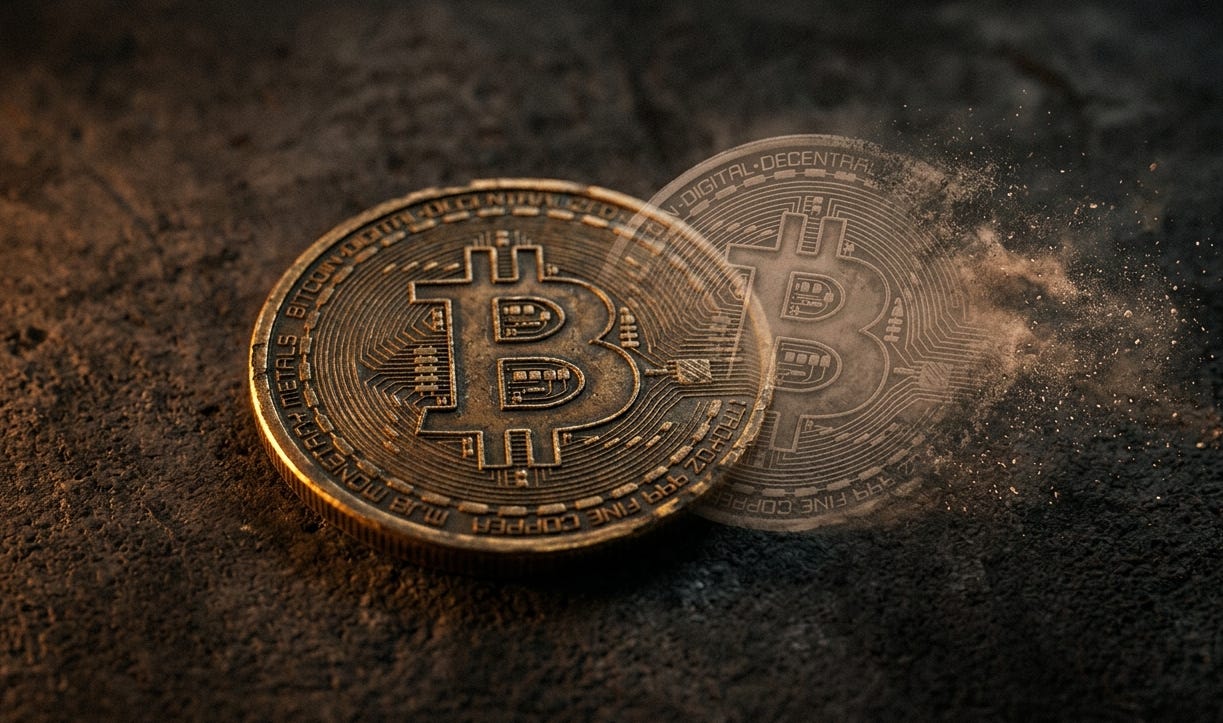
To frame the most recent case: at Bitcoin block 964,000, expected in August 2026, a new blockchain called eCash will launch. Its history will replicate Bitcoin’s up to that block. From then on, the two blockchains will diverge. Anyone holding N BTC at the time of the snapshot will find themselves with N eCash on the new blockchain.
The eCash base layer is described as a near-copy of Bitcoin Core. SHA-256d mining, same consensus rules, 1 megabyte blocks. The only technical difference: eCash launches with BIP300 and BIP301 activated, through a procedure the team calls “Core-Unmodified Soft Fork”. In practice, drivechains activated without touching the layer 1 consensus code.
BIP300 introduces “hashrate escrows”: vaults managed by miners through voting, which allow depositing and withdrawing coins between the main chain and the anchored sidechain. BIP301 adds “blind merged mining”: SHA-256d miners can collect fees from a sidechain without running its full node, by including the right commitment in their blocks. Sztorc has been working on this since 2015. Bitcoin Core, after ten years of discussion, has never activated them.
eCash will launch with seven drivechains already ready: Truthcoin (prediction markets, Sztorc’s old project), CoinShift (DEX), Bitassets, Bitnames, a Zcash-style chain for privacy, Photon (post-quantum), plus a seventh.
On the new chain, Sztorc intends to manually reassign approximately 500,000 eCash that, on the copy, would end up in addresses attributed to Satoshi Nakamoto. He doesn’t send them to the original addresses. He moves them to new keys controlled by investors, developers, and project funders.
Drivechains have never made it into Bitcoin. The debate has gone on for nearly a decade. Sztorc has transformed frustration into leverage: in a statement following the announcement, he implied that the fork would cancel itself if Bitcoin Core activated BIP300/301 before August. Translation: either drivechains enter mainnet, or he runs them on a parallel blockchain and takes away 1.1 million eCash to split with those who finance him. A technical proposal and commercial blackmail in the same sentence.
LayerTwo Labs, Sztorc’s startup, raised $5 million in a seed round in 2023. It has a structural incentive to see its stack adopted.
Let’s move to Dashjr. Maintainer of Bitcoin Knots, the alternative implementation to Core that gained traction in 2025 after the mempool changes in Bitcoin Core v30, with BIP 444 he proposed in October a twelve-month temporary soft-fork to limit data size in transactions. In the BIP text he wrote that there exists “a moral and legal impediment to any attempt to refuse this soft-fork”, and that those who refuse “may be subject to legal or moral consequences”. He then added that there was the possibility of a temporary hard fork to “protect” node runners from illicit content, denying it a few days later.
Lopp, finally. His quantum proposal, even more radical, would freeze forever UTXOs signed by exposed public keys, because they are vulnerable to a future quantum computer. The community rejected the proposal en masse.
Three different people, three different forks, one scene. Anyone proposing to alter Bitcoin’s rules at this stage of history either has an economic agenda direct enough to make the operation worthwhile even with success probability close to zero, or has an ego agenda strong enough to make public failure acceptable in exchange for media relevance. Often the two coincide. Tertium non datur, because anyone observing how Bitcoin has worked over the last eight years knows that proposing a fork is wasting time. Since 2017, no fork has dented BTC’s dominance. BCH, BSV, XEC, BTG: all alive on paper, all dead on the market.
Unless failure is the plan.
Announcing a fork creates short-term volatility. Positioning before the announcement, perhaps shorting BTC in the hours before, is a well-known asymmetric trade. I’m not accusing Sztorc, Lopp, and Dashjr of insider trading. I’m saying that the model exists, that it incentivizes those willing to get their hands dirty, and that every fork without realistic chances of adoption is, by default, a market shock favoring those who know when it’s coming.
Let’s return to Sztorc’s fork. His defense is formally correct: he doesn’t move a single BTC. On Bitcoin, Satoshi’s UTXOs remain where they are.
However, on eCash Sztorc claims to know which UTXOs belong to Satoshi. No one knows this with cryptographic certainty. The attribution is based on the so-called Patoshi pattern, identified by Sergio Demian Lerner in 2013: an anomalous distribution of nonces in blocks mined in Bitcoin’s first months, compatible with a single miner. From there, an estimate of approximately 1.1 million BTC attributable to that miner is derived.
It’s a statistical heuristic. Robust, cited, reproduced. It remains a heuristic. No one has Satoshi’s digital signature on those outputs. Reassigning the corresponding eCash, on the fork, amounts to a discretionary seizure based on an interpretation of cryptographic patterns. The fact that it happens on a copy doesn’t change the substance of the precedent.
Then there’s Sztorc’s second argument, the one he uses to justify the need for the fork: Bitcoin would be lacking on the privacy front and drivechains, particularly the Zcash-style one, would serve to fill the gap.
Privacy on Bitcoin exists and is already accessible even to unsophisticated users. Boltz allows swaps between Lightning, Liquid, and mainchain with a very simple interface. A few clicks, no account. Wasabi Wallet implements CoinJoin with the WabiSabi protocol. Bull Bitcoin Wallet integrates native PayJoin. Tools available today: building another blockchain to solve privacy is a solution looking for a problem.
The most likely scenario is irrelevance. The history of past forks tells a consistent trajectory: initial hype, price peak concentrated around the fork days, slow value erosion. Developer consensus cannot be bought with an airdrop. Exchange consensus is measured by real volume, and real volume follows users, who today are well distributed between mainchain and Lightning. Without adoption by exchanges, eCash becomes a self-referential asset where the 500,000 reassigned tokens are worth whatever those holding them can sell them for to the first unlucky buyer.
In the less likely but noisier scenario where one or more exchanges list eCash at launch, a market will open where BTC holders can sell their airdrop to accumulate more BTC. This is exactly what happened with Bitcoin Cash in 2017 for those with no ideological attachment to the fork.
One operational note remains. To see the eCash balance, a watch-only wallet that imports an xpub will suffice. To spend, you need the private key, and here’s where the risk begins.
The activation client published by the eCash team will be new, frozen 30 days before launch, subjected to a bug bounty in summer but not yet battle-tested. Importing the seed into a newly born wallet means trusting software that, in the best case, is a few months old. The practical rule is the one that applies to any airdrop on a shared seed phrase: before touching the eCash, move the bitcoin to a new seed phrase, isolated from the wallet used for the claim.
Sponsored announcement
Prague, June 11-13**: the most important European Bitcoin conference arrives at its fourth edition. Jeff Booth, Jack Mallers, Michael Saylor, Peter McCormack and many others, check out the list of all speakers here.
Buy your ticket now for the event of the year, do it with the code BTCTRAIN to get 10% off. I’ll obviously be there too, see you in Prague!
When you ask me where to buy bitcoin, my first answer is always the peer-to-peer market: Bisq, HodlHodl, Robosats. But I know not everyone wants to use these services. If you’re looking for an immediate service but compatible with Bitcoin’s original values, my choice today is Bull Bitcoin. By signing up with the code “federico” you get a reduced spread of 1.75% instead of 2%, forever. You can do it from here.
Non-custodial**, supports Bitcoin on-chain, Lightning and Liquid. And you can also spend your bitcoin to pay any IBAN in euros, without going through a bank.
KYC data is on self-hosted infrastructure, not shared with tax agencies, governments, or third parties. And they will continue not to cooperate until someone shows up with a judge’s order in hand. It’s the only service in Europe I can say this about with certainty.


Write a comment