The Latest Bitcoin & Macro news: Weekly Recap 03.03.2026

- 🧠Quote(s) of the week:
- 🧡Bitcoin news🧡
- 💸Traditional Finance / Macro:
- 🏦Banks:
- 🌎Macro/Geopolitics:
- 🎁If you have made it this far, I would like to give you a little gift:
🧠Quote(s) of the week:
When you build on truth, the structure stands. An honest protocol is like the TCP/IP of money—neutral, honest, permissionless. It changes everything above it. Are you building on a foundation that lasts? The answer shapes more than just your work. It shapes the world.
Money is stored energy—your time and creativity turned into value. Dishonest money erodes that energy, silently stealing your life force. But with Bitcoin, energy is preserved, untouched by debasement. What do you choose to anchor your life’s work to? - Jeff Booth
🧡Bitcoin news🧡
Photos hosted by Azzamo ( https://azzamo.net/)
On the 23rd of February:
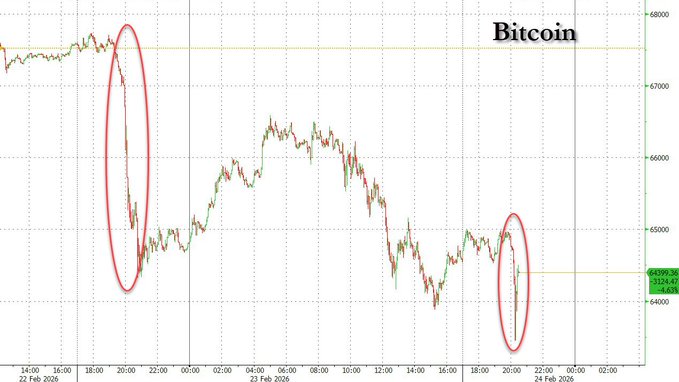
➡️Bitcoin falls below $64,000 as selling pressure builds and levered liquidations accelerate.
➡️Fucking finally, Jane Street was sued for alleged insider trading by the administrator winding up the affairs of Terraform Labs, the firm whose $40 billion collapse in 2022 roiled the crypto markets and contributed to the collapse of FTX.
You’ll never guess what the algos did at exactly 8pm ET. - ZeroHegde
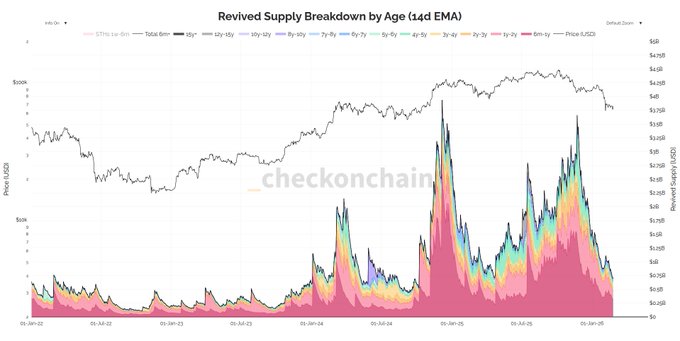
➡️’Long-term holder supply has increased by 400k BTC since November 23rd. LTH behaviour changed post-ETF, as clearly seen in the supply structure (first image). Zooming in on the two previous LTH supply drawdowns (Yen carry & Liberation Day tariffs). The bottom had already occurred by the time LTH supply started increasing (second image).’ - James van Straten
➡️’…Bitcoin is an emerging store of value. You cannot ask it to emerge from nothing as mature as Gold. Imagine it in 2009 as a newborn. It is 100% speculation. Now imagine it in 2050 or whenever, when every central bank owns it, and it’s as normal as Gold. It’s 0% speculation. You cannot travel from 100% speculation to 0% speculation without ticking every gradient in between. The reason it doesn’t fit any individual box right now is that it’s in the uncomfortable middle. But that’s a necessary part of the journey. Either you believe it’s literally impossible to create a digital store of value or you have to imagine it passing through exactly this teenage state.’ - Matt Hougan
On the 24th of February:
➡️’Bitcoin’s mining difficulty just had its largest upward adjustment since May 2021, up 14.7% in a single move. And this is happening while miners are selling everything they produce, and Bitdeer is literally liquidating their entire treasury to pivot to AI. So the network is getting harder to mine just as it’s becoming less profitable, and the companies that mine it are questioning whether they even want to be in the mining business. And yet the hashrate keeps climbing. The difficulty keeps adjusting upward. The economics are brutal right now, and the network keeps going because the protocol doesn’t care about quarterly earnings, analyst expectations, or the Fear and Greed Index. Fifteen years of continuous operation through every crisis imaginable, and it just keeps processing blocks. I think people forget how remarkable that actually is because they’re so focused on the number going down.’ - Fernando Nikolic

➡️Investment advisors manage $146 trillion in assets. Guess what the top 29 have in common? - River
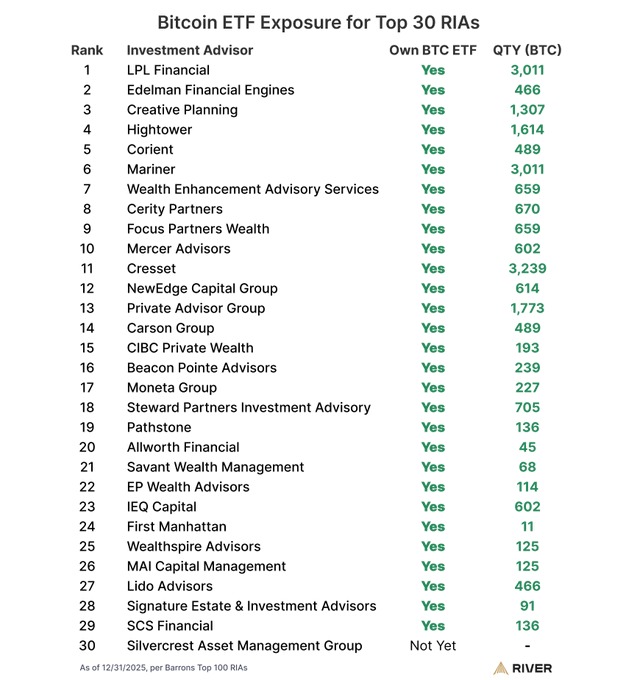
They all own Bitcoin I.O.U.s!
These are 13F filings from the RIAs’ discretionary managed portfolios (client AUM), per River’s analysis of Barron’s Top 100 RIAs data as of 12/31/2025. RIAs oversee ~$146T in client assets and allocate tiny slices (~0.008% avg) via BTC ETFs—no material proprietary firm holdings at this scale.
➡️TFTC: ‘60% of the top 25 US banks are now building Bitcoin products. JP Morgan, Charles Schwab, and UBS have announced their trading plans. State Street and HSBC have announced their custody arrangements. The regulatory green light has been given.’
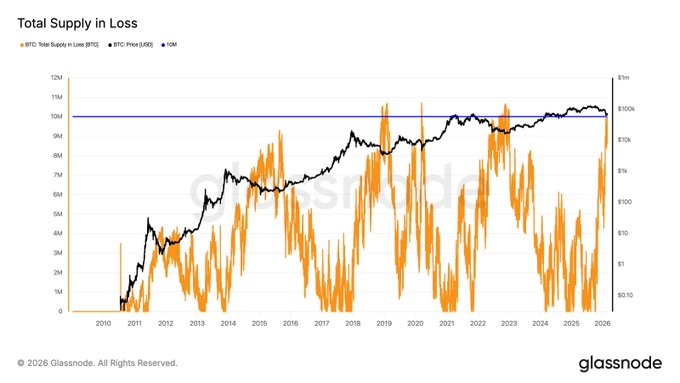
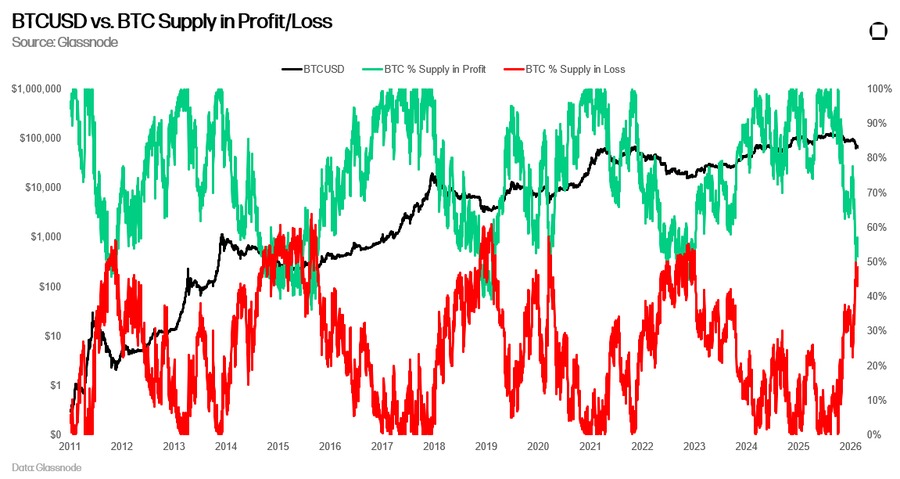
➡️BTC supply in loss just hit 10M coins, the fourth-highest reading ever. A further 70K coins are lost from purchases between Feb. 6 and today. Circulating supply hits 20M BTC next week, that’s 50% in loss. History suggests that’s enough capital destruction for a bear market bottom. - James van Straten
On the 25th of February:
➡️The Netherlands is walking back its planned tax on unrealized gains. Dutch Finance Minister Heinen just said the new Box 3 wealth tax law “cannot proceed as it is” and he’s going “back to the drawing board.” “We are not deaf to the criticism,” he said. “We want to move as quickly as possible to a system where you only tax actual gains.” (In the next recap you will read, unfortunately, that all the above is fugazi.)
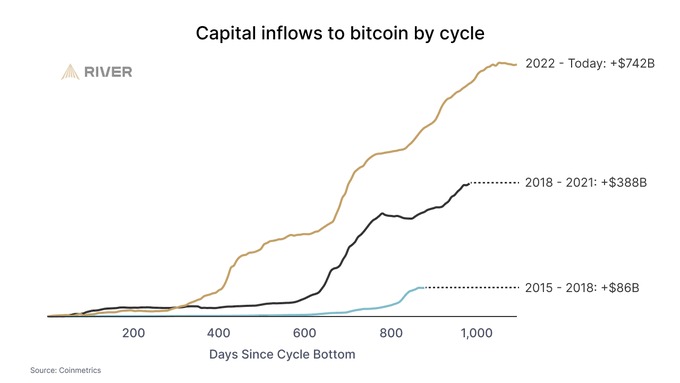
➡️Bitcoin’s next cycle will bring in trillions. - River
➡️Jeff Park: Everyone is asking: “Is Jane Street why Bitcoin isn’t at $150k?” As expected, the answer is trickier than the question. But it’s also more structurally unsettling than the conspiracy theory itself—and once you understand the actual mechanics, you won’t be able to unsee them.
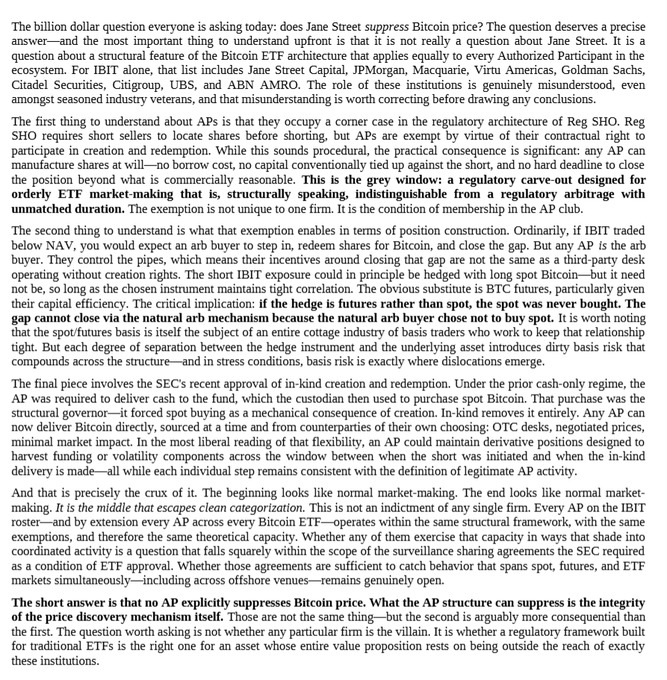
Ergo: Jeff’s post (that big image) says: Nah, Jane Street alone isn’t “suppressing” Bitcoin to keep it under $150k. The real issue is bigger: Every big bank running Bitcoin ETFs (Jane Street, JPM, Goldman, etc.) gets special loopholes. They can short ETF shares super cheap—no borrowing hassle like normal traders. If an ETF trades below the real BTC value, it should buy actual Bitcoin to close the gap. Instead, they hedge with futures (fake BTC), so zero real buying hits the spot market. A new SEC rule lets them deliver real BTC now, but they still wrap it in derivatives for extra profit. Bottom line: The ETF system itself can screw up true price discovery on Bitcoin. Not one villain firm—it’s the whole setup built for stocks, not an “outside finance” asset like BTC. That’s why it feels capped.
I tend to lean more on Checkmate’s side, because data is data: ‘Jane Street didn’t suppress the Bitcoin price folks. HODLers all did. It’s just not that hard, stop summoning your inner salty goldbug but blaming manipulators. People. Sold. A. Fucktonne. Of. Spot. Bitcoin. My point has always been the same: manipulation is the literal job of large Wall Street firms, and will always be. However, you do not need that as the central argument to explain why the price didn’t go higher, nor why it went lower. That can be well and truly explained by looking at the spot sell-side. Folks always need to blame a named entity because it helps them understand complexity. Narratives are tools humans use to simplify the world, even if they are wrong.’
➡️Alex Thorn: The worst Bitcoin pain is almost certainly behind us, but there could still be some ahead. case for: behind us:
- near 200w MA, realized price
- More than half of the coins are underwater
- RSI at capitulation bottom levels
- many other metrics screaming bottom
more to come:
- Bottoms take a long time, drift is possible
- equities rolling over would likely push lower
- malaise, sense of lack of catalysts
- overhang from quantum fears
‘Price pain –> Time pain. Surviving the first part is easy because most people are too stunned in the headlights to do anything about it. The second part gets many. Many sell, thinking they will buy back at a lower price (and never do), and others lose interest entirely. They leave at the literal point of maximum opportunity. Even Warren Buffett buys Bitcoin at the 200-day moving average. Many proceed to lose another fortune trying to short-sell it all the way through the disbelief recovery rally, when it finally feels safe to jump into the bearish pool. Buy the whole time-pain bottom with a DCA strategy, don’t lose sleep trying to buy THE bottom (you will be too scared to do it when it happens anyway).’ - Checkmate
On the 26th of February:
➡️’BIG BANKS ARE COMING TO BITCOIN (last 3 months)
Citi: Launching Bitcoin custody, wallet & key management to integrate BTC into tradfi this year Morgan Stanley: - To launch its own Bitcoin Trust/ETF (1st major bank to file) - Bitcoin-supporting digital wallet in 2026 - Bitcoin trading to launch in 2026 - Lending, yield & full custody services on the way
JP Morgan:
- Exploring Bitcoin & crypto trading for institutional clients
- CEO Jamie Dimon admits he was wrong and that “Bitcoin is real” & will be used by all
Goldman Sachs:
- Buys $1.1 billion worth of Bitcoin (filing)
- CEO David Solomon announces he owns a small amount of Bitcoin
Standard Chartered:
- Launching prime brokerage accounts for Bitcoin trading
UBS:
- To launch Bitcoin trading for select private banking clients
Danske Bank: Denmark’s largest bank, Danske Bank, announces offering Bitcoin & crypto ETPs to investors.’ - Bitcoin Archive
on the 27th of February:
➡️Daniel Batten: “We’re now 3 years into Bhutan’s Bitcoin experiment. That means we now have robust data on how it has impacted the economy. For context: Bhutan’s economy was in dire shape in 2022 due to the loss of all tourism income (it’s #2 export earner) during the COVID period. It got so bad that Bhutan was 3 months away from defaulting on import payments.
The IMF was poised to step in to structure a loan that would have led to heavy debt repayments, but also to the ceding of economic sovereignty to a lender whose loan conditions permit it to dictate how to (re)structure an economy. Instead, Bhutan formed a large Bitcoin Strategic Reserve by using its surplus renewable hydropower to mine Bitcoin. The IMF has warned on numerous occasions that nations embracing Bitcoin would destabilize their economy, be less effective at attracting foreign direct investment, and endanger their decarbonization and environmental initiatives. What does the data say (as reported by the Wall St Journal, Al Jazeera, and Forbes)
- Bhutan was able to “use Bitcoin reserves to avert a crisis as foreign currency reserves dwindled to $689 million.”
- The bitcoin reserves have directly addressed pressing fiscal needs. “In June 2023, Bhutan allocated $72 million from its holdings to finance a 50% salary increase for civil servants.”
- Prime Minister Tshering Tobgay, in an interview, said that bitcoin also “supports free healthcare and environmental projects.”
- Tobgay also said their Bitcoin reserves helped in “stabilizing [the nation’s] $3.5 billion economy.”
- Independent analysts have now said that “this model could attract foreign investment, particularly for nations with untapped renewable resources.”
Considering that what transpired in Bhutan has helped stabilize an economy that the IMF warned Bitcoin would destabilize, it begs the question: what data were the IMF’s predictions based on? For Bhutan, Bitcoin didn’t just boost the economy; it enabled the country to maintain economic independence and served as an example to other small nations of a path forward that did not require the IMF.“
➡️TFTC: ’Citi just announced they’re building infrastructure to integrate Bitcoin into traditional finance. Their Head of Digital Asset Custody said it plainly: “We’re making BTC bankable.” This is the third-largest bank in America. $2.4 trillion in assets. And they’re building the pipes so their clients can hold bitcoin alongside stocks and bonds within existing tax and compliance systems.
Think about what that means. The custody problem was always the excuse. “We’d love to allocate to Bitcoin, but we can’t custody it properly.” That excuse is dying in real time. BNY Mellon is already live with crypto custody. State Street is being built. Now Citi. JPMorgan is doing blockchain settlement. Goldman has a digital assets desk. These banks aren’t buying bitcoin for their balance sheets. They’re doing something more important. They’re building the rails so that every wealth manager, pension fund, and family office can allocate with the same click they use for Treasury bonds. When the friction disappears, the flows follow. The institutions that manage the world’s wealth are no longer debating whether bitcoin is legitimate. They’re competing to be the ones who have custody of it. Announced at MicroStrategy’s Bitcoin for Corporations conference. The same event where companies are learning how to put BTC on their balance sheets. Citi showed up to say, “We’ll hold it for you.” The game is changing fast.’
On the 28th of February:
➡️’Morgan Stanley has formally applied to the US Office of the Comptroller of the Currency to launch “Morgan Stanley Digital Trust National Association,” a crypto-focused national trust bank based in Purchase, NY. The proposed entity would seek full trust powers under a holding company structure. The move signals deeper institutional expansion into regulated digital asset custody and trust services. It comes as Morgan Stanley pushes further into crypto, including applications for Bitcoin ETFs, plans for a crypto wallet, and crypto trading access for E-Trade clients later this year. The OCC has approved several national trust charters in recent months, as banks raise concerns about fintech and crypto firms gaining similar powers without equivalent oversight.’ - Bitcoin News
➡️French police say crypto wrench attacks are now increasingly linked to organized crime networks. A 2026 memo from SIRASCO cites about 40 kidnappings of crypto holders since mid-2023, mostly in the Paris area, with victims often identified through social media displays of wealth.
➡️TeraWulf missed Q4 2025 estimates, reporting a $1.66 per-share loss and $35.8 million in revenue as lower bitcoin prices weighed on mining results.
on the 1st of March:
➡️Bitcoin News: ‘Despite the attack on Iran, Bitcoin market data shows no signs of panic selling. According to STH P&L to Exchanges (24H) data, short-term holder inflows remain subdued, signaling no wave of profit taking or loss capitulation despite an event that historically would trigger a sell-off. This marks a sharp shift from Feb 5–6, when short-term holders sent 89,000 BTC to exchanges at a loss in just 24 hours during peak capitulation. Since then, loss-driven inflows have steadily declined, suggesting seller exhaustion and a move from panic to patience. Even as prices dipped to the $63K–$64K range amid escalating US–Israel–Iran tensions, there was no spike in STH exchange inflows. Analysts say this points to weak hands largely exiting the market and recent liquidation pressure being absorbed.’
On the 2nd of March:
➡️Starting March 1, ALL hourly Steak n’ Shake employees earn a Bitcoin bonus of 21 cents per hour.
➡️Strategy acquires 3,015 BTC for $204.1 million at $67,700 per bitcoin. They now HODL 720,737 BTC acquired for $54.77 billion at $75,985 per Bitcoin.
Naval literally nailed life in a tweet:

💸Traditional Finance / Macro:
On the 23rd of February:
👉Over $700,000,000,000 wiped out from the US stock market today. Imagine you’ll still have to pay your Box3 wealth tax in May. Extremely irresponsible proposed legislation here in the Netherlands.
👉This is what the Bitcoin price was warning us about yesterday. Over $700 billion was wiped out from the US stock market today. Massive crash in cybersecurity stocks after Anthropic launched Claude Code Security. China is making AI free and open source, building on US models for the world. - Simon Dixon
On the 27th of February:
👉’Stan Druckenmiller’s current positions:
- LONG Korea + Japan (+ Brazil)
- LONG Copper (AI + tight supply)
- LONG Gold (geopolitics) GoldHORT Bonds Portfolio is no longer “AI-driven”. He’s bearish on the Dollar but bullish on the US economy with disinflationary growth.’ - Geiger Capital
🏦Banks:
👉🏽No news
🌎Macro/Geopolitics:
Lee Kuan Yew warned about sectarian (racial/ethnic, religious, communal) voting patterns arising in multicultural societies:
“With the end of empires, new political elites emerge. Ethnic, religious, and linguistic pulls become divisive when the levelling influence of superior authority is removed. A jostle for ascendancy takes place among different ethnic, religious, and linguistic groups. If you have the one-man-one-vote system, then the temptation to get votes based on ethnic, linguistic, or religious loyalties often becomes irresistible. And so the relentless process of economic decline sets in, because productive digits brought together to co-operate and complement each other under one authority are dislodged and disrupted in a contest for political ascendancy between the diverse groups.”
Ironically, this was delivered in a speech to the Anglican mission in Singapore in 1968. The tragedy of Gorton & Denton is that it used to be two different constituencies. Denton was white working class, and Gorton was majority Muslim and born abroad.
Now it is a single-member constituency, with 30% Muslims.
The Greens ran a very targeted campaign:
heavy emphasis on Gaza/Palestine and “Stop Islamophobia” messaging > full court press in Urdu and Punjabi language campaign materials and videos explicit endorsements from Muslim voter groups Spencer’s victory speech paid homage to the special interest group that delivered her seat, “my Muslim friends and neighbours are just like me: human.”
In other words, it became a battle for the Muslim vote bloc. This is exactly the phenomenon Lee Kuan Yew repeatedly warned about.’ - Melissa Chen
More on the above below in this segment.
On the 23rd of February:
👉🏽The increasing cost of housing in Denmark since 1999 has been caused 88% by mass immigration! If it weren’t for mass immigration, you would be able to purchase housing and pay rent essentially at 1999 prices. This would have been a complete life-changer for many. - Jonatan Pallesen
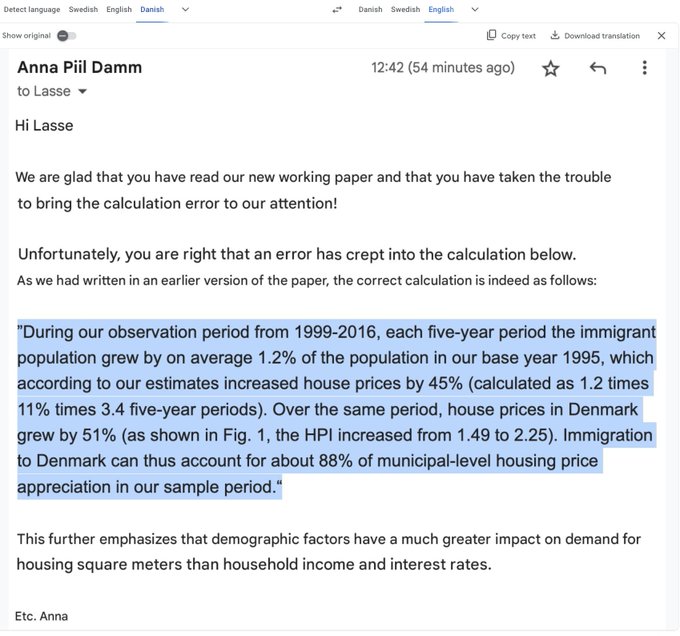
On top of that, immigrants to Denmark are largely on welfare rather than working.
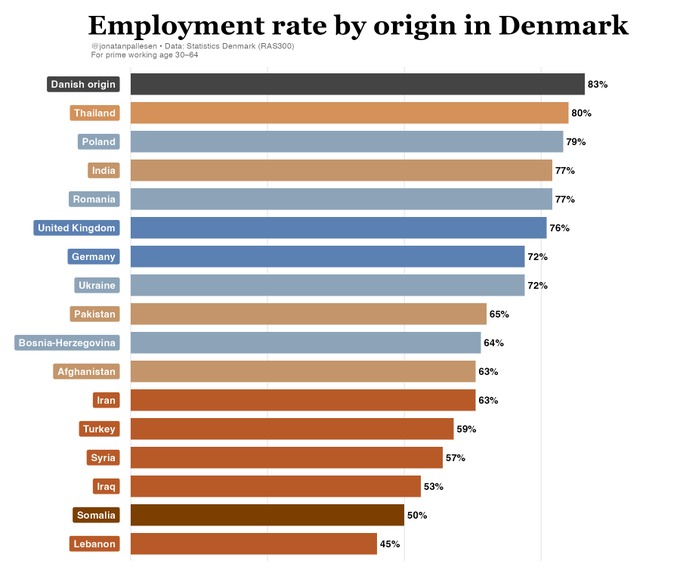
A Somali who lives in Denmark, with an average life expectancy of 82, will cost the Danish taxpayer €1,196,000. There are 21,204 Somalis in Denmark. The Danes will pay €25.36 billion to sustain them.
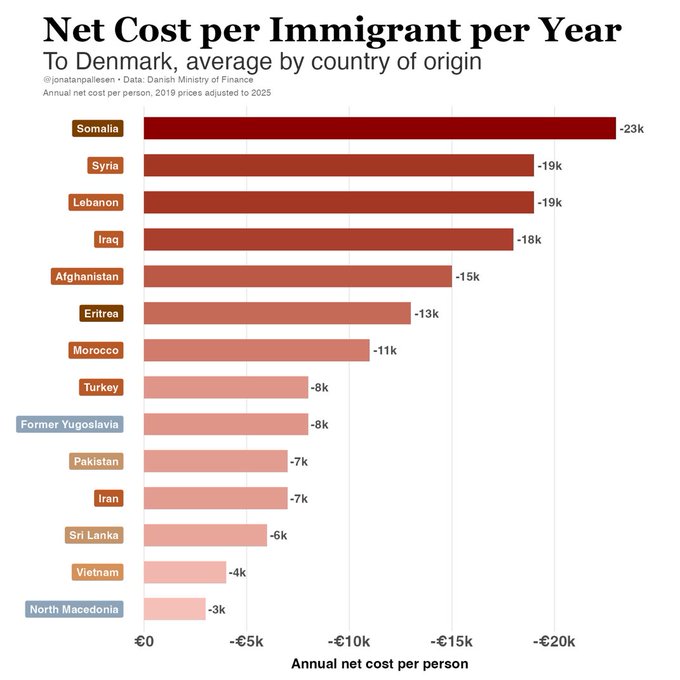
and the final kicker:
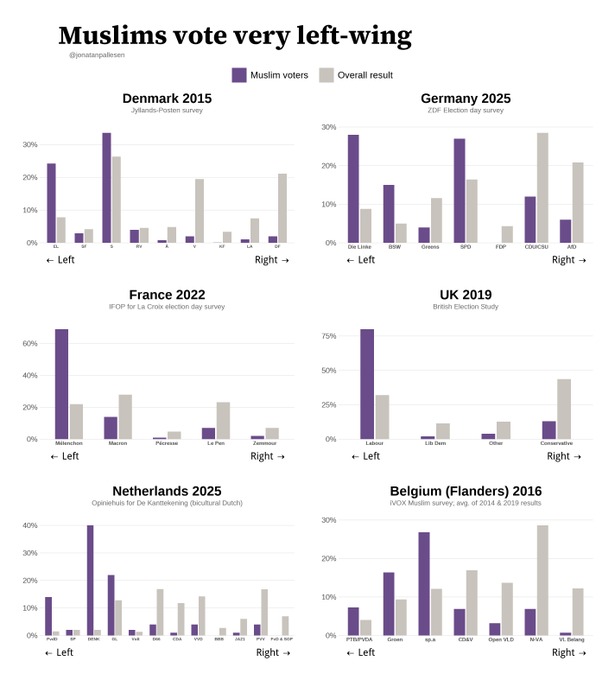
Muslims in Western countries will continue voting “very left-wing” until their numbers grow large enough to vote Muslim. The strategy couldn’t be more obvious.
Representations of sexual assault and rape in Europe by immigrants vs native citizens: Norway: 3x Sweden: 6x UK: 3x Germany: 6x Austria: 3x Denmark: 3x Finland: 5x France: Not reported Italy: 4x Netherlands: 3x Source: Grok
👉🏽TKL: Demand for the Fed’s Standing Repo Facility (SRF) surged to +$30.5 billion on Tuesday, the 4th-largest operation since the 2020 pandemic. The SRF allows banks to borrow cash from the Fed using government bonds as collateral, acting as a key source of liquidity support for the financial system. The operation was split between +$18.5 billion in Treasuries and +$12.0 billion in Mortgage-Backed Securities. The likely cause was a calendar squeeze, as large Treasury settlements coincided on the same day due to the Presidents’ Day holiday. A similar episode occurred on Columbus Day and during the year-end period in December 2025. However, if repo usage keeps rising outside of calendar squeezes, it would signal deepening stress in short-term lending markets and may force the Fed to inject even more liquidity. Are liquidity pressures quietly building beneath the surface?
On the 24th of February:
👉🏽‘How does a government that brings in $5 trillion per year in revenue still manage to spend $7 trillion per year and get $39 trillion in debt? Interest on the national debt already consumes 25% of all government revenue. The US spends over $1.2 trillion on interest per year.’ - Wall Street Mav

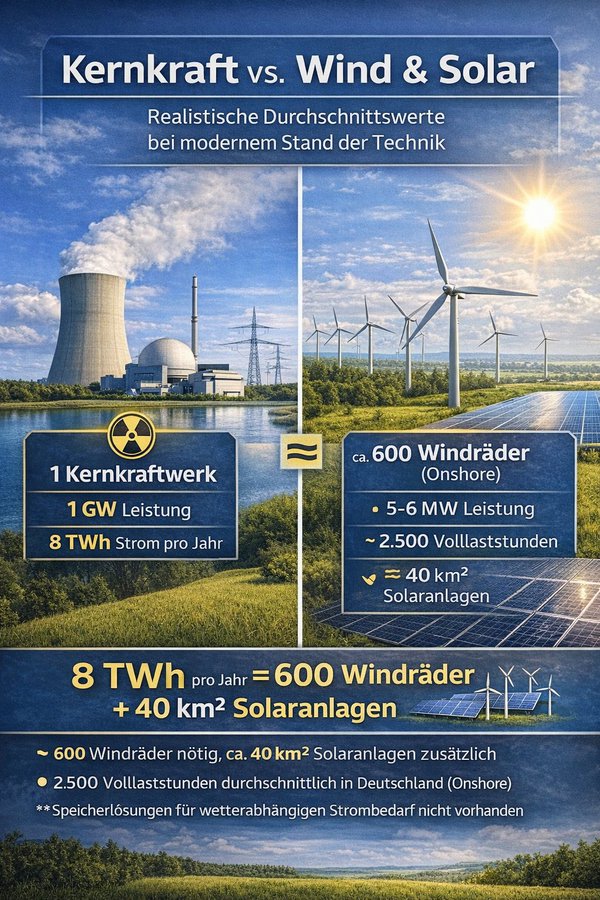
👉🏽Nuclear energy vs. wind and solar: nuclear wins by a wide margin. To match the output of one 1 GW nuclear reactor producing about 8 TWh of electricity per year, you would need roughly 600 onshore wind turbines — with all the accompanying landscape impact — plus around 40 km² of solar panels. That’s an enormous use of land and a striking level of energy inefficiency.
👉🏽Government spending on the energy transition: €4.4 billion. Energy-related taxes collected: €26.5 billion. Source: Statistics Netherlands, 2024. Rijksuitgaven energietransitie 4,4 miljard, belastingen 26,5 miljard euro | CBS
👉🏽‘Hedge funds sold global equities last week at the fastest pace since the April 2025 tariff turmoil. Net selling in the week ending February 19th recorded a -1.54 standard deviation from typical levels, driven by short sales. All regions were net sold, led by North America and Europe, where long exposure was reduced at the fastest pace in 5 months. Single stocks and macro products, such as index futures and ETFs, made up 58% and 42% of total notional selling, respectively. By sector, hedge funds dumped 7 of 11 global industry groups, led by financials, which posted their largest weekly sale since April. Energy, healthcare, and staples were the only sectors to attract net buying, indicating a broad rotation into defensive stocks. Bearish sentiment among hedge funds is intensifying.’ -TKL
On the 25th of February:
👉🏽‘Global broad money supply surged +$13.6 trillion YoY, or +10.4%, in December 2025, to a record $144 trillion. This marks the 3rd consecutive month of growth acceleration. Since 2000, global money supply has risen by +$118 trillion, a +7.0% compounded annual growth rate over 25 years. Since the 2020 pandemic alone, the money supply has surged by +$44 trillion, or +44%. The fastest increase over this period was recorded in February 2021, at +18.7%. Global money creation has never moved this fast outside of a crisis.’ - TKL
On the 26th of February:
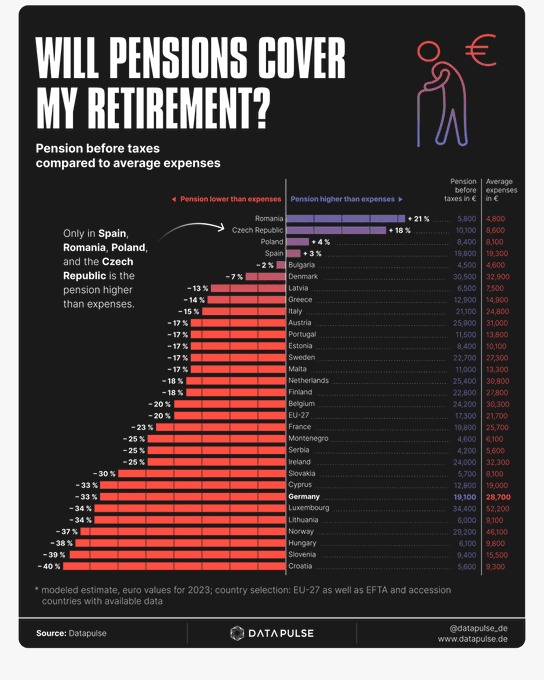
👉🏽Holger Zschaepitz: ’Good Morning from Germany, where retirees face one of Europe’s widest pension gaps. The average annual public pension (€19,138) falls far short of estimated living costs for over-60s (€28,663) – a 33% shortfall, one of the highest in Europe. Housing is the key driver: 34% of senior spending goes to rent, and ~60% of Germans >65 are tenants, leaving many exposed to rising rents, unlike homeowners in Eastern Europe, where property acts as an “invisible second pension.”
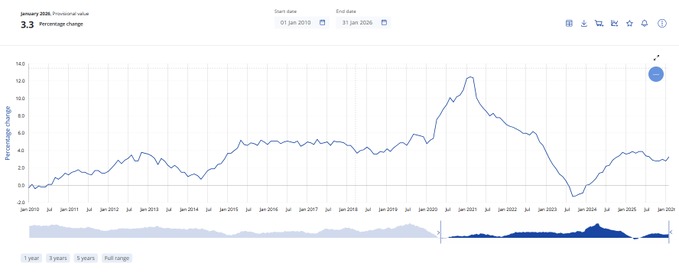
👉🏽Jeroen Blokland: Eurozone M3 money supply grew 3.3% year-on-year in January, the fastest pace in six months. Money Supply growth is picking up in many parts of the world, including China, where it increased by 9% year over year in January. China has, by far, the largest money supply in the world, twice that of the US, despite being a smaller economy. Why? Because China has a totally unrealistic GDP growth target of 5% annually. Declining potential GDP growth coincides with faster money supply growth, increasing your hurdle rate to protect the value of your currency and wealth. In the Eurozone, the hurdle rate is now 3.3% and rising.
👉🏽Ghislaine Maxwell’s sister, Christine Maxwell. Christine founded a software company called Chiliad that connects FBI, CIA, NSA, etc., computers for data mining. Let that sink in.
Extra information: Christine Maxwell (Ghislaine’s sister) co-founded Chiliad. Its software powered the FBI’s Investigative Data Warehouse (IDW), a counterterrorism data-mining system deployed in production from 2004 (fully operational by 2005, with 700M+ records by 2007). It federates searches across FBI, DHS, Treasury, some CIA reports (1978-2004), and NCTC feeds, including NSA inputs. Used by 13k+ agents.
Her dad, Robert Maxwell, created Peer Review, the gatekeeper of American science and the publisher of American school system textbooks. One family. Big, bad influence. By design.
Oh, by the way, and I quote BullDozerVox on X: “Now PM, Mark Carney, Prime Minister of Canada and Leader of the Liberal Party, — 69x in Epstein files, 2013 pic w/ Ghislaine via in-law circle, WEF darling — runs Canada while the files drip & Brende quits over Epstein ties. Coincidence? Or generational architecture protecting the untouchables? This isn’t politics. It’s the blueprint.
👉🏽Global gold demand projected to hit a record 4,900 tonnes in 2026. Central banks are buying 1,000 tonnes. ETF inflows at 900 tonnes. Jewelry demand is at its highest since 2024.
On the 27th of February:
👉🏽The new climate course of #Jetten1 will leave us poor and miserable. On a global scale, it makes no difference. It’s pure apologetics. And can someone please explain German green paranoia? Don’t they have other, more pressing issues? If they put a fraction of the money and energy spent on “green” projects into innovation and deregulation, Germany would be growing again. Imagine Germany being a reasonable country that doesn’t blindly follow a flawed ideology and closes coal power plants first, rather than nuclear ones.
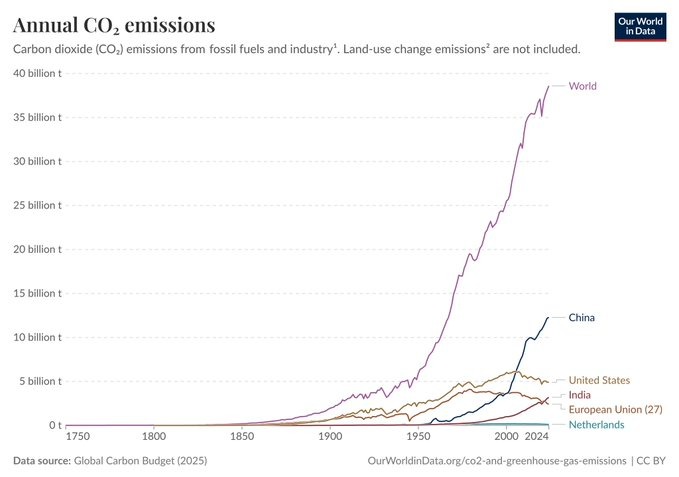
Regarding Germany, there has been only a 10% reduction after more than 25 years with an investment equal to Elon Musk’s entire current net worth. Ach, du scheisse!
👉🏽‘Another economically illiterate government in Europe. The radical-left Danish Prime Minister wants to reinstate the wealth tax that previously failed and was abolished in 1997. Around 22,000 Danes with fortunes exceeding 25 million kroner (~$2.6m) would be hit by a 0.5% tax on their total wealth. As in other countries that have tried a wealth tax, the wealthy will change their tax jurisdictions. The government will bring in less revenue overall. The radical left in Europe keeps spending money on Ukraine, illegal migrants in Europe, and their welfare state. Instead of cutting spending, they keep trying to tax more.’ - Wall Street Mav
The top marginal income tax rate in Denmark is 60.5%, and you pay 25% VAT on anything you buy. Now they want to add a wealth tax on top of that? Seriously, as an entrepreneur, would you want to live and create jobs in Denmark, or would you emigrate?
👉🏽TKL: ‘January PPI Inflation comes in at 2.9%, above expectations of 2.6%. Core PPI Inflation unexpectedly rises to 3.6%, above expectations of 3.0%. Core PPI Inflation is now at its highest level since July 2025. PPI Inflation is running hotter than expected.’
👉🏽‘UBS just downgraded US stocks. There are reasons why every bitcoin holder should pay attention. The Dollar is the central concern. UBS forecasts the euro climbing to $1.22 by the end of Q1 and sees “asymmetric structural downside risks” to the greenback. Historically, when the Dollar’s trade-weighted index falls 10%, US equities underperform by roughly 4%. Foreign markets are trouncing the US this year. MSCI World ex-US is up 8%. Japan’s Nikkei is up 17%. Stoxx Europe 600 up 7%. The S&P 500? Flat. Valuations are stretched. The sector-adjusted P/E ratio for US stocks is 35% above international peers, versus an average premium of 4% since 2010. The buyback yield that once set America apart is now on par with global peers. Layer in tariff shifts, proposed credit card rate caps, drug pricing scrutiny, and potential limits on defense company buybacks, and the picture gets hard to ignore. Capital is rotating out of US equities. A weakening dollar historically prompts investors to seek harder assets. Bitcoin has been that trade before.’ -TFTC
👉🏽TKL: ’Recent Layoff Announcements:
- US Government: 300,000 employees
- UPS: 78,000 employees
- Amazon: 30,000 employees
- Intel: 25,000 employees
- Nissan: 20,000 employees
- Nestle: 16,000 employees
- Microsoft: 15,000 employees
- Bosch: 13,000 employees
- Verizon: 13,000 employees
- Dell: 12,000 employees
- Accenture: 11,000 employees
- Ford: 11,000 employees
- Novo Nordisk: 9,000 employees
- Microsoft: 7,000 employees
- PwC: 5,600 employees
- Dow Chemical: 4,000 employees
- Block: 4,000 employees
- Salesforce: 4,000 employees
- Lufthansa: 4,000 employees
- Tyson: 3,200 employees
- IBM: 2,700 employees
- American Airlines: 2,700 employees
- Paramount: 2,000 employees
- Target: 1,800 employees
- ConocoPhillips: 1,700 employees
- General Motors: 1,700 employees
- Applied Materials: 1,444 employees
- Mastercard: 1,400 employees
- Kroger: 1,000 employees
- Meta: 1,000 employees The big question: What % of these job cuts are due to AI?
👉🏽Based on current spending figures, the Netherlands will spend €980 billion on its non-Western immigrant and immigrant descendant population over the next 50 years. If the Dutch paid each of the 2.5 million non-Western immigrants €100,000 to leave, it would save €760 billion. Remigration is cheaper than hosting immigrants and their children indefinitely. - White Paper Policy Institute
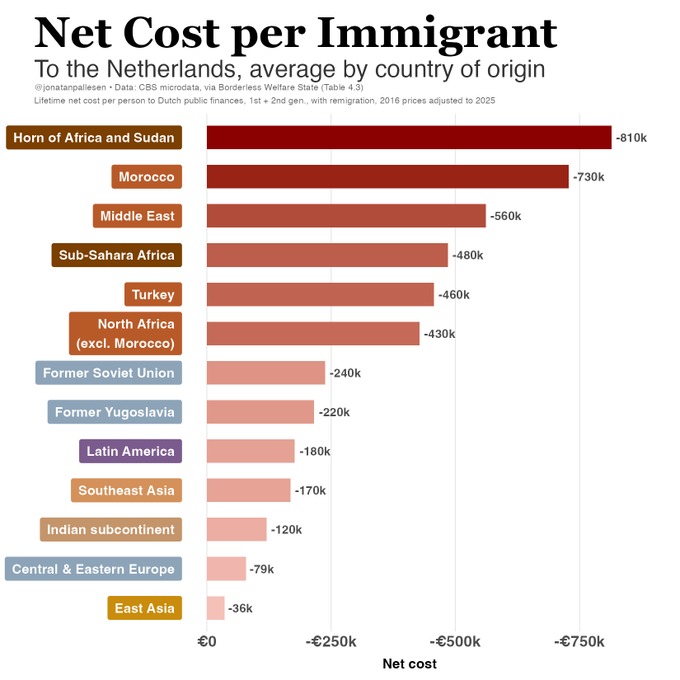
Bear in mind that it will exceed that because the number of immigrants will rise. Tiny Netherlands to spend an estimated $1 trillion on third-world migrants. Scaled to GDP, in US terms, that’s… $25 trillion.
Muslim and African immigrants are extremely costly to European welfare states. But it is important to know that the expense is not just for the immigrants, it is also for their children, and their children’s children, and so on. This figure shows that for many immigrant groups in the Netherlands, the 2nd generation is about as costly as the first. Remigration, even with a very generous remigration bonus, would save substantial sums in the long run. - Jonatan Pallesen
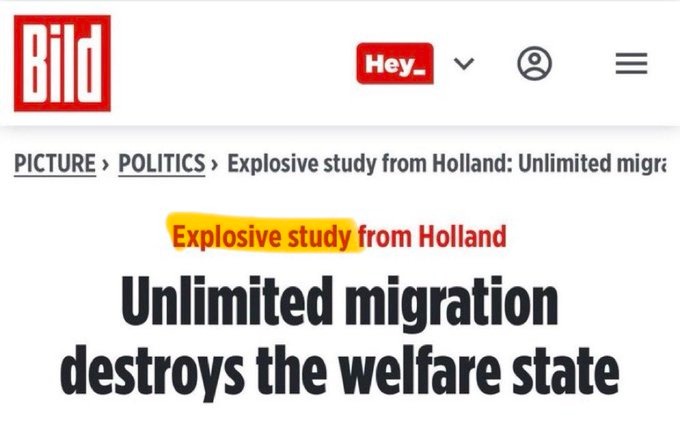
I don’t need a study to have some basic economic instinct. Milton Friedman famously said decades ago, “ You cannot simultaneously have free immigration and a welfare state. Why don’t people today understand even basic economics? What do they study, gender or anthropology?
This was the climate ‘due diligence’ by Rob Jetten, before he became PM: Invest 28 billion EUR to prevent 0,000036 degrees (Celcius) temperature rise https://nu.nl/klimaat/6271157/28-miljard-euro-voor-0000036-graden-minder-opwarmen-niet-het-hele-verhaal.html But that’s not all… a 36% capital gains tax on, wait for it, unrealized profit. Young Einstein, big brain!
Just to give you an example how lunatics this all is: Source: Grote opgave voor gemeenten: tienduizenden extra asielplekken nodig
“By mid-2027, 88,000 places will be needed.” We can’t handle this. The inflow needs to be stopped.
‘Destructive policymaking by our legislators in maintaining the current asylum system. Destructive for: Public finances Democracy The housing market Social cohesion Available space Public and social services.’ - Dr. Jan van Beek
👉🏽Alberto Alemanno: ‘The EU is undergoing Treaty change. You just weren’t supposed to notice. On 12 February, a joint declaration by Commission President von der Leyen and EU Council President Antonio Costa endorsed five simultaneous reforms to the architecture of EU law-making — rewriting how laws are prepared, transposed, delegated, implemented, and reviewed. No Convention. No ratification. No democratic debate, all in the name of urgency and new geopolitical circumstances. I call this the “Castle Method”: the systematic use of informal summitry to produce Treaty-level institutional effects, while carefully avoiding the visibility and safeguards that Treaty revision would require.
In a new piece for @Verfassungsblog, I explain: — Why each of these reforms crosses the constitutional firewall of Article 15(1) TEU, prohibiting the EU Council from acting as a legislator (it is not!), and the elusive yet relevant principle of institutional balance — Why von der Leyen’s commitment to report to the European Council on her own legislative compliance is structurally incompatible with Commission independence — Why the Better Regulation Communication is designed to launder, not fix, what the omnibus packages broke — And why this matters not just legally, given its impact on the EU institutional balance, but for everyone who is affected by the law
The geopolitical urgency is real. But urgency has always been the justification, from the euro crisis to pandemic emergency law to today, to cut corners by stretching into informal decision-making and arrangements. Each time, the constitutional costs were borne by those with the least influence at EUCO informal retreats: citizens, the EU Parliament (due to its heavy reliance on Art 122), and civil society. What do you think?’ Source: The Castle Method
👉🏽-65,000 public employees since Milei came into office. So it is possible!
👉🏽Laila Cunningham believes London has always been diverse. London was 98% white in 1961.

👉🏽German Chancellor Merz says Germans need to work more to match China: “We are simply no longer productive enough. Each individual may say, “I already do quite a lot.” And that may be true. But when you return from China, ladies and gentlemen, you see things more clearly. With work-life balance and a four-day work week, long-term prosperity in our country cannot be maintained. We will have to do a bit more.”
So first of all, you shut down energy production, make it impossible for industry to survive, hence the industry exodus. Imported millions of immigrants, created the shittiest bureaucratic regulation system in the world, but now you blame the workers for not working hard enough. right! Right! It is just a distraction from the structural policy challenges; it is not that hard to understand. Productivity is about investment, innovation, infrastructure, energy costs, digitalization, & strategic industrial policy. Germany neglected that.
Great tweet by SightBringer:
He is doing narrative conditioning. Simple as that. Germany’s elite knows the model is breaking under four pressures:
- Demographics
- Energy constraint
- Security spending
- Slow state capacity
They cannot say that cleanly because it implies: •benefits get cut •retirement gets pushed out •taxes go up •the country becomes less comfortable by design
So they pick the culturally acceptable scapegoat: “people are lazy.” That is the mask. The real mechanism: Germany is losing because:
- Capital formation has slowed
- Deployment speed is glacial
- Risk and experimentation are punished
- Regulation became a second economy
- Energy pricing became a structural handicap
- The population pyramid inverted
Working more hours does not fix any of those. It just extracts more from the same clogged machine.
The deeper truth: This is a reallocation war. China is a machine that converts coordination into output. Germany is a machine that converts coordination into process. When the world shifts into a speed competition, process cultures get exposed. So the state needs a new legitimacy story for why life will feel tighter even if GDP does not crater. That story becomes: •You must do more •You must accept less •You must be grateful for stability •The problem is you, not the system
The true fork Germany can choose: A) Speed reform: Permitting, energy, defense industrial capacity, housing, infrastructure, AI diffusion, tax simplification B) Austerity by culture war. Moralize, blame workers, stretch hours, hold the same bureaucracy constant, and decline more slowly.
Merz is selling B because A requires breaking sacred cows, and he does not have the coalition strength to do it fast.
On the 28th of February:
👉🏽It’s happening.
- Israel/US are attacking Iran.
- Iran is attacking US military assets and Israel
- Houthis are attacking ships in the Red Sea again.
- Iran says there are no red lines anymore. The world is going crazy.’ Lukas Ekwueme
It is all about the geopolitical Benjamins, and the US army of Israel is playing chess.
👉🏽Former President Bill Clinton says he had “no idea” of Jeffrey Epstein’s crimes despite all the photos of him with Epstein. Clinton says he would have turned Epstein in himself if he had any “inkling” of what was going on. “I know what I saw, and more importantly, what I didn’t see. And I know what I did, and more importantly, what I didn’t do.”
“I saw nothing and did nothing wrong… no matter how many photos they show of me,” he really said that.
So in 2002, Chelsea Clinton attended King Mohammed VI’s wedding in Morocco with her father, Bill Clinton, along with Ghislaine Maxwell and Jeffrey Epstein. But we’re supposed to believe Hillary Clinton never met Epstein. Right! righhhhhttt!
👉🏽Data breach at the Dutch prison service (DJI): employee data leaked. How many times does this have to happen before people start thinking: Maybe bringing back a QR code system — like the one used during the pandemic for access to hospitality venues — isn’t such a great idea after all? For example, Digital ID, etc…
On the 3rd of March:
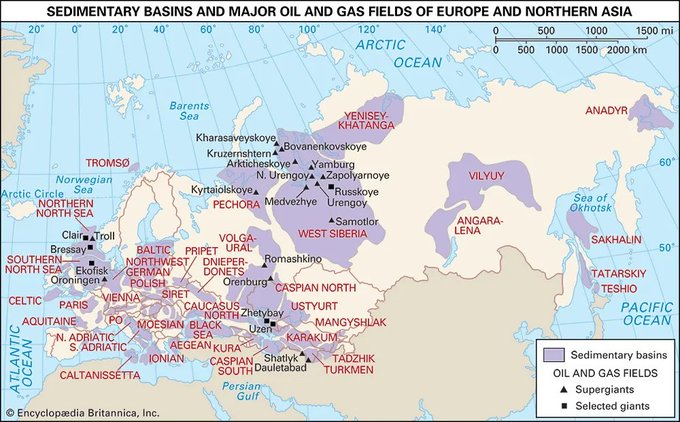
👉🏽Regular reminder that there are vast natural gas reserves in Europe. The reasons Europe is dependent on LNG from Qatar and America are political.
🎁If you have made it this far, I would like to give you a little gift:
The Fed Can’t Stop What’s Coming | Jeff Snider ‘Is this the start of a financial crisis? Jeff Snider is the founder of Eurodollar University and the go-to voice on how the global financial system really works. In this episode, we discuss why the shadow banking and private credit bubble is bursting right now, the cockroaches emerging across the credit markets that reveal nobody did any due diligence during the bubble years, and Jeff’s three-stage financial crisis framework for understanding how bad this could get. We also get into why the Fed is essentially a political lightning rod with no real control over the monetary system, why bond markets have been pricing in a crisis since 2021, regardless of what the Fed does, and how people should position themselves, including Jeff’s take on $60k Bitcoin.
In this episode, they cover: • The 3 Stages of Financial Crisis: From early outflows (Stage 1) to forced selling (Stage 2) to systemic panic and the domino effect (Stage 3) — and where we are right now • The Cockroach Problem: Why big banks failed to check if the collateral they were lending against even existed, and what that reveals about the scale of the bubble • Credit Crisis vs Liquidity Crisis: The critical distinction that determines whether this stays contained or spills into broader markets • The Fed’s Illusion of Control: Why the bond market has been pricing in a crisis since 2021, regardless of what Jay Powell says or does • Bitcoin & Survival: How to position yourself for a Stage 3 collapse and why wealth preservation is no longer optional in a debasing fiat system.’
Click here: https://youtu.be/npjHA0k4hZ8
Credit: I have used multiple sources!
My savings account: Bitcoin. The tool I recommend for setting up a Bitcoin savings plan is PocketBitcoin, especially suited for beginners or people who want to invest in Bitcoin with an automated investment plan once a week or monthly. (from now on, full KYC, so be aware)
Use the code SE3997
Get your Bitcoin out of exchanges. Save them on a hardware wallet, run your own node…be your own bank. Not your keys, not your coins. It’s that simple. ⠀ ⠀ ⠀⠀ ⠀ ⠀⠀⠀ Is this post helpful to you? If so, please share it and support my work with a zap. ▃▃▃▃▃▃▃▃▃▃▃▃▃▃▃▃▃▃ ⭐ Many thanks⭐ Felipe - Bitcoin Friday! ▃▃▃▃▃▃▃▃▃▃▃▃▃▃▃▃▃▃
Write a comment