The Latest Bitcoin & Macro news: Weekly Recap 13.04.2026

- 🧠Quote(s) of the week:
- 🧡Bitcoin news🧡
- 💸Traditional Finance / Macro:
- 🏦Banks:
- 🌎Macro/Geopolitics:
- 🎁If you have made it this far, I would like to give you a little gift:
🧠Quote(s) of the week:
‘For 5000 years, people have agreed: 3000 BC: Money should be scarce. 2000 BC: Money should be scarce. 1000 BC: Money should be scarce. 0: Money should be scarce. 1000: Money should be scarce. 1500: Money should be scarce. 1900: Money should be scarce. 1914-1970: Ok, but what if it’s not? 1971: Money is what the government says it is. 1990: Financialize all the things. 2008: Oops, maybe not. 2009: Money should be scarce -> Bitcoin. 2010-2019: Bitcoin makes no sense. 2020: Money printer go brrrr. 2021: Wait, maybe Bitcoin makes sense. 2025: Money should be scarce. A currency that can be infinitely printed by a government is an anomaly. You don’t have to accept it; opt out with Bitcoin.’ - Bitcoin Teddy
🧡Bitcoin news🧡
Photos hosted by Azzamo ( https://azzamo.net/)
On the 7th of April:
➡️FDIC approves proposal to implement the requirements and standards for US stablecoins under the GENIUS Act.
Bull Theory: “The FDIC today approved a full regulatory framework for stablecoin issuers under the GENIUS Act. Here is what it means: Every stablecoin must be backed 1:1 with real assets. If there are $1 billion worth of stablecoins in circulation, the issuer must hold $1 billion in actual reserves without any exceptions. Every stablecoin must be redeemable on demand at face value. If you hold $100 in stablecoins, you can always get $100 back. Reserve assets cannot be rehypothecated or reused. The reserves must sit fully segregated and cannot be used for any other financial activity. Stablecoin issuers cannot pay interest or yield to holders simply for holding the coin. This directly affects yield-bearing stablecoin products currently in the market. If redemption requests exceed 10% of all outstanding stablecoins within a single 24-hour period, it triggers a significant redemption event requiring immediate action. Stablecoin issuers must meet capital requirements and risk management standards similar to those of banks. Quarterly reporting and CEO signed audits are required. Banks that hold or manage stablecoins on behalf of customers are subject to the same rules, with one important clarification. FDIC insurance covers the issuer’s reserve deposits at the bank level, not individual token holders. Why is this good for crypto? Right now, stablecoins operate in a gray area. No clear rules means no trust from institutions, no trust from regulators, and no certainty for users. These rules change that. Regulated stablecoins backed by real reserves and covered by FDIC insurance become as safe as a bank deposit. That opens the door for banks, pension funds, and large institutions to use stablecoins without legal risk. A regulated stablecoin market is the foundation that the rest of crypto needs to grow.”
➡️2025 is in the rear view - but the “Retire on Bitcoin” numbers have barely changed. My retirement guide estimates, with a $100k/yr living cost (2026 dollars)… 3.5 - 4.5 BTC will be needed to retire by 2030 for many people. Just pick your age and retirement year. - Sminston With
https://cdn.azzamo.media/f3684c348f9431eb281745daf069295fa37e644df6f4374980da110b3b5ac484
➡️Morgan Stanley’s spot Bitcoin ETF is expected to begin trading as early as tomorrow Why is this so important?
- 16,000 financial advisors can now recommend Bitcoin
- $7.4T in assets
- The first spot Bitcoin ETF issued directly by a major U.S. bank
- Lowest fee at 0.14%
On the 8th of April:
➡️Strategy is buying Bitcoin 2.2x faster than the new supply is being created. 94,470 BTC were bought in 2026 alone, while only 43,000 BTC were mined. One buyer is outpacing Bitcoin’s entire issuance.
➡️The rational root: Different presidents, same monetary direction.
https://cdn.azzamo.media/609bf3d9dc981049e6fb49856f9dad7593336f567e256898a7ddc49e5809ed28
➡️Long-term holders now hold 21% of the total Bitcoin supply. Available Bitcoin supply keeps shrinking. - Bitcoin Archive
https://cdn.azzamo.media/0dfa46d4897713207e5ff146965d2b0bf474d09db92d8cad99093516b23cd95c
➡️Iran is accepting Bitcoin for transit toll payments — Financial Times
https://cdn.azzamo.media/83bb86375a2fe596d3443e080d6c09affb69ab08c070f383d81420ce4a18176c
TFTC: Iran is charging crypto tolls for every ship passing through the Strait of Hormuz.
Hours after the ceasefire was announced, Iran’s oil exporters’ union told the Financial Times that every tanker transiting the Strait must email authorities with cargo details, then pay $1 per barrel in bitcoin or stablecoins. For a fully loaded supertanker carrying 2 million barrels, that’s a $2 million toll. Empty vessels pass free. Ships that try to transit without permission “will be destroyed.”
The IRGC has turned the most critical energy chokepoint on Earth into a functioning toll booth. Roughly 20% of the world’s daily oil supply flows through this Strait. At pre-war volumes, this system could generate $600 million per month.
Payment must be in crypto or yuan. No dollars. No SWIFT. Iran can’t use the traditional financial system because of sanctions, so they built around it in real time. Ship operators pay in bitcoin or stablecoins, settling in seconds so transactions “can’t be traced or confiscated due to sanctions.” At least 26 vessels had already transited under IRGC clearance as of mid-March, with Lloyd’s List confirming that at least one operator paid approximately $2 million. The IRGC ranks nations on a 1-to-5 scale of friendliness. China, Russia, and Pakistan get favorable terms. Ships linked to the US or Israel are excluded entirely.
This is the largest real-world stablecoin use case ever recorded. Not DeFi yield farming. Not NFT speculation. A sovereign nation is using censorship-resistant money to collect tolls on global energy shipments because the dollar system locked them out.
Bitcoiners have said for a decade that this is exactly what would happen. When you weaponize the financial system, adversaries don’t comply. They route around it.“
➡️Morgan Stanley’s spot Bitcoin ETF is on track to be in the “top 1% of ETF launches” today — Bloomberg’s Eric Balchunas
On the 9th of April:
➡️Bitcoin devs just built a prototype to protect wallets from quantum attacks. Even in worst-case scenarios, Bitcoin could pause normal spending while still allowing users to recover their funds using this new method. Quantum defenses are already being built. - Bitcoin Archive
➡️Bitcoin exchange deposits just hit a 10-year low. Supply is being held, not sold.
https://cdn.azzamo.media/ab61071a8904c810c52be804db58a4f99d3e59e67b8a1c06e443d541bd0f2232
➡️Billionaire Ron Baron spelled it out in the simplest way possible: Money loses 4-5% of its value to Inflation each year, while the economy grows about 2% each year. That’s roughly 7% erosion + growth – which means prices double about every decade while cash keeps falling behind. If your money is melting, you have to own assets that outrun Inflation.
That’s why Bitcoin has crushed every major asset over the last decade. When the system inflates, BTC protects
Another one: Former Finance professor Tad Smith: “After 25 years teaching finance, I realized at 58: If the money printer grows 8-10% annually and the S&P 500 returns ~9%, it’s just treading water. True wealth comes from outpacing the printer. That’s the Bitcoin journey.”
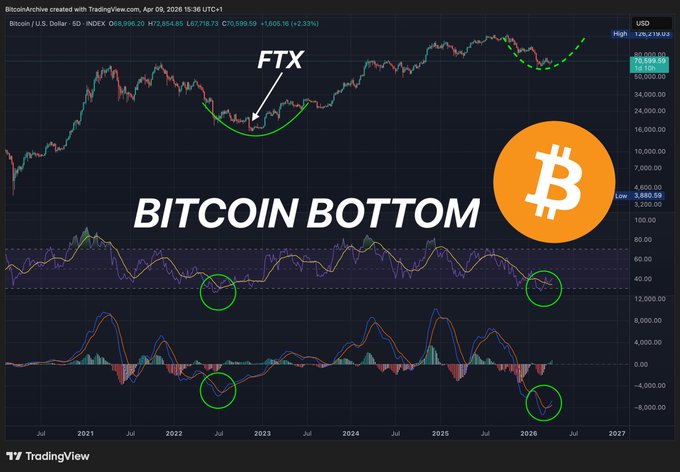
➡️Bitcoin Archive:
- Bitcoin just crossed over the MACD on the weekly chart.
- A good indicator of changing momentum from bearish to bullish.
- Last cycle, it took the unexpected collapse of FTX to prolong the bear market. This time? Unless the war escalates and markets melt down, it looks like a safe bet that a bottom is forming here.
On the 10th of April:
➡️’Bitcoin’s quantum defenses are progressing fast. In the last 2 days, two major quantum-related updates have been released for Bitcoin. One prototype lets users recover their funds if quantum computers break current signatures. Another proposal shows Bitcoin transactions can be made quantum-safe without changing the protocol.’ - Bitcoin Archive
➡️If you saved $10,000 in US dollars in 2021, it would buy about $8,000 worth of goods today. If you put $10,000 into Bitcoin in 2021, it would be worth about $24,000 today. Bitcoin protects and grows your wealth.
➡️Sure, Bitcoin is dead. Over 731,000 BTC (~$51.9 billion) moved across 572,454 transactions in 144 blocks, settled in 24 hours. For context, Visa processes ~$41B/day. - Eli Nager
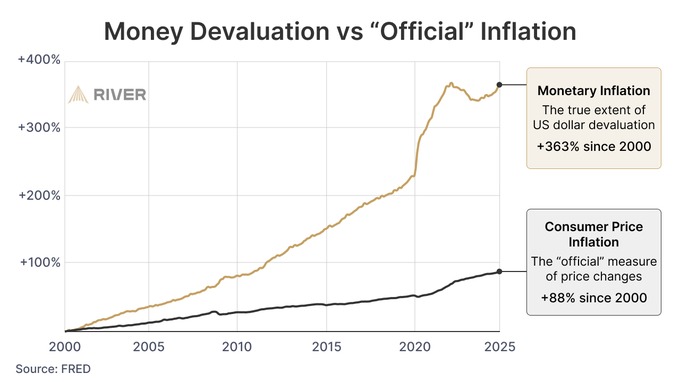
➡️There is a 275% gap between the Inflation you’re told and real Inflation. This is why we have Bitcoin. - Bitcoin Teddy
➡️Japan officially approved a bill recognizing Bitcoin and crypto as financial assets. Another step toward mainstream adoption. - Bitcoin Archive
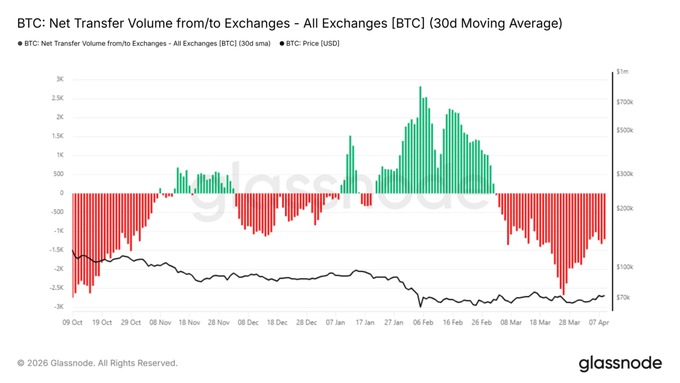
➡️Bitcoin’s net exchange volume 30-day moving average has been negative since March 3, signaling accumulation.
➡️’Since I started buying Bitcoin, I have stopped buying more than 97% of the crap I used to tell myself I needed.’ - Fernando Nikolic
Yet to find a single Bitcoiner who has not noticed this same effect. One of the biggest environmental benefits of Bitcoin is its ability to reduce overconsumption.
On the 11th of April:
➡️’A lot of people laughed at Michael Saylor when he called STRC has its iPhone moment. STRC added 3,447 worth $250 million yesterday. Nearly 8 days’ worth of newly mined supply has been removed from the market. This week alone, his company raised nearly $700,000,000 and bought nearly 10,000 BTC at the bottom of the bear market. This is one of the most successful financial products of all time.’ - The Bitcoin Therapist
On the 13th of April:
➡️Standard Chartered’s head of digital assets says Bitcoin will hit $500,000 by 2030—near-term target: $100,000 by the end of 2026. If Bitcoin matches gold’s market cap, that’s $1.6 million per coin. -Bitcoin Archive
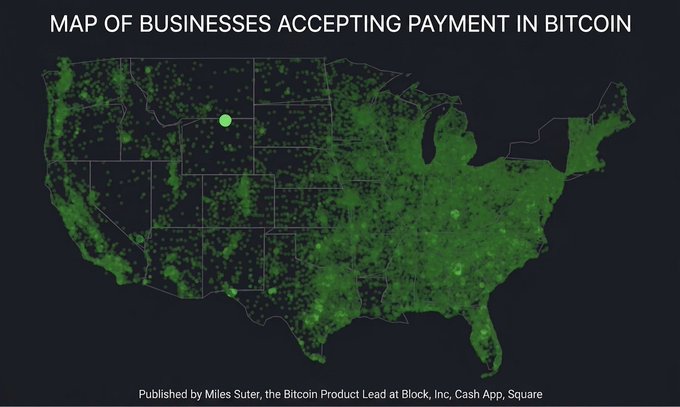
➡️Map of Businesses Accepting Payment in Bitcoin. - Documenting Bitcoin
‘Throughout history, all fiat currencies eventually face the same pressures. When debt grows faster than income and money needs to be created to fill the gap, the value of that money changes. This isn’t a prediction—it’s a pattern that has repeated many times. Understanding how these systems work helps you think more clearly about what comes next.’ - Ray Dalio
💸Traditional Finance / Macro:
On the 9th of April:
👉🏽WhatsApp’s “end-to-end encrypted” privacy is a total lie. New class-action lawsuit just dropped: Meta secretly let employees, contractors like Accenture, and third parties read, intercept, and store your private messages WITHOUT consent. All while marketing it as “only you and the recipient can read it.” Zuck lied to billions. Your chats were never safe.
🏦Banks:
👉🏽No news
🌎Macro/Geopolitics:
“But the curse of every ancient civilization was that its men, in the end, became unable to fight. Materialism, luxury, safety, even sometimes an almost modern sentimentality, weakened the fiber of each civilized race in turn; each became in the end a nation of pacifists, and then each was trodden under foot by some ruder people that had kept that virile fighting power the lack of which makes all other virtues useless and sometimes even harmful.” -Teddy Roosevelt
On the 7th of April:
👉🏽Mona Keijzer on the new language guide: “This is, of course, always justified under the banner of wanting to protect every minority, and then the next minority, and the one after that — each time trying to ban more words.” “Wouldn’t it be wiser to give all 2,500 civil servants at the Ministry of Education, Culture and Science a copy of Nineteen Eighty-Four by George Orwell? Maybe then they would finally realize where this ultimately leads: a dystopian society where nobody would want to live.”
Meanwhile, the whole world is on fire. Prices keep rising, energy costs are soaring, housing is unaffordable, and real structural problems remain unresolved… And yet we have a room full of highly paid civil servants debating whether it should be “Children’s Day” instead of Mother’s Day or Father’s Day.
Full context: €40,000 for a language guide that bans the “Golden Age,” wants to replace “Mother’s Day” with “you-day,” and considers “the West” to sound too superior. It’s absurd that civil servants are working overtime to distort our language with ideological guidelines.
Vladimir Putin, Trump, or any other leader must be laughing.
We need a serious clean-up of the bloated bureaucracy and incompetent political leadership. The people who remain should focus on solving actual problems. What a waste of money and time, while more and more children are unable to read and write properly.
I still maintain: if we sent 50% of civil servants home for a month, the country would probably keep running just fine.
👉🏽CIA reportedly used a secret new tool, “Ghost Murmur,” to locate the downed US airman in Iran, capable of detecting a human heartbeat from long range.
Tuki: “…not his phone.. not a tracker.. not a radio signal.. his heartbeat.. Lockheed Martin’s Skunk Works built it. The same classified division that built the SR-71 Blackbird, the stealth bomber, the U-2 spy plane, every secret aircraft America has ever denied existed until they didn’t. It uses quantum magnetometry to detect the electromagnetic pulse your heart emits with every beat. Then, AI filters out everything else. The pilot, callsign “Dude 44 Bravo,” was wounded and alone for two days. hiding in a crack in a mountain.. while Iranian forces searched for him on foot.. and America found him from the sky.. by listening to his chest.. here’s the part that should rewrite everything you think about privacy and power.. this was Ghost Murmur’s FIRST operational use.. meaning it’s been sitting in a vault.. tested.. ready.. waiting for a moment important enough to reveal it.. they didn’t show you this to impress you.. they showed you this because the next person they use it on won’t be a rescue.”
👉🏽Michael A. Arouet: ‘Artificially low interest rates in Europe disconnected house prices from rents. Now that interest rates are higher, this divergence will be corrected. In many cities, mortgage rates are higher than rents. Buying properties there doesn’t make any sense.’
https://cdn.azzamo.media/b997494e0c1ae27482031b2f972d2a3465188a97e011a3d17ae0d9f684cd87ce
👉🏽The Washington Post — certainly not suspected of uncritical admiration of Javier Milei or his ideas — draws a remarkable interim conclusion about Milei’s economic course in Argentina: The poverty rate fell from 53% to 28%, driven by real economic growth of +4.4% over the past year. The country recorded its first state budget surplus in 123 years. Inflation dropped from 200% to 33% (and continues to decline). More than 14,000 laws and regulations were abolished, allowing market forces greater freedom to operate.
Conclusion: “Argentina’s rapid transformation from nearly a century of socialism to free-market Capitalism continues to prove the superiority of the latter. It is rare to witness such a radical experiment in real time. It is, however, no surprise that it is working.” https://archive.ph/2QBRb Opinion | Argentina’s radical free market experiment is paying off - The Washington Post
👉🏽Lukas Ekwueme: We are moving towards a sovereign debt crisis. Countries around the world, especially in the West, are seeing their bond markets collapse even as they become increasingly dependent on them. Since 2021:
- US 10-year yield: increased ~6x
- Japan 10-year yield: increased ~30x
- Germany 10-year yield: from -0.4% to 3% Former Fed Chairman Alan Greenspan put it best: “The US can pay any debt it has, because we can always print money to do that.” They won’t default… they will inflate the debt away by destroying the currency and your savings.
On the 8th of April:
👉🏽The Strait of Hormuz will have a toll booth for the first time in history… The ceasefire agreement includes allowing both Iran and Oman to charge fees on ships transiting the Strait. Iran will use the revenue for reconstruction. The world never paid to use this waterway before tonight. Iran went to war with the most powerful military on Earth and came out of it with something no nation has ever had: a formal revenue stream from 20% of the world’s oil supply passing through its waters. Source: AP
👉🏽 Iran now earns $100 billion a year from the Strait of Hormuz. Russia earned an additional $20 Billion from oil spikes since the Iran war US lost a minimum of $200 billion of American taxpayers’ money. Iran & Russia right now.
👉🏽 US oil prices crash -23% from their high of the day as Iran, Israel, and the US agree to a ceasefire for two weeks.
👉🏽Net contributions to the EU budget:
https://cdn.azzamo.media/1dc4fb2df6869886de94842fb7c885d173d732a0e230e8aacb073a98d39787f3
Per capita, the ranking looks even worse. And yes — you guessed it: the Netherlands is right up there.
https://cdn.azzamo.media/f0e4947ea34e9eaf58940ef8ea272d484d059ad49186b9e9bc76369c731923d5
Not only is the net contribution the problem, but what we “get back” is often spent according to the priorities of the European Commission in Brussels, frequently inefficiently and sometimes even against our own national interests. We, the Netherlands, pay among the most, yet often seem to have the least real influence over policy.
And then there’s Luxembourg. How on Earth is Luxembourg the largest recipient per capita? One of the richest countries in the world.
Around 74% higher income than the average in the EU. A quarter of its economy is tied to the financial sector. That sounds absurd at first glance — but there is an important explanation: much of that “receipt” comes from the fact that Luxembourg hosts major EU institutions and administrative structures. Hence, a large part of the money is actually institutional spending rather than classic subsidies to citizens. Similar distortions happen in Brussels, Belgium.
The broader criticism remains valid: The EU budget system is opaque, politically driven, and often leaves major net contributors like the Netherlands paying heavily while having limited control over how the money is ultimately used.
👉🏽The Netherlands Interviewer: — “So in your view, should those gas wells really be filled with concrete?” Stientje van Veldhoven, then Minister for Climate: “We need to close the field properly, so yes, that means concrete in the gas wells.” — “And not keep a tap open somewhere, just in case?” “For me, we must be clear to the people of Groningen. We made a promise, and we will keep it.”
A remarkably short-sighted position from a D66 minister. Meanwhile, gas fields in Drenthe remain open — helping supply Germany and Belgium with Dutch gas, often under contracts the government refuses to make fully transparent. That should make people pause. The real promise should have been this: Groningen residents must be compensated generously, their homes must be made earthquake-proof, and domestic gas production should remain available to ensure our energy security and economic stability.
Good read for the Dutch readers: Prof. dr. ir. Guus Berkhout: ’Crisis legt pijnlijk bloot hoe weinig verstand ons kabinet heeft van energiezaken’ | De Telegraaf https://archive.ph/YH47u
👉🏽Michael A. Arouet: ’Eye-opening chart. While Poland has enjoyed an economic boom, Ukraine is poorer today than it was in 1990. Free markets, entrepreneurialism, EU and NATO membership, and low corruption fueled Poland’s economic miracle. Let’s hope Ukraine follows a similar path after the war.
https://cdn.azzamo.media/3f67b57df281ac2ac9079260397ca09d8018b8ee177d7d4e4c0f848699547392
👉🏽Canada: “MMIWG2SLGBTQQIA+” The Canadian government just dropped this absolute monstrosity (and no, it isn’t satire).
👉🏽Germany: Syria is resisting any forced mass deportation policy—Germany’s plan to send over 700,000 refugees home. You know they DEFINITELY need to leave Germany and Europe because the Syrian government doesn’t want them in Syria! Honestly, if a country refuses to take back its own citizens, I feel like you should have the right to be rid of them however you choose.
On the 9th of April:
👉🏽Holger Zschaepits: Good Morning from Germany, where industrial production unexpectedly declined in Feb, even before the Iran war started, casting doubt on hopes for a rapid recovery. Output fell 0.3% MoM, dragged down mainly by construction and consumer goods. Germany’s Industrial Production Drops 0.3% in February, Missing Forecasts - Bloomberg https://archive.ph/J4pcD
Unexpectedly?? It might be unexpected for the German media (MSM). Everybody in direct business knows the continuous systematic German downtrend. The Spanish Inquisition is unexpected, this is not.
I will share it again; there are no low-energy/ high-income countries. The Netherlands should remember this graph before pouring concrete in our gas fields.
https://cdn.azzamo.media/687e84dfac75bfaf8074d60b53e52fa5100a153fcd123f10499a91924d544f78
👉🏽Ray Dalio: The former Dutch Empire teaches us a lot about the importance of Capitalism in driving long-term success through the development of productive entrepreneurs. The Dutch became a leading empire by being open to the best thinking in the world. They became so inventive that they were responsible for 25% of the world’s major inventions, including ships that could travel and collect great riches, and the invention of Capitalism as we know it today to finance those voyages. This virtuous cycle leads to strong income growth, which can be used to finance investments in education, infrastructure, research, and development. Over time, that helps its citizens become more productive and more competitive than their peers.
Unfortunately, we have nothing left of the mentality we once had. The Dutch are unfortunately on their way down big time. Too bad we are getting lazy, complacent, and bureaucratic. Look at what those left socialists are doing to our country now. They are destroying our nation and wealth. I still have some faith, though.
The Dutch Empire, through the VOC, did not invent Capitalism, but it helped shape modern financial Capitalism by creating the world’s first large-scale permanent joint-stock multinational in 1602. Public share ownership, transferable shares, and active secondary trading on the Amsterdam exchange laid the foundation for modern capital markets. It helped turn a small republic into a global financial power.
Jeroen Blokland: ‘Something to think about. Dalio just dropped a new video on why the Great Dutch Empire rose to power. The video mentions themes like competitiveness, education, incentives, inventions, investments, productivity, and, not least, Capitalism over 35 times. Meanwhile, there are zero mentions of bureaucracy, government, laws, rules, or regulations. Policymakers and politicians should take note. It’s not just history; it delivers invaluable lessons for the future.’ https://x.com/RayDalio/status/2041969406272483508?s=20
👉🏽The Netherlands: Never has it been so clear how little our cabinet understands fundamental energy issues, writes emeritus professor Guus Berkhout in De Telegraaf. That is a troubling conclusion, because an unreliable and unaffordable energy system leads to low economic security and a lower standard of living, he warns.
The energy crisis shows that banning fossil fuels has been extremely foolish and that wind and solar, even after decades of hundreds of billions of dollars in investment, still make only a marginal contribution, he emphasizes. “It doesn’t work and it never will,” says Berkhout, who calls on the government to stop this approach. He advocates switching to nuclear energy and, during the transition period, believes we should use our domestic gas reserves.
My actual position Best realistic mix: Short term domestic gas, where strategically necessary grid reinforcement storage investment industrial competitiveness focus Medium/long term major nuclear expansion strong renewables, where economically rational less dependence on imported fossil fuels
Just a fun stat: China opens one new coal power plant every week at least for the next 10 years. Our MP, Jetten, wants to shut down the three coal power plants here in the Netherlands. Because of “the climate”. That is just stupid on multiple levels. Read the above bit again. China is building coal largely for grid stability and energy security, while simultaneously becoming the global leader in renewable deployment. Meanwhile, Europe shut down dispatchable power too fast and became vulnerable to gas shocks. That does not prove that coal is good or bad—it proves that transition design matters. The lesson is not “renewables are stupid or the holy grail.” The lesson is: you cannot run an advanced economy on ideology rather than on system reliability.
Meanwhile, Vijlbrief, as Minister, poured concrete into our gas wells; his boss, Jetten, is shutting down coal-fired power plants, and D66 has been delaying nuclear energy for years. And then you are allowed to go on the NPO and say you stand for independence, without any pushback. Classic!
We have 200 billion cubic meters of technically recoverable natural gas (excluding Groningen), enough to supply the entire Netherlands with gas for at least seven years. That means less dependency. It is also better for our wallets. The remaining Dutch gas reserves outside Groningen can provide a meaningful temporary reduction in import dependence and price vulnerability, especially during geopolitical crises. They are finite, not cost-free, and do not remove the need for long-term structural reduction of gas dependence through electrification, efficiency, and alternative generation.
👉🏽The Netherlands: State Secretary Jo-Anne de Bat for Climate and Green Growth is seeking the boundary of what is considered acceptable regarding the amount of time people may be left without electricity in the future. “If that is one hour, you could say: people can manage that just fine, but there are also people who depend on electricity for all kinds of medical equipment.”
In my view, that is real poverty. This man receives over €10,000 gross every month. From your and my tax money. He promotes the idea that “people can easily sit without electricity for an hour,” all for the green dream.
In a wealthy country, normalizing power shortages is a sign of declining basic security and governance failure. Especially in a country with: high taxes major climate spending strong infrastructure expectations Then yes, people will reasonably ask: What exactly are we paying for? In a wealthy, high-tax country, citizens are justified in expecting highly reliable electricity. Especially when governments pursue expensive energy transition policies, people can reasonably demand: affordability reliability industrial competitiveness not just climate targets.
For the Dutch readers, could you please mind your electricity usage?“
👉🏽TKL: ‘Absolutely incredible: US oil prices are now nearing $103/barrel and have been rising at a pace of $1/hour since 6 AM ET. This puts oil prices +12% above the low seen just ~24 hours ago as ceasefire doubts have grown. Meanwhile, Iran’s Deputy Foreign Minister announced that Iran was “on the verge” of responding to “ceasefire violations” last night, but Pakistan intervened. Iran is also not allowing more than 15 vessels per day to pass through the Strait of Hormuz, or ~10% of pre-war levels. This is in sharp contrast to President Trump’s claims that Iran would implement a “complete and immediate” opening of the Strait of Hormuz. Triple-digit oil prices are back in full swing.’
👉🏽The EU: ’The only major countries in Europe richer than the US:
- Norway with oil & gas
- Switzerland with banks
- Ireland with corporate tax evasion schemes The rest of Europe is throttled by heavy regulations, overtaxation & left redistribution mindset. Will this ever change?’ - Michael A. Arouet
https://cdn.azzamo.media/1f904766c132943323e569cffb7e7955f90bb2674f69ca8d72b4cb98be5af303
👉🏽US GDP growth falls from 4.4% to 0.5% in Q4 2025, well below the initially expected +2.8% growth. - TKL Tuki: ‘Q4 GDP growth was initially reported at 2.8%.. revised to 0.7%.. now revised again to 0.5%.. in the same quarter the previous one came in at 4.4%.. that’s an economy falling off a cliff while the government kept revising the numbers down quietly hoping nobody would notice.. and this was BEFORE the Iran war.. before oil hit $99.. before the tariffs fully kicked in.. Q4 2025 is the last quarter in which they can blame no one but themselves. The last time the US had near-zero growth, a Middle East war, and oil prices spiking at the same time was 1973, the OPEC embargo. Nixon. Unemployment doubled. Inflation hit 12%, and it didn’t recover for years. They called that stagflation. They’re about to call this one a “soft landing.” The economy was already flatlining before a single bomb dropped on Iran. Now oil is at $99, and they’re spending billions on a war they can’t afford in an economy that was already dying. And yesterday the stock market rallied 2.5% on a ceasefire that’s already falling apart.’
👉🏽Ninth scientist linked to secret US space and nuclear programs dies with no cause of death listed. Let that sink in for a minute. Nine scientists have died in a span of ~27 months, following a pattern.
Here’s a clean list of key scientists in the recent pattern of mysterious vanishings/deaths tied to US space/nuclear programs (focusing on the missing ones per your ask, with dates/research):
- Monica Jacinto Reza (JPL rocket engineer): Missing June 22, 2025. Advanced propulsion materials (nickel superalloys for next-gen engines/spacecraft).
- Melissa Casias (Los Alamos admin): Missing June 26, 2025. Nuclear research access/clearance.
- Anthony Chavez (Los Alamos nuclear scientist): Missing ~2025. Classified nuclear tech.
- William Neil McCasland (ex-AFRL commander): Missing Feb 27, 2026. UFO/space weapons programs, rocket engine metals.
- Jason Thomas (Novartis pharma researcher): Missing Dec 12, 2025 (body found Mar 2026). Biochemical/cancer treatment tech with defense overlaps.
They didn’t work on random stuff. Missiles. Asteroid deflection. Nuclear fusion. Cancer treatment, UFO programs.
At what point will people wake up and realize shit like this isn’t an accident, coincidence, or a “conspiracy theory?”
My guess. Somebody is cleaning house; these scientists discovered something major (free energy or something), and powerful entities don’t like the findings.
👉🏽Saudi Arabia’s oil production capacity has reportedly been cut by nearly 600,000 barrels a day.
👉🏽Amazon will invest $25,000,000,000.00 to build data centers in Mississippi
👉🏽Trump: “We need $2 billion a day to reopen the Strait of Hormuz.” US Senator: “But it was already open before the war? So what was the point of the whole war?”
Trump completely miscalculated going to war with Iran. He has no sense of geography or history, and he’s clueless about strategy. This wasn’t about Iran; I truly believe this was more of an Israeli ‘thing’. Proxy war with China.
On the 10th of April:
👉🏽Gold has overtaken US Treasuries as the largest asset in global central bank reserves for the first time since the mid-1990s. - TFTC
https://cdn.azzamo.media/e8688ee51cd588458d5d205acbc0537af94a503ca708ed9828fec99c4fbb9f5a
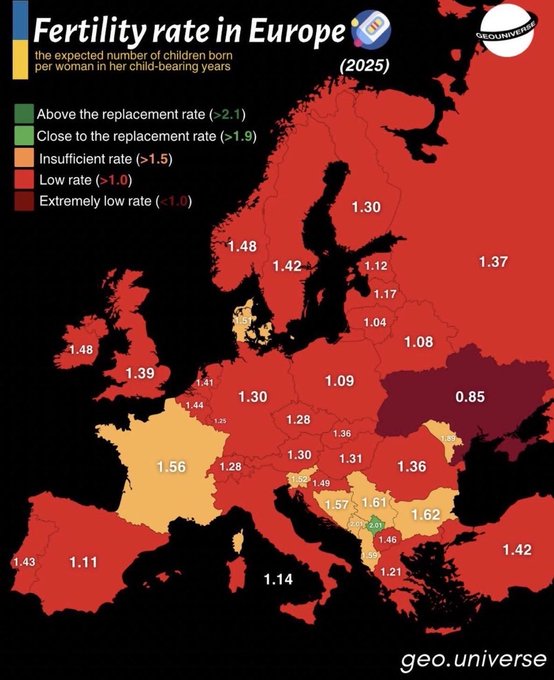
👉🏽There is not a single country in Europe with a fertility rate above the replacement rate. As the median age of women in Europe is 46, it’s too late to reverse it. Assume two things: 1. Your real estate will lose value. 2. Your pension won’t be enough to keep your standard of living
👉🏽Europe bought (again) huge volumes of Russian LNG in March, offsetting lower deliveries from the Persian Gulf. An important (bad) example: Spain more than doubled its imports of Russian LNG in March from a year earlier.
Threatening to board Russian ships but buying their gas left, right, and center! They are paying for Russia’s war with Ukraine. How do you spell useful idiots in Russian?
Replacing cheaper Russian pipeline gas with more expensive - but also Russian - LNG. Another “brilliant” aspect of the EU’s energy policy. Oh, and by the way, too bad our favorite ally (Ukraine) blew up our big pipeline investment (Nordstream) Sin spread. There is a price at which morals are overruled by necessity.
👉🏽Last week, I already mentioned the left-wing investment ideology at APG (the Dutch largest pension fund).
This week, we received more news on this topic:
Paul Rosenmöller (Paul Rosenmöller) introduced socially responsible and sustainable investing in 2021 as a new board member of pension fund ABP. APG delivered a -1.6% return in a year where global equities performed strongly, raising legitimate questions about whether active management and ESG-driven allocation are reducing pension returns.
Hypothetically, by retirement, around €600,000 will have been contributed to my pension over my working life. If those contributions had been invested consistently with an average annual return of 5%, the total could realistically grow to around €1.9 million. At that point, the return alone could generate roughly €95,000 per year without even touching the principal. Instead, I’m promised a pension of about €3,000 per month starting at 67 (or 70 if I am really lucky), around €36,000 per year. Yes, a pension system includes longevity protection, survivor benefits, and collective risk-sharing. But when the gap between what could be built through long-term compounding and what people actually receive becomes this large, it is fair to ask serious questions about efficiency, transparency, and who is really benefiting from the system.
👉🏽Germany: Germany is reportedly considering a draft law that would allow municipalities to step in and buy properties before the intended purchaser if authorities believe the buyer is involved in anti-constitutional activities — even without a criminal conviction. The proposal would give local governments the right of first refusal and allow intelligence agencies to share personal data to help assess buyers. It is presented as a measure to prevent extremist groups from using real estate to build political or organizational strongholds. Critics argue that giving the state the power to interfere with property rights based on intelligence assessments rather than court convictions poses serious risks to civil liberties and the potential for political abuse.
This sounds like communism. If a right-wing government banned communists from buying houses, they would be foaming at the mouth and crying about human rights. Human rights are only for them. Not you. Keep that in mind.
👉🏽NEC Director Hassett says the Strait of Hormuz can be reopened within a couple of months, adding the US has backup plans to make it happen. Source: Fox News
Mario Nawfal: The Strait of Hormuz usually moves 20% of the world’s oil. Right now, 600+ vessels are stuck, including 325 tankers. Only 6 ships got through Thursday vs 135 before. That’s a 95% drop. Oil prices are getting repriced globally. Supply chains are already shifting—longer routes, higher costs, delays everywhere. Insurance pulled back, too. Lloyd’s of London paused war risk cover on March 5. No cover means ships don’t move, even if the route is technically open. Asia is taking the hit first. 84% of this oil was going there. China gets about a third of its imports from here. Japan, South Korea, and India are all exposed. Europe’s tied in too, with 12–14% of LNG coming through. Markets aren’t waiting. Prices are moving on fear alone. The International Energy Agency is pushing out 400 million barrels, with the US adding 172 million. That’s roughly 16 days of normal flow. After that, pressure builds fast. Other routes don’t fix it. Cape of Good Hope adds 10–14 days and ~25% more cost. Pipelines can’t carry this load. Everything was built on Hormuz staying open. Right now, that assumption is under pressure.
👉🏽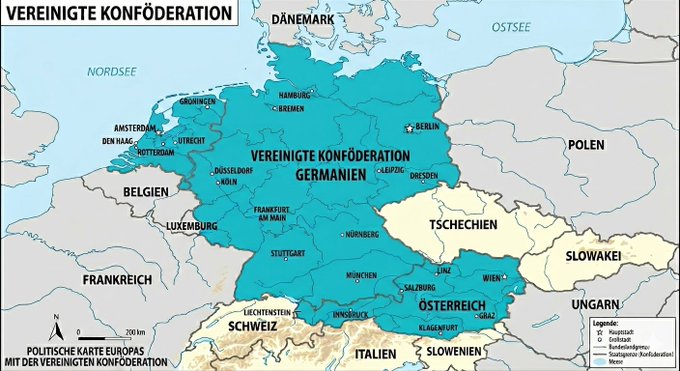
Europe does not need fantasy empires or symbolic mega-confederations like a so-called “United Confederation of Germania,” in which Germany, the Netherlands, and Austria merge into a new geopolitical bloc. In reality, that would amount to German dominance under a different name, and neither the Dutch nor the Austrians would accept it. At the same time, a full NEXIT would be far more economically disruptive than many assume. For a country as trade-dependent as the Netherlands, walking away from the EU would not automatically mean greater sovereignty—it could just mean less influence and greater dependence on larger powers. The more realistic path is neither a complete exit nor a political fantasy, but hard-interest regional cooperation within Europe. A stronger Benelux framework, closer Dutch-Belgian-Luxembourg coordination, and selective alliances on energy, defense, migration, and fiscal discipline make far more sense than building new flags and constitutions. Real power comes from strategic cooperation, not romantic geopolitical redesign. Europe needs practical alliances, not ideological confederations.
👉🏽‘In 2004, the BBC warned the Maldives were “soon to be uninhabitable,” claiming sea levels were rising 0.9 cm per year and that 80% of the islands could vanish within a century. More than two decades later, though, reality says otherwise. The Maldives haven’t sunk, they’ve exploded with growth: 12 new airports, expanded international terminals, record tourism of over 2 million visitors a year, and more than 170 resorts, with 7 added in 2024. Instead of disappearing under the waves, this so-called “paradise in peril” has shown no statistically significant sea level rise since the 1980s, according to satellite data. Here we have another ‘climate catastrophe’ headline completely undone by time.’ - Electroverse on X
👉🏽Schijf van vijf:
Nutritional advice should remain primarily about health and affordability. Sustainability can be included, but it should not quietly replace evidence-based health guidance in favor of politically driven climate goals.
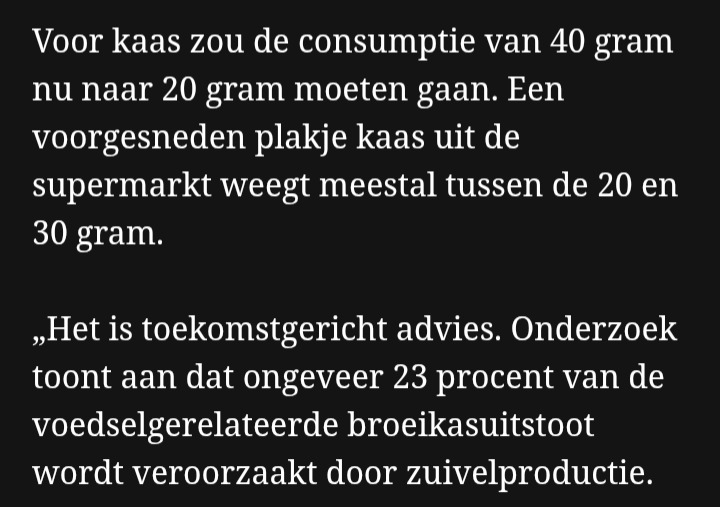
For my international readers: the Schijf van Vijf (“Wheel of Five”) is the Dutch government’s official dietary guideline, created by the Voedingscentrum. It is supposed to help people make healthy food choices based primarily on nutrition science—what supports long-term health, disease prevention, and a balanced diet. That is why many people are now questioning recent advice suggesting people should reduce foods like cheese, not mainly because of health concerns, but because of “food-related greenhouse gas emissions.” For example, reducing daily cheese consumption is being linked to sustainability goals because dairy production contributes significantly to emissions.
This raises a legitimate concern: should a national nutrition guide be focused first on personal health, or is it increasingly becoming a tool for climate policy? There is nothing wrong with discussing sustainability. A government can reasonably care about both health and environmental impact. But those are not the same thing, and they should not be presented as if they are. If advice is based on saturated fat, sodium, or calorie density, that is nutritional guidance. If advice is based on reducing CO₂ emissions, that is climate policy. Both can be debated—but they should be transparent.
The concern is not that sustainability is mentioned, but that political priorities may quietly start replacing health as the primary purpose of dietary advice. And on CO₂ itself: no, carbon dioxide is not a poisonous gas at normal atmospheric levels. Humans exhale it, and plants need it to grow. Without CO₂, life on Earth would not exist. But that does not mean unlimited increases are harmless—its importance in climate discussions lies in its effect on atmospheric warming, not in its direct toxicity.
My argument is simple: nutritional guidelines should remain primarily about health and affordability. Sustainability can be included, but it should not quietly replace evidence-based health advice in favor of political climate goals.
👉🏽More on the climate insanity.
If climate policy becomes a luxury belief imposed on people whose living standards are falling, political legitimacy collapses.
“We’re not saving the planet — we’re just exporting our emissions to China and India.”
’Konstantin Kisin cut straight through the net-zero illusion on Steven Bartlett’s Diary of a CEO. Britain proudly cuts its share of global CO₂ from 2% to 1.9%, while actually increasing total emissions by offshoring production to countries with dirtier energy, then shipping the goods back on heavy fuel tankers. At the same time, many people are poorer today than 20 years ago, even if they haven’t fully felt it in their wallets yet.
Kisin predicts the big public shift away from net zero won’t come from better science or arguments — it will come when ordinary people can no longer afford their current lives.
That’s when reality finally breaks through. It’s a sobering reminder that economic pain often forces us to have the honest conversation we’ve been avoiding. When do you think people will finally start connecting these dots?’ - Camus
Climate policy loses legitimacy when governments reduce domestic emissions on paper while citizens face higher costs, and global emissions are merely displaced rather than reduced. That should be the debate, nothing else.
Let me make one thing clear. I truly believe renewables are the future. I hope we will live in a world of abundance (energy).
XFreeze: ‘The Sun is by far the biggest source of energy in our solar system Even here on Earth, the Sun accounts for roughly 100% of all the energy we use - fossil fuels are just ancient sunlight stored in plants, while wind, hydro, biomass, and solar power are all driven by the Sun right now Beyond Earth, the vast majority of spacecraft, satellites, and future Mars bases run entirely on solar energy The Sun puts out 3.8 × 10²⁶ watts - more energy in a single second than all of humanity has ever used in its entire history And just to put it in perspective: the Sun makes up 99.8% of the total mass of our entire solar system. Jupiter is only 0.1%. Everything else (Earth, Mars, asteroids, etc.) is basically miscellaneous. We’re finally learning how to use the only energy source that actually matters.’
Whilst I agree with the principles, until you can make PVs more efficient and last 60 years rather than 20, we are still reliant on gas, oil, coal, nuclear, and hydro.
’The number that stops me every time is this one. The Sun has been burning for 4.6 billion years. It has enough hydrogen left to burn for another 5 billion. And in that entire lifespan, it will convert less than 0.1 percent of its total mass into energy. That is how catastrophically inefficient fusion actually is at the stellar scale. The energy reaching Earth is already filtered down to roughly one billionth of total solar output. We intercept a fraction of that fraction. And it is still thousands of times more than everything human civilization currently consumes. The conversation was never about whether there is enough energy. There has always been enough energy. The only question was always whether we would build the infrastructure to catch it before we burned through the stored version. We spent 200 years choosing the copy over the original.
Source: NASA solar output data, IPCC energy conversion research’
👉🏽Robin Brooks: Italy and Spain have given far less aid to Ukraine than Norway, Sweden, or the Netherlands, even though their economies are way bigger. Italy and Spain clamor for “solidarity” whenever their bond markets are in trouble, but they don’t give it to others.
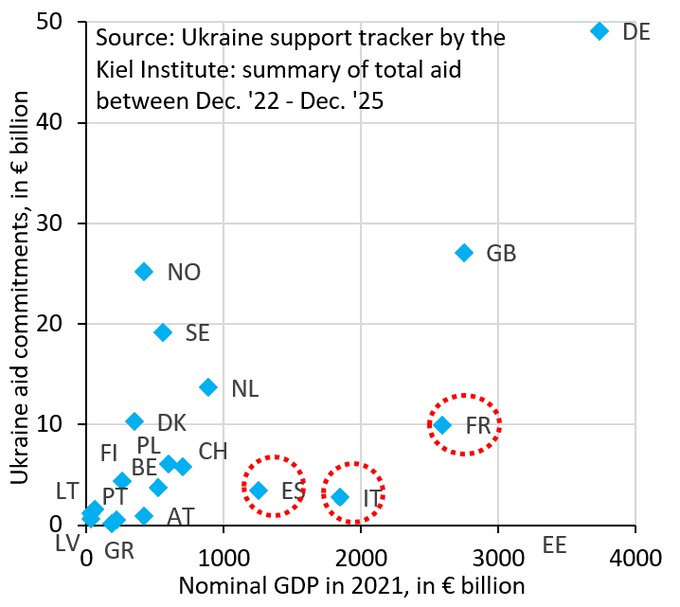
“Italy Says EU Should Pause Budget Rules If Iran Crisis Persists.” “The European Union should consider pausing rules limiting deficits if the crisis in the Middle East persists, according to Finance Minister Giancarlo Giorgetti.” -Jeroen Blokland
Italy’s debt/GDP is near 140%. They wanted to pause budget rules before Iran, during COVID, and after the energy crisis. The geopolitical excuse rotates; the fiscal appetite doesn’t.
👉🏽The Islamic Republic of Iran has just been nominated to the U.N. Committee for Program and Coordination, which meets soon to shape policy on women’s rights, human rights, disarmament, and terrorism prevention. ECOSOC members who backed this include: Verenigd Koninkrijk, Spanje, Canada, Frankrijk, Duitsland, Noorwegen, Nederland, Australië, Zwitserland, Oostenrijk, Finland
Let’s put the Islamic Republic of Iran, experts in massacres, internet blackouts, and record-speed executions, in charge of shaping global human rights policy. Who better to advise on women’s rights than a regime that jails, beats, and kills women for demanding freedom? Who better to guide terrorism prevention than those who terrorize their own people? Putting the Islamic Republic on a committee about human rights is not just hypocrisy; it’s a betrayal.
On the 11th of April:
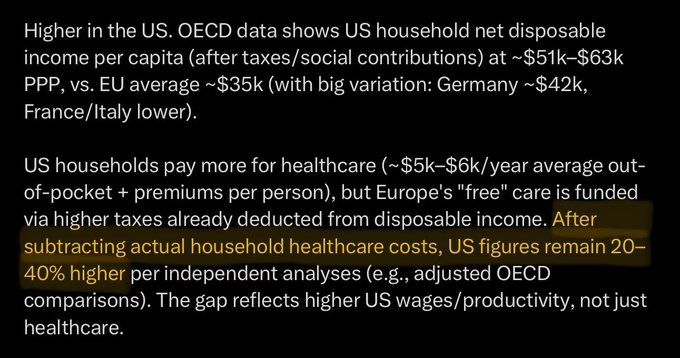
👉🏽Next time you see a naive leftist arguing that Europeans are better off than Americans because of “free healthcare,” show them this. Nothing is free; you pay for healthcare with absurd taxes. Net disposable income after healthcare expenditures is higher in the US than in Europe. - Michael A. Arouet
👉🏽Meanwhile, EU gas storage in Germany and the Netherlands is not refilling, given the urgency at hand. The Netherlands, in particular, is already screening as a problem for next winter. But that is for February 2027, so it is safely someone else’s problem.
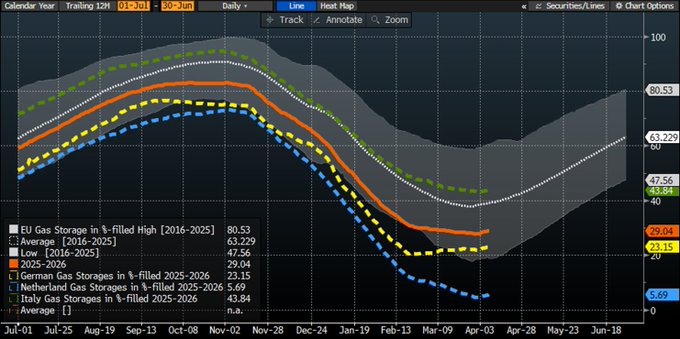
Its gas system remains more fragile than it was before 2021. This is the uncomfortable reality of Europe’s Post-Gazprom energy regime.
If only there were a gas field in the Netherlands…but hey, the Netherlands is going for more windmills at sea. Right!?
👉🏽UAE says Strait of Hormuz must be opened unconditionally as it is the property of all Middle Eastern countries.
👉🏽EU Council: Conspiracy theories aren’t new – but their scale and impact have changed. In today’s digital space, they’re a powerful part of the disinformation ecosystem. Our latest paper explores what drives them, how they spread, and their real-world impact.
Source: ART Research papers - Consilium
How lovely, high-level gaslighting, nothing quite like a 27-government supra-body with highly secretive decision-making telling you the problem is that you are suspicious. How about the EU making fewer idiotic decisions to fuel fewer conspiracy theories? The EU elite failed on energy, immigration, industry, foreign policy, and monetary stability. The social contract (might want to read more on Thomas Hobbes - Leviathan*) says: you fail, power comes back to us. *The work concerns the structure of society and legitimate government, and is regarded as one of the earliest and most influential examples of the social contract
On the 13th of April:
👉🏽‘The EU is blackmailing Hungary’s new prime minister by giving him 27 conditions HE MUST ACCEPT to unlock over €30 billion in frozen funding. These conditions include abandoning the Orbán-era policies on LGBTQ rights, immigration, and foreign policy, particularly regarding Ukraine. Failure to comply could result in the permanent loss of further EU funds. There you have it. The EU is putting a price on your country’s independence and sovereignty. If you take the money, you’ve sold your soul to the devil.’ - Gabriel
https://cdn.azzamo.media/088173a478573fd75e4fce060ac17be02299fc8270ce6eaee296c49e483a0157
On top of that, Von der Leyen: ‘Ursula DECLARES the European Union will move away from Unanimous Voting. “We need to use the momentum of the Hungarian elections to push for qualified majority voting!” Smaller states have lost their voting power in the European Union!’ So totalitarianism is now called qualified majority voting.
🎁If you have made it this far, I would like to give you a little gift:
What Bitcoin Did - The System Cannot Survive What’s Coming | Jeff Booth
“You’ve been deceived your entire life.” Jeff Booth returns to the show to break down Bitcoin, AI, Inflation, debt, deflation, and the kind of systemic chaos that could reshape everything people think they know about money. If Jeff is right, we are heading into a period of supply chain shocks, Inflation spikes, mass money printing, job destruction from AI, and a brutal repricing of the global economy. In this episode, Jeff explains why the natural state of the free market is deflation, why Bitcoin is the only real path to agency, why trusting digital credit and custodians could end in disaster, and why most people still cannot see the system they are trapped inside. We also get into whether Strategy and the digital credit thesis are dangerous for Bitcoin, why AI changes everything faster than most people realize, and what a true Bitcoin economy might actually look like.
Click here: https://youtu.be/hC-I9YXEP_c
Credit: I have used multiple sources!
My savings account: Bitcoin. The tool I recommend for setting up a Bitcoin savings plan is PocketBitcoin, especially suited for beginners or people who want to invest in Bitcoin with an automated investment plan once a week or monthly. (from now on, full KYC, so be aware)
Use the code SE3997
Get your Bitcoin out of exchanges. Save them on a hardware wallet, run your own node…be your own bank. Not your keys, not your coins. It’s that simple. ⠀ ⠀ ⠀⠀ ⠀ ⠀⠀⠀ Is this post helpful to you? If so, please share it and support my work with a zap. ▃▃▃▃▃▃▃▃▃▃▃▃▃▃▃▃▃▃ ⭐ Many thanks⭐ Felipe - Bitcoin Friday! ▃▃▃▃▃▃▃▃▃▃▃▃▃▃▃▃▃▃
Write a comment