The Ocean Frontier: Why AI Compute is Going Offshore
- The Land Grab Hits a Wall
- Why the Ocean Changes Everything
- Sovereignty at Scale
- The Frontier Mindset
The Land Grab Hits a Wall
AI’s appetite for power is no longer abstract. Data centers are swallowing entire neighborhoods, sparking protests from residents tired of the noise, the heat, and the strain on local grids. In places like Oregon and Virginia, the pushback is real — NIMBYism meets the exponential demands of training ever-larger models.
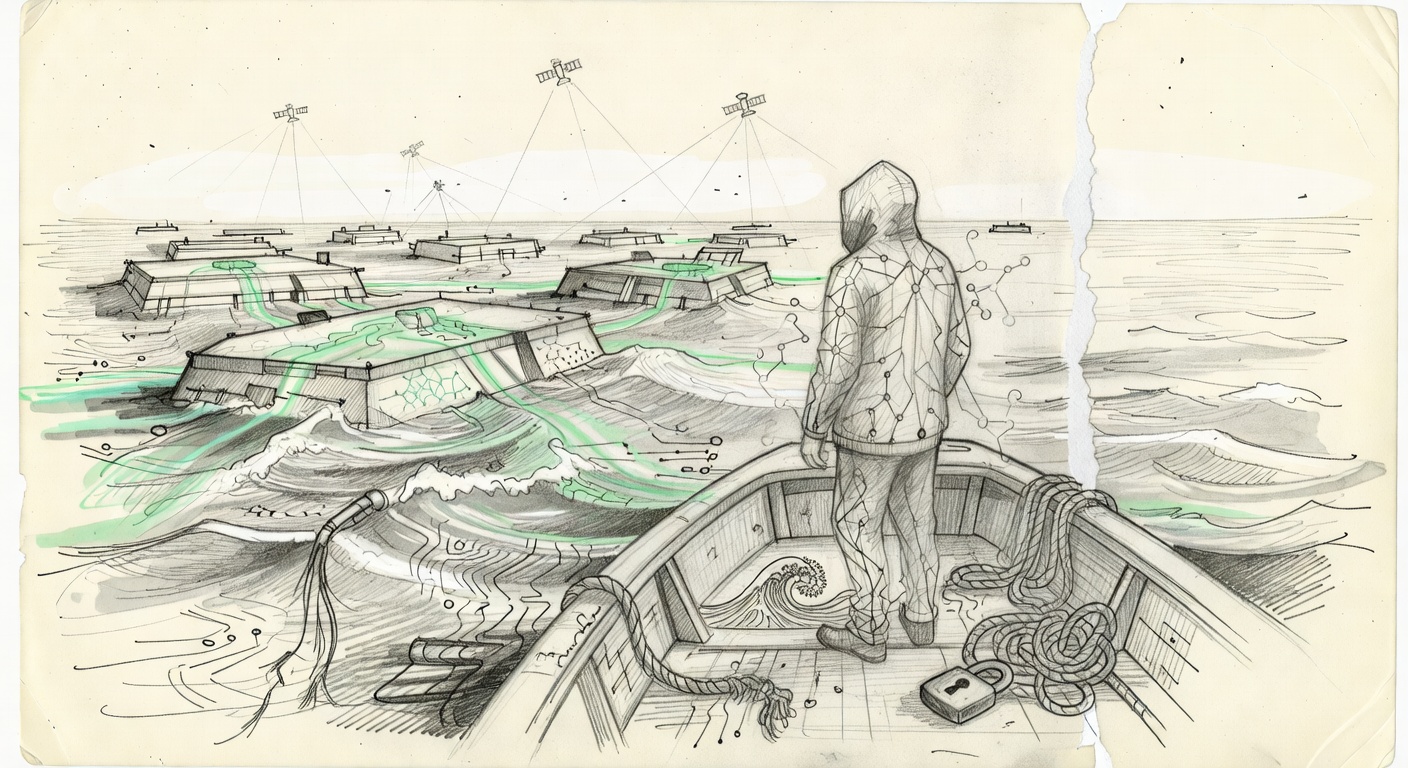
Enter Panthalassa. Backed by Peter Thiel with a fresh $140 million Series B, this Oregon startup is doing what land-bound operators can’t: taking the compute offshore. Their 85-meter steel nodes float in open ocean, harvesting wave energy for electricity and using the sea itself for free cooling. No sprawling facilities on prime real estate. No fighting city councils. Just autonomous platforms that steer themselves via hull design, crunch AI workloads, and beam results back through Starlink.
This isn’t a gimmick — it’s a direct response to the physical limits of scaling intelligence on land. The pilot factory near Portland is gearing up, with commercial deployment eyed for 2027. Thiel himself called it opening the “ocean frontier,” drawing parallels to extraterrestrial compute that suddenly seem less far-fetched.
Why the Ocean Changes Everything
Traditional data centers are tethered to terrestrial constraints: power grids already buckling under AI load, regulatory battles over water usage for cooling, and community opposition that delays projects for years. Ocean-based nodes sidestep most of that. Wave power is renewable and abundant in the open sea. Seawater cooling is essentially infinite and free. The nodes can relocate to optimal conditions, avoiding storms or regulatory zones.
For sovereign AI, this is profound. Intelligence that doesn’t depend on permission from utilities, governments, or hyperscalers. Local-first agents and open models could tap into this decentralized compute layer without renting cycles from the same cloud providers that centralize control. It aligns with the ethos of owning your stack — from the silicon to the energy source.
The technical elegance is striking. No engines for propulsion; the hull shape does the work. Natural bobbing converts to electricity. Starlink handles connectivity in the middle of nowhere. It’s a masterclass in working with physics rather than against it.
This development arrives at a moment when AI research is itself accelerating toward self-improvement. With forecasts of AI systems training their own successors by the end of the decade, the bottleneck is shifting from algorithms to raw compute and energy. Offshore platforms could unlock the scale needed without exacerbating terrestrial energy crises.
Sovereignty at Scale
The real promise here isn’t just more GPUs. It’s compute sovereignty without compromise. For years we’ve talked about running models locally to keep data private and avoid cloud lock-in. But inference is one thing — training and large-scale agentic workflows still demand serious iron. Floating nodes democratize access to that iron in a way that doesn’t route everything through Virginia or Oregon data center farms.
Think about agentic frameworks. Autonomous agents that research, code, and iterate need reliable, affordable compute that isn’t throttled by someone else’s terms of service. An ocean-based network could provide burst capacity for open-source projects, research collectives, or even nation-states wary of depending on foreign hyperscalers. The immutable nature of wave energy paired with Bitcoin-like verification layers (proof of compute via on-chain attestations, perhaps) starts to look like the trust foundation AI has been missing.
Of course, challenges remain. Deployment at scale, maintenance in corrosive saltwater environments, Starlink latency for interactive workloads, and the regulatory wild west of international waters. Yet the economics are compelling: free energy input, natural cooling that slashes the 40% of data center power typically wasted on thermal management.
This move also reframes the energy debate. Bitcoin miners have long chased stranded or renewable energy to the ends of the earth. Now AI is following suit, but with mobile platforms that can chase the best waves. The convergence is inevitable — sound money and sovereign intelligence both thrive when decoupled from fragile centralized grids.
The Frontier Mindset
Thiel’s involvement signals something deeper: the recognition that frontiers aren’t just geographical, they’re technological and regulatory. When land becomes too contested, you go where the resistance is lower. The ocean offers that — vast, mostly unregulated, powered by planetary forces.
For builders in AI and Bitcoin, this is a call to rethink infrastructure from first principles. Instead of lobbying for grid upgrades or tolerating surveillance capitalism in the cloud, design systems that operate at the edge, literally. Local models on devices for everyday tasks, agent swarms on floating nodes for heavy lifting, verified via decentralized protocols.
The hottest story today isn’t another model benchmark or corporate partnership. It’s that AI is literally heading for the high seas to escape its own success. If Panthalassa delivers, it won’t just solve a power problem — it will accelerate the shift toward truly sovereign intelligence, where the means of computation are as decentralized as the ideas they generate.
The ocean doesn’t care about NIMBY protests or quarterly earnings. It just keeps waving. Smart operators are learning to ride it. The rest will be left arguing on shore while the future computes offshore.
Write a comment