This is a longform article test

List of random shite
Hotdog
%5Bhttps://www.png%5Dall.com/wp-content/uploads/2016/04/Hot-Dog.png)
A hot dog[1][2] is a grilled, steamed, or boiled sausage served in the slit of a partially sliced bun.[3][4][5] The term hot dog can also refer to the sausage itself. The sausage used is a wiener (Vienna sausage) or a frankfurter (Frankfurter Würstchen, also just called frank). The names of these sausages commonly refer to their assembled dish.[6] Hot dog preparation and condiments vary worldwide. Common condiments include mustard, ketchup, relish, onions in tomato sauce, and cheese sauce. Other toppings include sauerkraut, diced onions, jalapeños, chili, grated cheese, coleslaw, bacon and olives. Hot dog variants include the corn dog and pigs in a blanket. The hot dog’s cultural traditions include the Nathan’s Hot Dog Eating Contest and the Oscar Mayer Wienermobile.
Noblest of all dogs is the hot-dog; it feeds the hand that bites it. - Laurence J Peter
Frog

A frog is any member of a diverse and largely semiaquatic group of short-bodied, tailless amphibian vertebrates composing the order Anura[1] (coming from the Ancient Greek ἀνούρα, literally ‘without tail’). Frog species with rough skin texture due to wart-like parotoid glands tend to be called toads, but the distinction between frogs and toads is informal and purely cosmetic, not from taxonomy or evolutionary history.
Frogs are widely distributed, ranging from the tropics to subarctic regions, but the greatest concentration of species diversity is in tropical rainforest and associated wetlands. They account for around 88% of extant amphibian species, and are one of the five most diverse vertebrate orders. The oldest fossil “proto-frog” Triadobatrachus is known from the Early Triassic of Madagascar (250 million years ago), but molecular clock dating suggests their divergence from other amphibians may extend further back to the Permian, 265 million years ago.
Adult frogs have a stout body, protruding eyes, anteriorly-attached tongue, limbs folded underneath, and no tail (the “tail” of tailed frogs is an extension of the male cloaca). Frogs have glandular skin, with secretions ranging from distasteful to toxic. Their skin varies in colour from well-camouflaged dappled brown, grey and green, to vivid patterns of bright red or yellow and black to show toxicity and ward off predators. Adult frogs live in both fresh water and on dry land; some species are adapted for living underground or in trees. As their skin is semi-permeable, making them susceptible to dehydration, they either live in moist niches or have special adaptations to deal with drier habitats. Frogs produce a wide range of vocalisations, particularly in their breeding season, and exhibit many different kinds of complex behaviors to attract mates, to fend off predators and to generally survive.
Being oviparous anamniotes, frogs typically spawn their eggs in bodies of water. The eggs then hatch into fully aquatic larvae called tadpoles, which have tails and internal gills. A few species lay eggs on land or bypass the tadpole stage altogether. Tadpoles have highly specialised rasping mouth parts suitable for herbivorous, omnivorous or planktivorous diets. The life cycle is completed when they metamorphose into semiaquatic adults capable of terrestrial locomotion and hybrid respiration using both lungs aided by buccal pumping and gas exchange across the skin, and the larval tail regresses into an internal urostyle. Adult frogs generally have a carnivorous diet consisting of small invertebrates, especially insects, but omnivorous species exist and a few feed on plant matter. Frogs generally seize and ingest food by protruding their adhesive tongue and then swallow the item whole, often using their eyeballs and extraocular muscles to help pushing down the throat, and their digestive system is extremely efficient at converting what they eat into body mass. Being low-level consumers, both tadpoles and adult frogs are an important food source for other predators and a vital part of the food web dynamics of many of the world’s ecosystems.
Frogs (especially their muscular hindlimbs) are eaten by humans as food in many cuisines, and also have many cultural roles in literature, symbolism and religion. They are environmental bellwethers, with declines in frog populations considered early warning signs of environmental degradation. Global frog populations and diversities have declined significantly since the 1950s. More than one third of species are considered to be threatened with extinction, and over 120 are believed to have become extinct since the 1980s. Frog malformations are on the rise as an emerging fungal disease, chytridiomycosis, has spread around the world. Conservation biologists are working to solve these problems.
Albuquerque, New Mexico
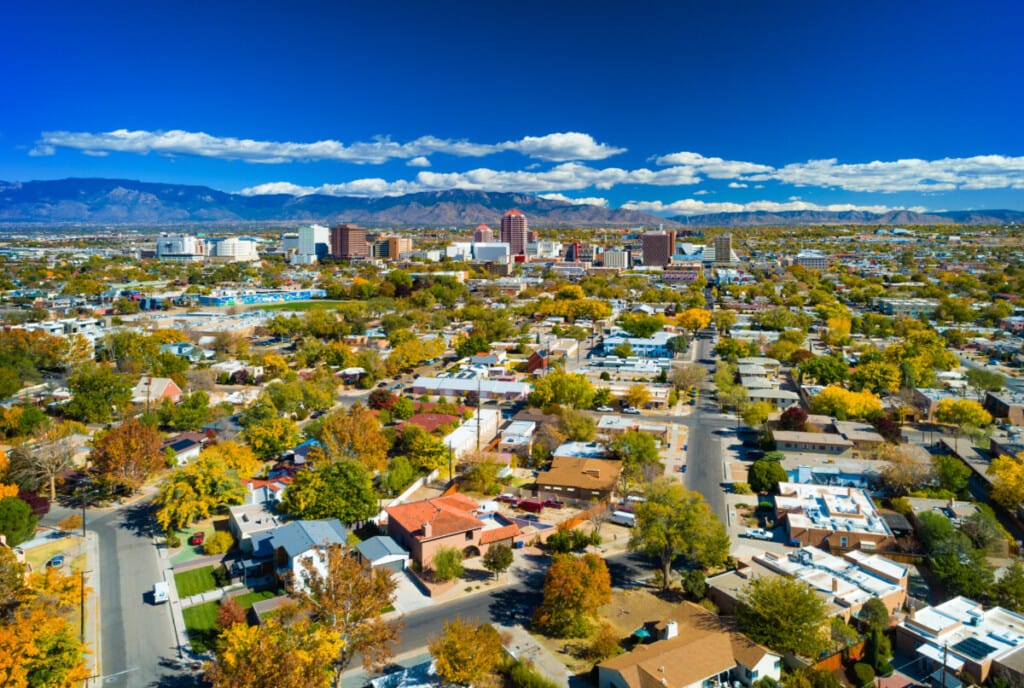
Albuquerque (/ˈælbəkɜːrki/ ⓘ AL-bə-kurk-ee; Spanish: [alβuˈkeɾke] ⓘ),[a] also known as ABQ, Burque, the Duke City, and in the past ‘the Q’, is the most populous city in the U.S. state of New Mexico,[6] and the county seat of Bernalillo County. Founded in 1706 as La Villa de Alburquerque by Santa Fe de Nuevo México governor Francisco Cuervo y Valdés, and named in honor of Francisco Fernández de la Cueva, 10th Duke of Alburquerque and Viceroy of New Spain, it was an outpost on El Camino Real linking Mexico City to the northernmost territories of New Spain.
Located in the Albuquerque Basin, the city is flanked by the Sandia Mountains to the east and the West Mesa to the west, with the Rio Grande and its bosque flowing north-to-south through the middle of the city.[7] According to the 2020 census, Albuquerque had 564,559 residents,[8] making it the 32nd-most populous city in the United States and the fourth-largest in the Southwest. The Albuquerque metropolitan area had 955,000 residents in 2023, and forms part of the Albuquerque–Santa Fe–Los Alamos combined statistical area, which had a population of 1,162,523.[9]
Albuquerque is a hub for technology, fine arts, and media companies.[10][11] It is home to several historic landmarks,[12] the University of New Mexico, the Albuquerque International Balloon Fiesta, the Gathering of Nations, the New Mexico State Fair, and a diverse restaurant scene, which features both New Mexican and global cuisine.[13]
Write a comment