Tracking CBDCs: Venezuela’s Non-Digital Digital Currency

One of the challenges of tracking the development of central bank digital currencies (CBDCs) is keeping track of how each country will put its own spin on things. Nowhere is that more the case than in Venezuela, where Maduro’s regime introduced a CBDC that doesn’t actually exist.
The Headline Data
First, let’s look at the current state of the world. According to the Human Rights Foundation’s CBDC Tracker, 10 countries have CBDCs that are open to the public; 53 countries, the Eurozone, the Eastern Caribbean Currency Union, and Hong Kong have CBDC pilots; and more than 74 countries are researching CBDCs.
Digging Deeper
There is much to say about Venezuela, but it’s probably best to start in 2021 when president Nicolás Maduro briefly hinted that a “digital bolívar” would soon be part of an effort to digitize the Venezuelan economy. Many people took this statement to mean a CBDC was on the way.
Later that year, the Banco Central de Venezuela seemed to confirm those suspicions when it announced the digital bolívar was indeed on the way. Curiously, however, that was not the only thing that the central bank had in store for Venezuelans. The central bank also noted that there would be a currency devaluation. It was removing six zeros from the currency so that 1,000,000 sovereign bolívars would be equal to 1 digital bolívar.
When push came to shove, the digital bolívar was finally unveiled. And here it is.
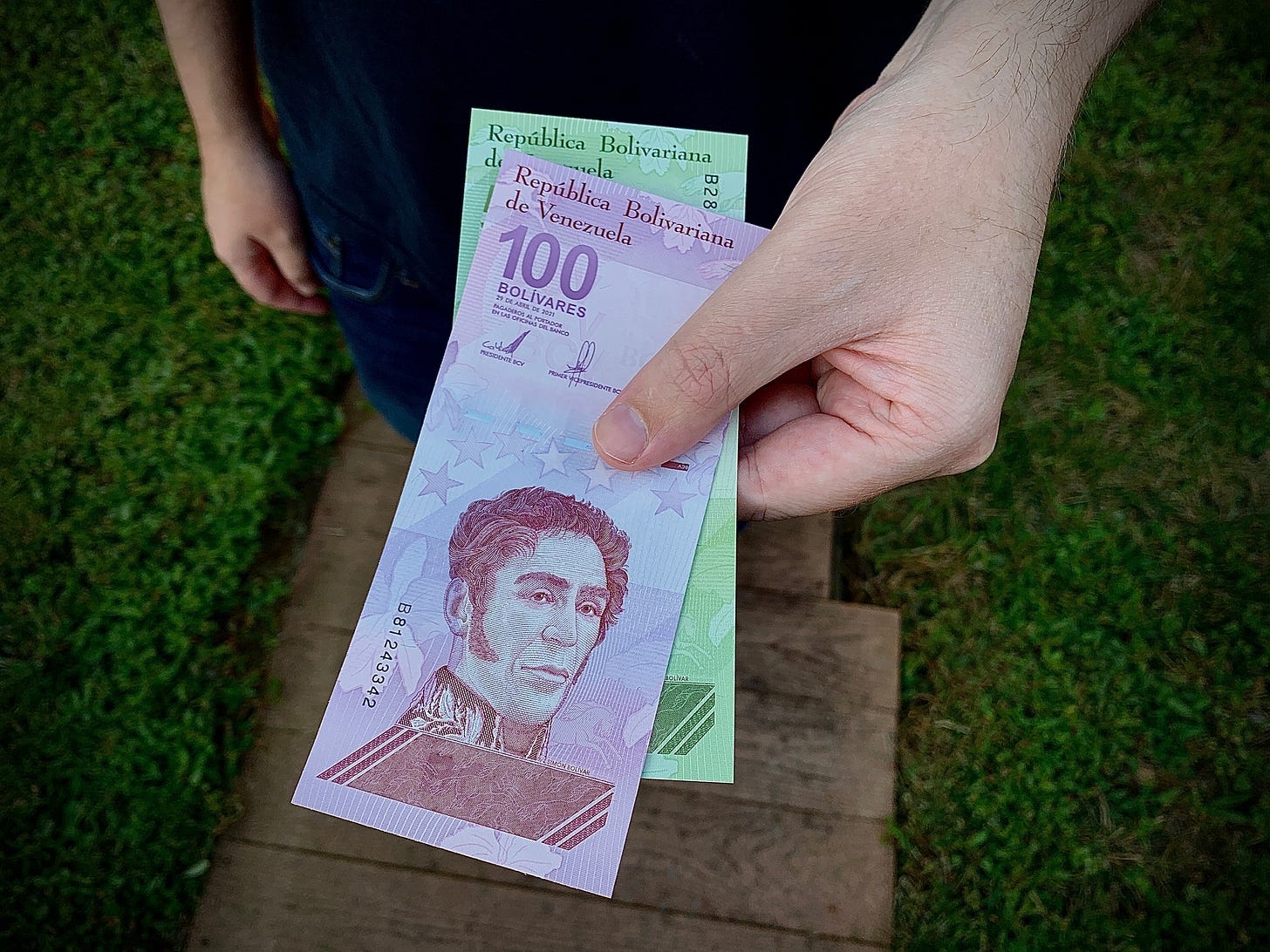 I don’t often include pictures in this newsletter, but it felt necessary here. Before you ask, the answer is “no.” This image is not a hyperrealistic AI-generated image of what a digital bolívar might look like. The so-called digital bolívar really is a physical banknote. The only thing that’s new about it is that it has been devalued. And frankly, that’s not even a novel occurrence in Venezuela.
When it was first introduced, Miguel López, a financial and accounting consulting partner at EY Venezuela, told CoinDesk there are “no digital components that make the bolívar digital different from the sovereign bolívars, which could also be transacted electronically.” Alejandro Castro, a Venezuelan economist, further said, “In the end, the digital bolívar is digital in name, not in practice.”
So, judging from the available information, the digital bolívar is not a CBDC.
With that said, there is a side note to this story that unexpectedly captures just how absurd the Venezuelan monetary system has become. To spur adoption of the digital bolívar, the central bank forced shops to post prices in both sovereign bolívars (Bs) and digital bolívars (Bs.D). Yet, there is a third label on prices that can also be seen in Venezuelan shops: REF.
REF simply means that the posted price is in dollars, and customers should reference the exchange rate if they plan to pay in bolívars.
For the fans of economics and statistics who are reading, I probably don’t need to point it out. However, “REF” is also the error code that Microsoft Excel will display if a formula is broken. And frankly, this label could not be more fitting. Something is clearly broken if a central bank has launched a non-digital, digital currency denominated at 1/1,000,000th of its previously hyperinflated currency that was already on its second devaluation.
It would be funny if it were not so sad that the Venezuelan people have to put up with this nonsense.
Looking Forward
As if this story were not enough, there’s also the tale of when Maduro introduced an actual digital currency called the “petro.” And while the petro can be called a CBDC (unlike the digital bolívar), I’ll leave that story for another day.


Write a comment