The Sabbath and the Doctrine of Creation
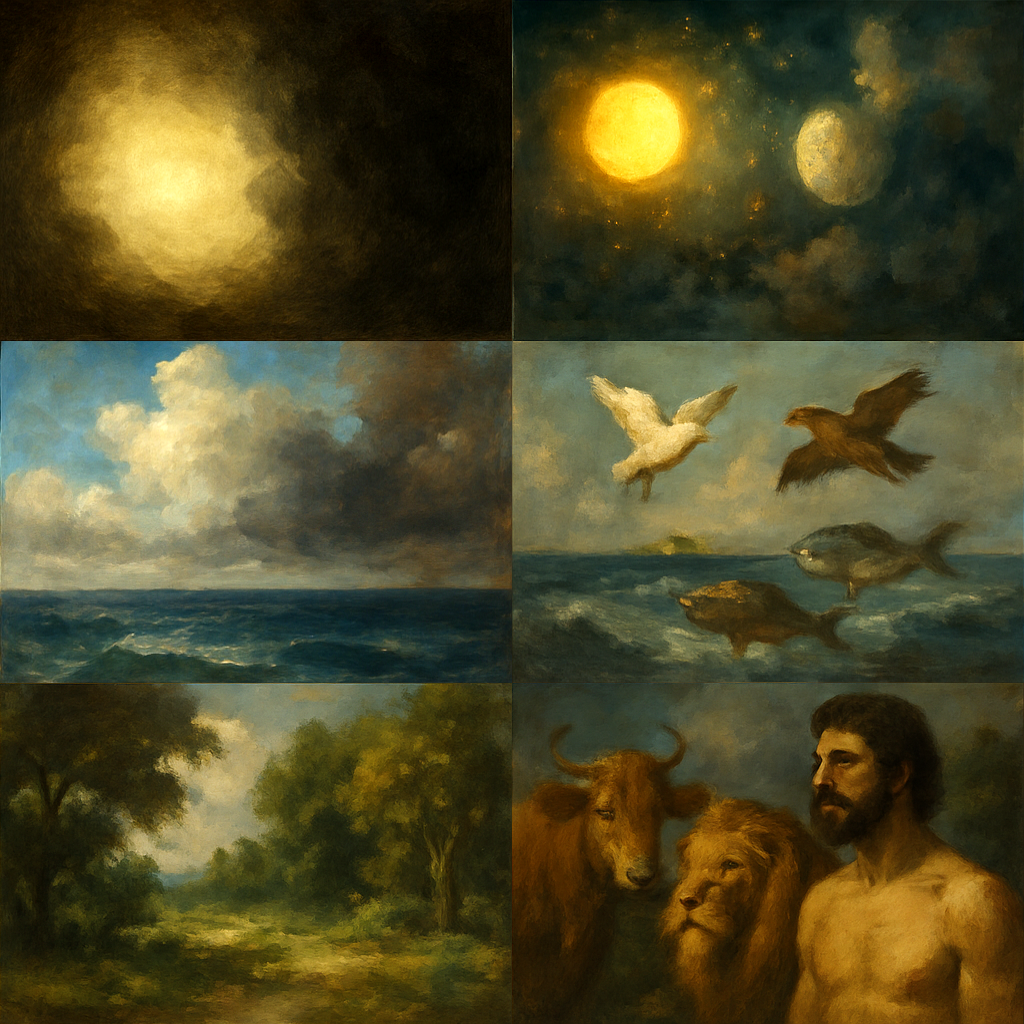
The first chapter of Genesis depicts the creation account in language that can only be described as methodical and majestic. Methodical, because there is an unmistakable pattern which each day follows, and a symmetry which the six days combine to display. Majestic, because we are told that by the power of God’s command all things came into being ex nihilo, out of nothing. These factors have led many to conclude that the days of creation should not be taken in a normal, historical sense. Instead, they say that we ought to take the account figuratively, or at least more loosely.
For instance, Lee Irons explained the increasingly popular Framework Interpretation with these words, “What sets the framework interpretation apart is its claim that the total picture of the creation week is figurative. The creation history is figuratively presented as an ordinary week in which the divine craftsman goes about His creative toil for six days and finally rests from and in His completed work on the seventh.” To be fair, Irons views the days of creation as literal solar days, but he believes that the fourth, fifth, and sixth days are not separate from the first, second, and third. That is what he means when he says that the creation week is figurative. He does not see it as six chronological days followed by the first Sabbath. He admits that the traditional week is what the text portrays, but he argues for a figurative interpretation which could involve less days, and a different order.
Obvious & Intentional Pattern
The language of the first chapter of Genesis is certainly unique. Each day follows a very distinct pattern apparent even in casual reading of the text. First we have the narrative, “And God said,” followed by his creative declaration, (e.g. “Let there be light.”). Then we see the results of his almighty command, with God’s assessment of his work on each day as “good.” Finally it is set in its temporal framework with the words, “And there was evening and there was morning.” The six days all follow this pattern, giving the impression that it is an intentional literary device.
A more subtle pattern also appears in the six days, relating to what God created on each day. Victor Hamilton notes this saying:
It is not difficult to see that the first six days fall into two groups of three. Thus on day one, God created light in general or light bearers; on day four, there were specific kinds of light. On day two, the firmament separated waters above from waters below; on day five, God made creatures of sky and water. On day three, God created the earth; on day six, He made the creatures of land.
The first three days God forms, and the last three he fills what he had formed, each in its turn. Perhaps this pattern, more than the first, leads many to the conclusion that the creation account is figurative to one extent or another. But the days of creation are not a self-contained literary unit with no bearing on the rest of Scripture. Our understanding of the creation week, and whether or not there were six ordinary days on which God worked, with a seventh day of rest, must be informed by the rest of Scripture.
The Creation Mandate of Rest
Of course, I am referring to the fourth commandment in particular. In Exodus 20, God’s words to Moses make the creation week the basis for the commandment to observe the sabbath. Here is how the ESV renders the text:
Remember the Sabbath day, to keep it holy… For in six days the Lord made heaven and earth, the sea, and all that is in them, and rested on the seventh day. Therefore the Lord blessed the Sabbath day and made it holy. (Ex. 20:8,11)
Now, if the creation week is the model and specified reason for the Sabbath, and the commandment is to work for six ordinary days and rest on the seventh, we should expect that the days of creation were ordinary days as well. It would make no sense to base the Sabbath on the creation week, if God actually took eons of time, or even a mere four days, rather than six days. Dr. Robert Reymond notes this argument as well:
If we follow the analogia Scripturae principle of hermeneutics enunciated in the Westminster Confession of Faith to the effect that “the infallible rule of interpretation of Scripture is Scripture itself: and therefore, when there is a question about the true and full sense of any Scripture (which is not manifold, but one), it must be searched and known by other places that speak more clearly,“ then the “ordinary day” view has most to commend it since Moses grounds the commandment regarding seventh-day Sabbath observance in the fact of the divine Exemplar’s activity.
The Sabbath was instituted by divine example in the first chapter of Genesis. Any interpretation which undermines this example should be highly suspect by anyone who acknowledges Scripture as the foundation and ultimate authority in their epistemology. The text in Exodus 20 certainly treats the creation week as equivalent to the week leading to the Sabbath, for which it is the model. Using that as our guide, we would be right to interpret the creation week as six ordinary days of work, followed by a day of rest.
Evening and Morning
What about the text of Genesis 1 itself? Is there anything which would suggest a figurative interpretation? To the contrary, the text of Genesis 1 also supports the “ordinary day” interpretation, in a few major ways.
First, whenever the word ‘day’ is used in Scripture with a number – such as the ‘first’ day, or ‘second’ day – it is always referring to a calendar day. If that is not the case in Genesis 1, it would be the only example of a deviation from this principle in Scripture.
Second, the text seems to make the “ordinary day” interpretation unavoidable when it repeats the refrain, “And there was evening and there was morning, the ___ day.” (Genesis 1:5, 8, 13, 19, 23, & 31) It is almost as though God is telling us, “Don’t be confused about what I mean by the word ‘day’. I mean evening and morning.” A measurable span of time is clearly specified.
Third, there are things created on earlier days, that require things created on later days to continue to exist. We see this in the third and fifth days specifically. On the third day, God created dry land and all plants (vv. 9-13), but God didn’t create the sun for photosynthesis till the fourth day (vv. 14-19), or any living creatures to pollinate the plants until the fifth day (vv. 20-23). It does not, therefore, seem likely that there could have been a long span of time between the third and fifth days.
So it is that we see, both in the treatment of the creation week by other passages of Scripture, and the text of Genesis 1 itself, that the creation week should rightly be understood as a normal seven day period. The fact that there exists a pattern in the ordering of the days, with the first three days of forming and last three days of filling, only serves to teach us that our God is a God of order.
Where were you when I laid the foundation of the earth? Tell me, if you have understanding. Who determined its measurements–surely you know! Or who stretched the line upon it? On what were its bases sunk, or who laid its cornerstone, when the morning stars sang together and all the sons of God shouted for joy? (Job 38:4-7)


Write a comment