Building Sustainable Circular Economies Through Impact Funds
- Workshops are the key differentiator
- Enabling local entrepreneurship, not dependency
- Our pilot
- Become a Field Partner on Geyser
We are making an important change to the main Bitcoin Adoption Impact Fund.
Funds will no longer be distributed through applications alone, and project evaluation will no longer be handled by Geyser or a board alone.
Instead, project selection and evaluation will increasingly be done by Field Partners.
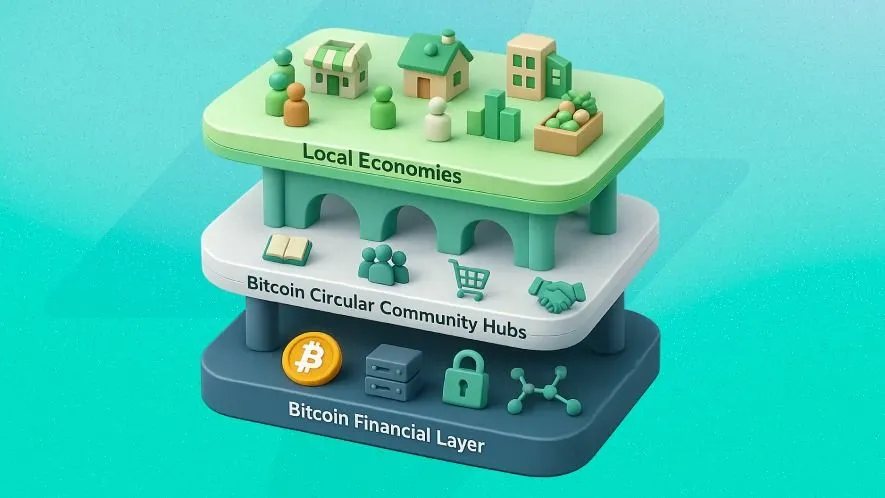
Field Partners are trusted Bitcoin circular economies that are deeply connected to their local communities.
The Latin America Impact Fund will continue through applications for now.
Right now, we have around $10k ready to deploy through this new model.
This new model looks at fostering local capabilities rather than fostering dependency, and building models for circular economy hub sustainability.
Learn more below.
Field Partners: the trust layer between Bitcoin and local realities

Our Field Partners are trusted circular economy hubs on Geyser.
They are the bridge between global Bitcoin capital and local communities that need Bitcoin capital and tooling.
They educate their communities about Bitcoin, onboard merchants, and stay close to what is actually happening on the ground.
They can see who is doing the work, what needs are emerging in a community, whether a plan is credible, and where a small amount of capital can create the most impact.
That is why we are using hubs as therust layer. They help bring tools and capital to the people around them: entrepreneurs, community leaders, educators, merchants, and builders who can use Bitcoin as a tool even when Bitcoin is not the message.
This also means we want to go deep with each Field Partner, not just spread thin across a long list of hubs.
To start, we expect to work closely with 3 to 10 hubs at a time. We will not be able to select every hub from day one.
We will review and update the active set of Field Partners frequently as we learn what is working, where demand is strongest, and where more support is needed.
Apply here if you’re interested in becoming a Field Partner.
Workshops are the key differentiator

The core of this model is not just grant distribution. It is the workshop layer.
Workshops are the open platform where projects can emerge from the ground.
They bring local communities into direct contact with the tooling and capital we offer: self-custody, Bitcoin crowdfunding, micro-lending, and other practical ways to use Bitcoin.
They also make the process more participatory. Instead of waiting for polished applications to arrive online, workshops surface real needs, real people, and real ideas from within the community itself.
That is a key difference in this model. We are not only funding projects that already know how to ask for capital. We are creating the conditions for good projects to emerge in the first place.
A path towards sustainability for Circular Economies
This model also gives circular economy hubs a path toward sustainability.
Field Partners can be compensated for useful work: running workshops, verifying projects, doing due diligence, supporting borrowers, and helping capital reach the right places.
- Run workshops about Bitcoin tooling: self-custody, crowdfunding, micro-lending, and related tools that help communities become more financially sovereign.
- Receive loan interest: if they enable loans, part of the interest can compensate the hub for the verification and support layer it provides. Learn more about the micro-lending launch from @geyserfund.
In short, this model offers a vision for Circular Economy Hubs as not just education centers, but as gateways into the financial tools and services offered by Bitcoin and the Bitcoin economy.
This model also gives circular economy hubs a path toward sustainability.
Field Partners can be paid for useful work: running workshops, verifying projects, doing due diligence, supporting borrowers, and helping capital reach the right places.
- Run workshops about Bitcoin tooling: self-custody, crowdfunding, micro-lending, and related tools that help communities become more financially sovereign.
- Receive loan interest: if they enable loans, part of the interest can compensate the hub for the verification and support layer it provides. Learn more about the micro-lending launch from @geyserfund.
In short, this model offers a vision for Circular Economy Hubs as not just education centers, but as gateways into the financial tools and services offered by Bitcoin and the Bitcoin economy.
Enabling local entrepreneurship, not dependency
This workshop-first model moves away from grant dependency and toward enabling local entrepreneurship.
- Social entrepreneurship: neighborhoods looking to make art, artists looking to fund their big ideas, community programs, local education, and public goods.
- Business entrepreneurship: shops looking to grow, local businesses getting started, and new local startup ideas that need affordable access to capital.
We believe that connecting locals around the world (especially the emerging markets) to global markets and capital can lead to an economic revolution.
And if the fiat world won’t do that, Bitcoiners can, with Circular Economy Hubs as the bridge to these local realities.
We see individuals on the ground as the key economic unit of transformation. If we bring capital to them (as donations towards social entrepreneurship programs or micro-loans for new business ventures) we can enable this change.
We see individuals on the ground as the key economic unit of transformation.
On micro-loans, we have received over 1 BTC in allocated commitments to fund bitcoin-powered micro-loans. More on that from @geyserfund, and more coming soon.
Our pilot

We are already testing this model by allocating $500 each to five circular economies around the world.
We partner with hubs, train them to run workshops in their local context, and help them get projects set up on Geyser.
These are:
- Bitcoin Berlín, El Salvador (@BitcoinBerlinSV)
- CasaBitcoin Santa Ana, El Salvador (@casab_sv)
- Node Nation (@NodeNationSV)
- Bitcoin Kakuma, Kenya (@btckakuma)
- Bitcoin Study Hubs, Malawi (@RightOnTheTape)
Early results are already encouraging:
- In El Salvador, @NodeNationSV ran a workshop where students came up with practical ideas to improve their local reality. The winning project will be announced soon. See here.
- In Kenya, @btckakuma is building a Bitcoin center in the heart of the Kakuma refugee camp. See here.
Become a Field Partner on Geyser
If you are interested in becoming a Field Partner on Geyser, express your interest here. Keep in mind that we will only be selecting a handful of initial Field Partners as we prefer maintaining a deep relationship with a few as we look to grow this service out.
And if you’d like to contribute some sats towards spreading Bitcoin adoption at the grassroots level, please do so here:


Write a comment