When Opportunity Has to Be Carried

We talk about opportunity as if it moves easily. As if it flows. As if the world is already connected. It isn’t. Opportunity—real opportunity—has to be carried.
When our family first moved to Istanbul, our oldest son was still an infant. We were new to everything. Language. Culture. Rhythm. Even the smallest interactions required attention. We found community through a small local church—one of the few places where relationships formed slowly, but deeply. It was there that we came to know Yonatan’s family. Most of those early years were spent learning—studying Turkish, making mistakes, trying to understand how life actually worked in a place that was not our own. But over time, those relationships became real.
Life moved on, as it does. Our family eventually relocated to a different part of the city, where we found stability—academically, professionally, and in community. But the relationships didn’t disappear. They rarely do. They just change form.
Years later, I find myself further away geographically—but, in some ways, more able to help. And that’s where this story begins again.
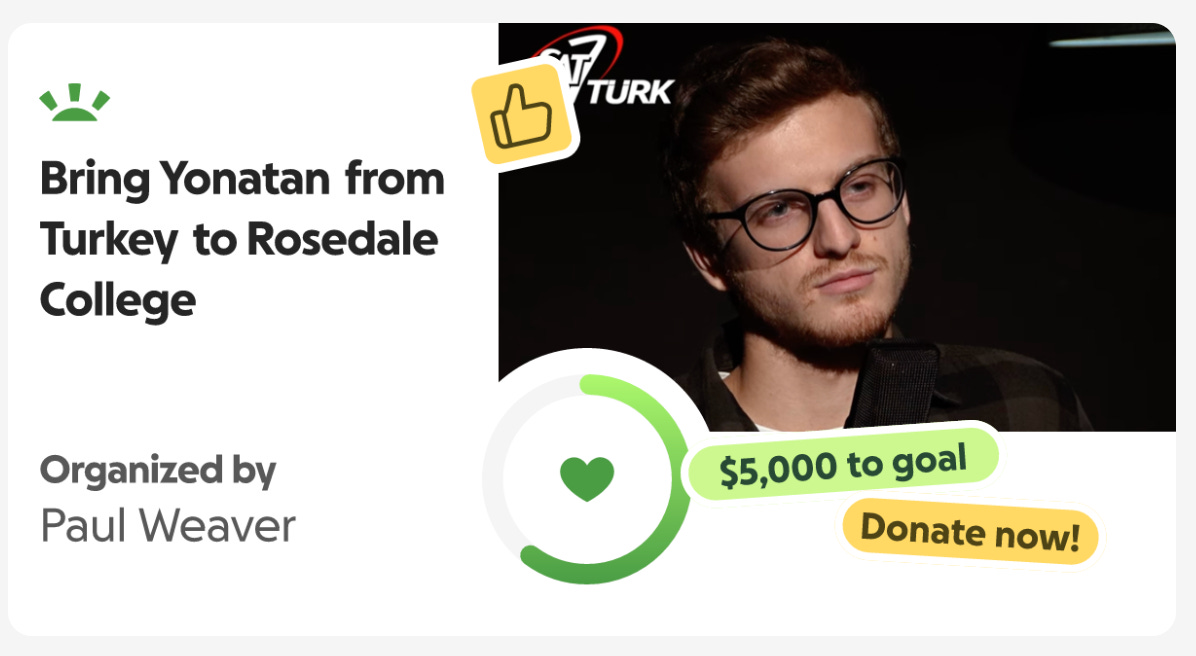
Yonatan now has the opportunity to attend Rosedale College. On paper, that sounds simple. But crossing a border is never just about distance. It involves systems, approvals, finances, timing—and a network of people willing to carry something forward.
This is where we often misunderstand the world we live in. We assume systems move people. They don’t. People move people—through systems.
Yonatan’s story carries something more as well. He represents a third generation of Christian leadership in Istanbul. That is far rarer than it sounds. His grandparents, Agnes and Misak Günay, were part of a pioneering generation—building and sustaining a Protestant Christian presence in a place where, for a long time, almost none existed. That kind of legacy doesn’t continue on its own.
So this, for me, is not just about helping one person. It’s about participating—however modestly—in something that has been carried across decades. Something relational. Something often unseen. Something that doesn’t move unless people choose to move it.
I’ve written before about the idea that we don’t eliminate trust—we move it.
That trust gets built in specific places, through specific relationships, over years. Istanbul was one of those places for our family. Yonatan’s family was part of that.
Coming alongside them now isn’t charity. It’s continuity. It’s a way to meet a need I wasn’t able to when we lived closer—and to honor what that season of our lives actually meant.
If you’re reading this and you don’t know me well: I write about trust, borders, and how things actually move in the world. This post is a little different from my usual—more personal, more direct. But it reflects the same things I keep returning to. Real networks aren’t built online. They’re built in living rooms, in church basements, over meals where you don’t quite speak the language yet. What you’re reading is one of those networks asking for help.
If you want to be part of carrying this forward for Yonatan, we’ve opened a way to help.
Support the campaign:
gofund.me/e900555b2
And if giving isn’t the right fit right now, sharing this with someone who might connect with the story matters just as much.
Paul Weaver
Write a comment