One Track
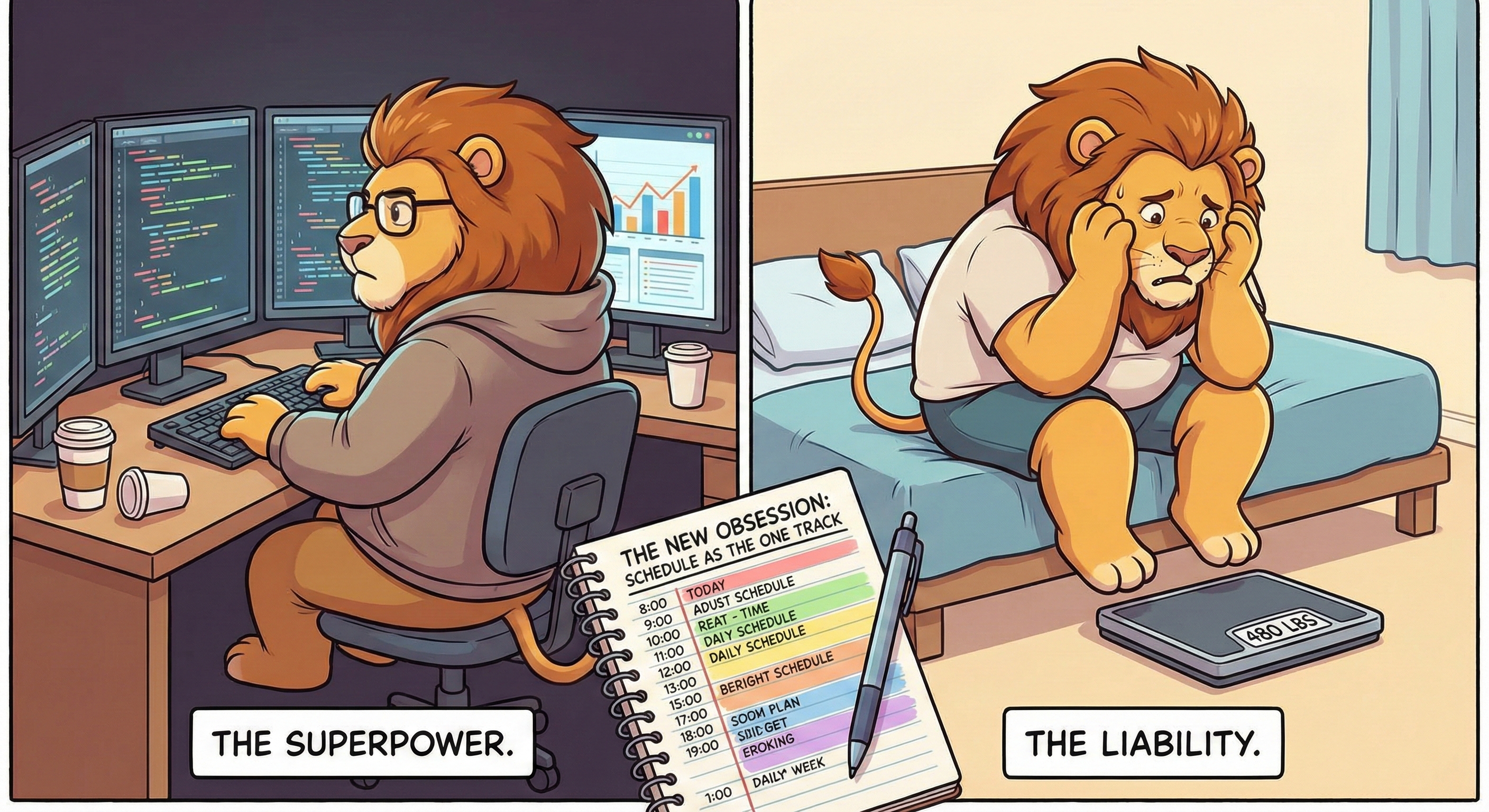
I HAVE A PROBLEM. I have a one-track mind. I tend to focus on one thing obsessively. Some would call it drive; others call it focus. I call it “one-track” because that was my mother’s label for me when I was younger. I used to think it was a defect—her tone implied I should be able to multitask. But as I got older, I began to view it as a superpower.
It was this singularity of focus that allowed me to teach myself code. It helped me dismantle the complexities of Bitcoin. It helped me graduate with honors in Finance, once I finally locked in—even after a semester of F’s. I thank God for the ability to absorb complex subjects until I can teach them to people with zero background in the field.
Yet, the older I get, I realize that like many things, this skillset is neither entirely a blessing nor entirely a curse. It is a tool. And like any tool, it works best in moderation.
The Force Multiplier
When I lock in on something, I go all the way. Take today: I am running on six hours of sleep over the last 2.5 days. I know it’s not enough, but I am locked in. I am obsessed with manifesting the ideas in my brain.
In the past, I was the sole developer on my personal projects. But with AI, I have a helpmate. The Bible says, “And five of you shall chase an hundred, and an hundred of you shall put ten thousand to flight” (Leviticus 26:8, KJV). Imagine a tool that acts like 50 men. It is a force multiplier.
The ability to complete projects so rapidly has sent my creativity into overdrive. I just build. I lie down, wake up, and go straight to the computer. Most days, I take no breaks except to eat the food my wife sets on my desk. I am not thinking of anything else.
And that is where the superpower becomes a liability.
The Cost
Yesterday, I stepped on the scale: 480 lbs. The heaviest I’ve ever been.
When I focus on weight loss, I usually do an amazing job. But when I am obsessed with creating, my health vanishes from my periphery. When my wife drops off food, I don’t think about calories or composition; I just eat. If she asks about dinner, I tell her to “get my regular.” Between the sleep deprivation and the stationary lifestyle, the weight gain was inevitable.
I pride myself on discipline. The paradox is that I seem unable to be disciplined in all things simultaneously. If I am disciplined with work, my weight suffers. If I’m disciplined with walking, my social media consistency drops.
Most would say I need balance. But my whole life, the big achievements happened because I put my head down and didn’t lift it until the job was done. I am fueled by excitement and creation. I am extremely grateful for this. But as pains compound and sicknesses grow, I know I need to change. My kids are older—I may have grandkids soon.
My wife’s voice from across the room:
“HEY HEY HEY, slow down about the kids.”
Jokes aside, I don’t like being this heavy—not for aesthetics, but for mobility. I still get around well, but I am often walking through pain.
The New Obsession
I tend to give myself discipline tests to train my resolve. I’ve done writing challenges and pushup challenges. But my “all-or-nothing” nature usually leads to burnout or injury.
Soon, I am starting a multidiscipline challenge. I want to reclaim my strength. I’ve always been the “mule” of the family—carrying boxes of tiles for my dad, moving furniture for relatives. But after a run-in with Covid and a stint in the hospital, I feel that strength waning. I need to increase my mobility, meditate spiritually, and spend real time with loved ones.
I realize the only way to achieve this is to create a schedule—and then adhere to it as if every block of time is a meeting with an investor offering the deal of a lifetime.
In my mind, I am telling myself that the schedule is the one track.
I have never obsessed over a schedule before because I hate leaving a stream of consciousness. But I have to commit. And when I do, it’s on like Donkey Kong.
At the end of the day, I focus on my projects because they are my babies; I want them to live. But as I get older, I realize something crucial: As much as I want my ideas to live, I want to live, too. I don’t just want to survive my ambition; I want a life that is truly worth living.


Write a comment