Quantum Computers and Their Potential Impact on Bitcoin
- 1. Why Quantum Computing Threatens Bitcoin
- 2. The Core Problem
- 3. Why It’s Hard to Fix
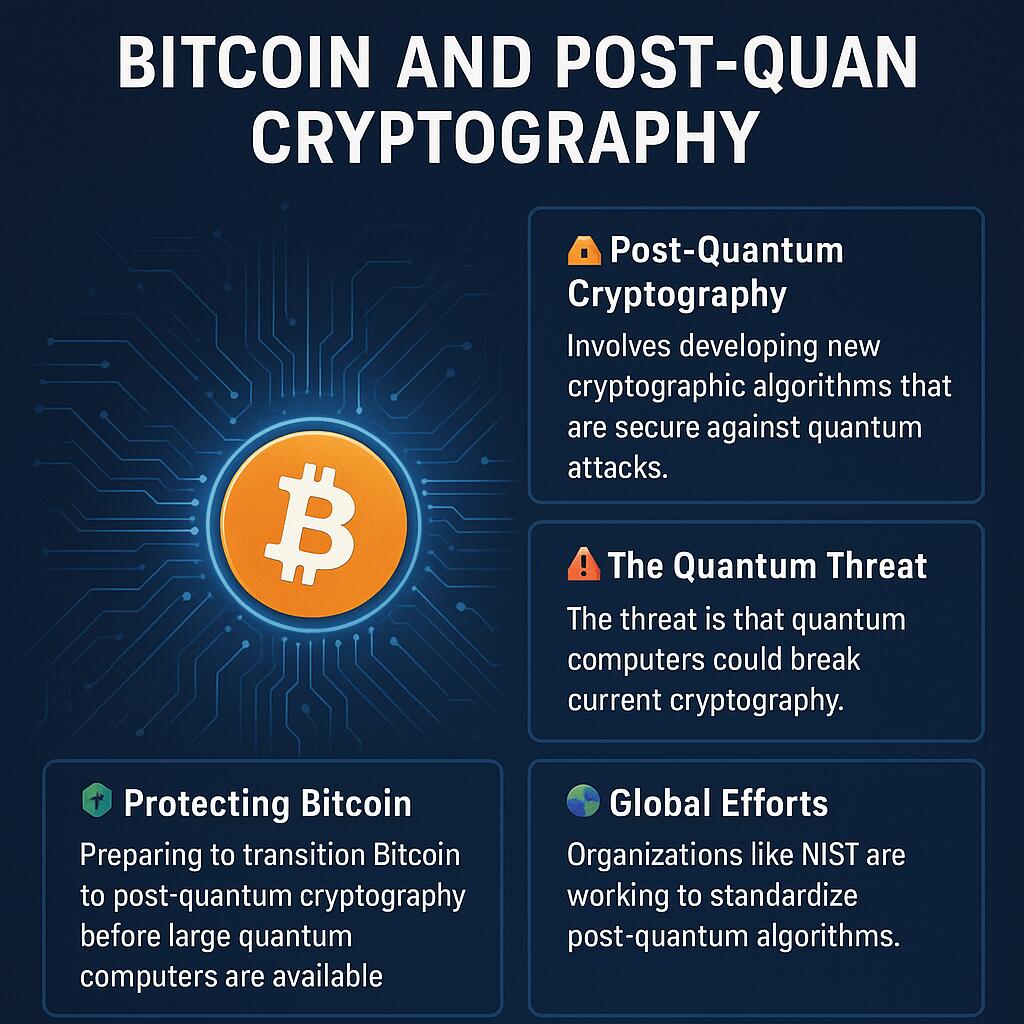
- 4. The Path Forward
- References & Further Reading
This article explores potential vulnerabilities in bitcoin that quantum computers might exploit in the future.
But to be clear: today’s quantum computers are still in early stages, many questions are unresolved, and they are not expected to pose a serious threat any time soon.
1. Why Quantum Computing Threatens Bitcoin
Bitcoin’s current cryptographic security relies on ECDSA (Elliptic Curve Digital Signature Algorithm). While this is secure against classical computers, a sufficiently powerful quantum computer could break it using Shor’s algorithm, which would allow attackers to derive private keys from exposed public keys. This poses a serious threat to user funds and the overall trust in the Bitcoin network.
Even though SHA-256, the hash function used for mining and address creation, is more quantum-resistant, it too would be weakened (though not broken) by quantum algorithms.
2. The Core Problem
Bitcoin’s vulnerability to quantum computing stems from how it handles public keys and signatures.
🔓 Public Key Exposure
Most Bitcoin addresses today (e.g., P2PKH or P2WPKH) are based on a hash of the public key, which keeps the actual public key hidden — until the user spends from that address.
Once a transaction is made, the public key is published on the blockchain, making it permanently visible and linked to the address.

🧠 Why This Matters
If a sufficiently powerful quantum computer becomes available in the future, it could apply Shor’s algorithm to derive the private key from a public key.
This creates a long-term risk:
- Any Bitcoin tied to an address with an exposed public key — even from years ago — could be stolen.
- The threat persists after a transaction, not just while it’s being confirmed.
- The longer those funds sit untouched, the more exposed they become to future quantum threats.
⚠️ Systemic Implication
This isn’t just a theoretical risk — it’s a potential threat to long-term trust in Bitcoin’s security model.
If quantum computers reach the necessary scale, they could:
- Undermine confidence in the finality of old transactions
- Force large-scale migrations of funds
- Trigger panic or loss of trust in the ecosystem
Bitcoin’s current design protects against today’s threats — but revealed public keys create a quantum attack surface that grows with time.
3. Why It’s Hard to Fix
Transitioning Bitcoin to post-quantum cryptography is a complex challenge:
- Consensus required: Changes to signature schemes or address formats require wide agreement across the Bitcoin ecosystem.
- Signature size: Post-quantum signature algorithms could be significantly larger, which affects blockchain size, fees, and performance.
- Wallet migration: Updating wallets and moving funds to new address types must be done securely and at massive scale.
- User experience: Any major cryptographic upgrade must remain simple enough for users to avoid security risks.
4. The Path Forward
The cryptographers worldwide are already working on solutions:
- Post-Quantum Cryptographic Algorithms are being standardized by NIST, including CRYSTALS-Dilithium, Kyber, FALCON, and SPHINCS+.
- Prototypes and experiments are ongoing research networks.
- Hybrid signature schemes are being explored to allow backward compatibility.
Governments and institutions like NIST, ENISA, and ISO are laying the foundation for cryptographic migration across industries — and Bitcoin will benefit from this ecosystem.
References & Further Reading
- https://komodoplatform.com/en/academy/p2pkh-pay-to-pubkey-hash
- https://csrc.nist.gov/projects/post-quantum-cryptography
- https://www.enisa.europa.eu/publications/post-quantum-cryptography-current-state-and-quantum-mitigation
- https://en.bitcoin.it/wiki/Quantum_computing_and_Bitcoin
- https://research.ibm.com/blog/ibm-quantum-condor-1121-qubits
- https://blog.google/technology/research/google-willow-quantum-chip/
- https://azure.microsoft.com/en-us/blog/quantum/2025/02/19/microsoft-unveils-majorana-1-the-worlds-first-quantum-processor-powered-by-topological-qubits/
- https://www.aboutamazon.com/news/aws/quantum-computing-aws-ocelot-chip


Write a comment