Travel Booking Giant to Buy Biometrics Firm for €1.2 Billion, Linking Face Scans Across Journeys
If you’re tired of censorship and dystopian threats against civil liberties, subscribe to Reclaim The Net. (https://reclaimthenet.org/go/rss-top-post-join)
The world’s largest travel booking system wants your biometric data to follow you from the moment you search a flight to the moment you check out of a hotel.
Amadeus, which already sits behind a huge share of airline reservations and hotel bookings, has announced plans to acquire Idemia Public Security for €1.2 billion.
The price tag, roughly $1.40 billion in cash, buys something more consequential than a French biometrics vendor. It buys the missing piece of an identity system that stretches across the entire journey, from booking engine to border gate.
The acquisition (https://www.reuters.com/business/amadeus-buy-french-biometrics-firm-idemia-12-billion-euros-2026-04-29/) is expected to close mid-2027, pending regulatory approval. By then, Amadeus will own the company that supplies governments with biometric identification systems alongside the booking infrastructure that processes hundreds of millions of travelers a year.
The combination is the point. Idemia handles passports, border control, and what the announcement calls “government grade biometric identification and data solutions.”
Amadeus knows where you’re flying, who you’re flying with, what hotel you booked, and which seat you picked. Stitch all that together and you have something a single airline or government agency could never assemble alone.
Luis Maroto, President and CEO of Amadeus, framed the logic in marketing terms, calling biometrics “one of the most transformative technologies for delivering fast, convenient, and secure end-to-end traveler journeys” and pointing to the company’s ambition to extend traveler ID throughout the journey. Translated out of the press release register, that means linking your face to every transaction the travel industry generates about you.
Booking history, payment data, loyalty profile, hotel preferences, and border crossings. Each of those data sets already exists. What’s new is the verified biometric identifier that ties them all to the same person, durably, across companies and across borders.
Amadeus is explicit about wanting “a secure identity layer exists across the entire journey” by integrating “biometric capabilities with airline, airport, border systems, and hotels.” This is a private company building the connective tissue that lets airlines, airports, hotels, and government border agencies all recognize you as the same biometric entity, in real time, with no friction.
The company calls that the future of travel. It is also, plainly, the architecture of cross-sector identity tracking on a scale that travelers have never agreed to.
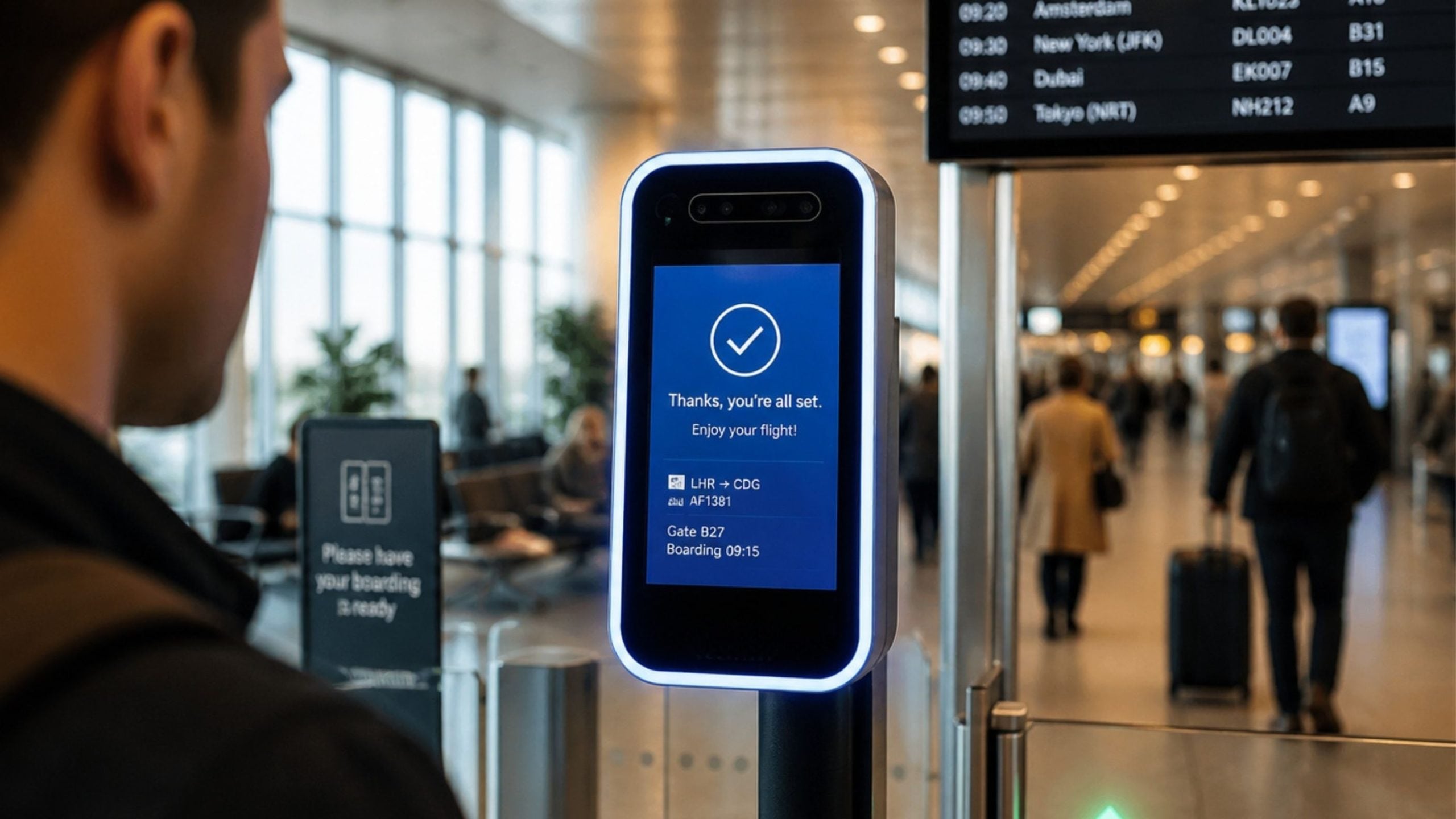
Amadeus already bought Vision-Box in 2024, a firm that builds biometric gates for airports and airlines. The Idemia deal compounds that capability.
Idemia employs around 3,300 people and serves more than 600 customers across the public and private sectors, which means the resulting entity will hold biometric relationships with both the companies that sell you travel and the governments that police your movement across borders.
Amadeus markets this as orchestration of the travel ecosystem. From a privacy standpoint, orchestration is also the right word for what happens to your data once a single vendor sits at the center of every checkpoint.
The case for biometrics, as Amadeus presents it, rests on speed. Faces process faster than passports. Maroto said biometrics “allows identity to be verified instantly, enabling faster processing, better security, and more efficient operations.”
What goes unmentioned is the trade. Faster processing requires that your biometric template exist in the system before you arrive, which means it has to be enrolled, stored, and made queryable across the network.
The convenience is downstream of the surveillance, not separate from it. A traveler who walks through a face-scan gate without breaking stride has, by definition, been pre-identified by a private database before boarding.
The deal also collapses a useful separation that has, until now, partly protected travelers. Booking systems hold one set of records. Border agencies hold another. Hotels hold a third. The friction between these systems, the fact that they don’t talk to each other smoothly, has been an accidental privacy feature.
A merger between the world’s largest travel reservations company and a vendor of government-grade biometric platforms removes that friction by design. Amadeus describes the result as “a more integrated passenger journey from booking, through airport processing, and boarding.” Integration, in data terms, means the previously separate dossiers become joinable.
What’s clear is the direction. The travel industry is consolidating around biometric identity as the default authentication system and the companies driving that consolidation are vertically integrating across booking, airport processing, border control, and hotels.
If you’re tired of censorship and dystopian threats against civil liberties, subscribe to Reclaim The Net. (https://reclaimthenet.org/go/rss-bottom-post-join)
The post Travel Booking Giant to Buy Biometrics Firm for €1.2 Billion, Linking Face Scans Across Journeys (https://reclaimthenet.org/amadeus-idemia-biometric-travel-identity-tracking) appeared first on Reclaim The Net (https://reclaimthenet.org).
Write a comment