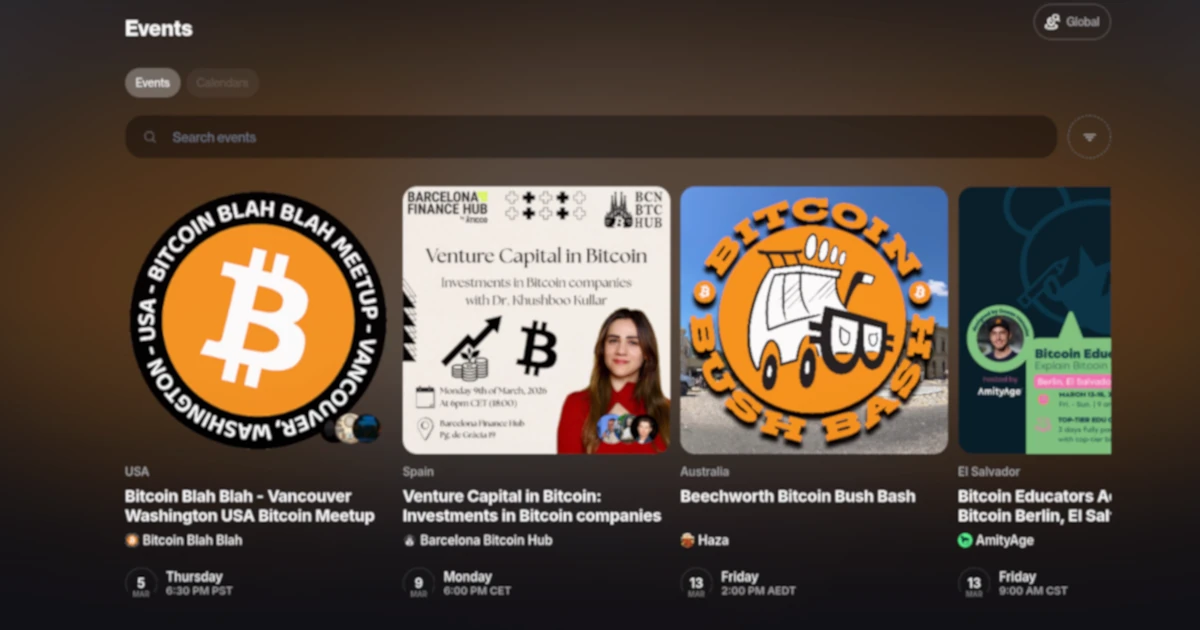
The Feed Isn’t the Future: Rethinking Nostr Through Tools, Places, and Real-World Use
Bitcoin Magazine The Feed Isn’t the Future: Rethinking Nostr Through Tools, Places, and Real-World Use While Nostr was founded in 2020/2021, it only really gained initial traction once Will Caserin launched Damus and Jack Dorsey tweeted about it. A few months later, the first Nostr world conference was held in Costa Rica (Nostrica), and things really started to move. Over the next 18 months, many — myself included — were convinced Nostr was going to take off. Unfortunately, fast-forward to late 2025, and growth seems to have stalled. The data suggests that activity on Nostr has not only flatlined but may have even declined, despite significant improvements in the quality of apps and clients built on the protocol. I say this is an observation of the data, not a criticism, because I want this protocol to succeed and I’m interested in what’s happened. So… Why Has Nostr Not Lived Up To Its Potential? I believe there are two main reasons: Competing for content is difficult: Content creators want to go where the audience is and content consumers want to go where the best creators are. This is a very hard cycle to break, especially when TikTok, Instagram and X are so good at what they do. I’ve seen firsthand how much of a chore it is for people to post on “yet another platform,” even if it’s just copy-pasting the same content. It’s too high friction for too little reward (hence the massive drop-off in retention we see on the Nostr stats). The censorship resistance boat has sailed. The short of it is that not enough people care. Those who do are on X, Substack and Rumble, not because those platforms are more censorship resistant, but because they have better marketing departments and can win the narrative war. Even Instagram has changed: It’s full of memes and truth bombs that would have got you perma-banned only 6 months ago. The truth is that people’s memories are short and most of them just don’t have the technical prowess to know why Nostr is superior in this department. The conditions for these factors could change. If, for whatever reason, the incumbent products degrade and their creator bases collapse, while Nostr apps simultaneously become 10 times better than the incumbents, then it might lead to a mass migration of creators. However, I find this highly improbable. The teams at X, Meta and ByteDance are too damn good, their products are too damn engaging, their top creators get way too many benefits, and their audiences are way too addicted for this to realistically happen. How about the censorship resistance angle? Sure, the landscape might shift again in the future. There could be another wave of widespread internet censorship, and those on Substack, Rumble and X might learn the hard way. But when might that occur? Two, five, ten years from now, when the political climate swings back? Where will Nostr businesses and therefore Nostr be then — especially if funding for the best products dries up due to stalled growth? There was a golden window of opportunity for this narrative, but in my opinion, it’s now closed. As such, I believe there must be a better, more sly, roundabout way to do this*. *At least for us as a business — because while Nostr is a protocol and can survive long enough for a good product to come along and revive it 10 years from now; we are a business and we operate on a different timeline. We must find product-market-fit in a much shorter timeframe, or we’re toast. The Cold Start Problem Andrew Chen is one of my favorite thinkers on network effects. He was previously the head of Rider Growth at Uber and authored “The Cold Start Problem” — one of the best books on the topic of network effects and marketplace products and platforms. I’ve read this book twice, and both times it reinforced how challenging this problem is to solve and how powerful the results can be when you do. In it, Chen discusses four main strategies for solving the cold start problem and achieving initial critical mass: Invite-only / Waitlists (e.g., Raya, LinkedIn and Facebook in the early days) Come for the tool, stay for the network (DropBox, Yelp, IG) Buying the hard side (Uber, Coca-Cola) Flintstoning / Simulating Users (DoorDash, Reddit) I believe Nostr, as a network, accidentally employed the invite-only strategy by capturing the Bitcoin community, creating a strong, concentrated early network (what Chen calls an atomic network). It was niche enough that it only attracted specific kinds of people (without needing an explicit invite-only approach) and there were enough of us there to make the connections and experience meaningful. My guess is that this is also why it remains active today. But, as I said, because the timing of the products, the culture and the protocol’s maturity were slightly misaligned, growth has stalled out and for now it’s stuck at the same level it was 12 months ago — a bit like the valence level for electrons around a nucleus. To extend the analogy, we now need to boost this “valence” to unlock a new quantum energy state, and I believe this requires a new approach over the top of the current content-focused approach (one must build atop the other). Come for the Tool, Stay for the Network We are in a new era of tech, which is driving a renaissance in consumer applications and tools. This is largely thanks to the AI revolution, but Nostr and Bitcoin can play a significant role if utilized correctly as tools in the stack. Chen, in his book, highlights a couple of key network applications that were initially tools and later became networks, including Instagram, DropBox and Yelp. The story of Instagram is particularly interesting to me because it was an inspiration for us at Satlantis. It displaced Hipstamatic, a $3.99/month photo filter app that allowed users to apply filters to, and save photos to their phones, which they could later post to Facebook. Instagram not only offered similar functionality for free but also enabled users to share these edited photos natively on their own Instagram profiles while also making it easy to post to other social media platforms (Twitter and Facebook at the time), from the app. It went viral as a tool (photos with cool filters shared off-platform) and remained sticky because people began building profiles and establishing networks on-platform. I believe the ingredients for the next Nostr unlock might lie in this strategy (at least for us and our product). We’ve been building Satlantis as a kind of travel-centric social network à la Nostr: based on TripAdvisor, crossed with meetup.com and with an Instagram feel. Since releasing the beta at BTCPrague in June, we’ve received valuable user feedback, analyzed usage patterns and deeply considered the true value of our product. I must admit, it hasn’t been an easy process, as it revealed several uncomfortable truths. First, we set out to build too much, too early. This not only created an immense workload for ourselves (developing multiple apps with distinct functionality across both web and desktop) but also made it incredibly difficult to articulate our product in simple terms. Second, I believe we made an error by prioritizing social features first, and in particular, content creation. I realized this late last year, but I was still somewhat captivated by the allure of building a social app — because, hey, Nostr is a social protocol, right? But here’s the truth, and the big breakthrough for us: People don’t really need another social app, regardless of whether it’s built on Nostr. Posting content is a chore, and having yet another place to do it adds more friction, not less. When you have to push all but the most dedicated users to engage (as opposed to them being pulled toward it), you know it’s not true product-market fit. However, it’s not all bad news! After all, Nostr is not just about “notes,” is it? We also discovered that there was real value in two very distinct tools amid the cacophony of features we’d built. Tools that are not only more narrow, clear and explicit, but that are also enhanced by their relationship to a social network. Let’s explore what these are and what I mean. Nostr Beyond the Feed Feeds are powerful, but they are also very hard. This is an area where we’ve struggled to differentiate ourselves. I didn’t want to build another Nostr clone with the same feed, filled with the same content from the same people you already follow. So… instead of replicating existing models, we experimented. We started with media-only posts first, but found that lacking so added back text, video and images. We then incorporated a very light-touch algorithm that weights content not only by who you follow but also by the interests you select during onboarding. This provides a blend of “for you” content alongside content from those you follow, offering both discoverability and connection. We also made our feed more multifaceted — a bit like Facebook. You can share more than just text, images and video on Satlantis, including places and merchants, events and beautiful collections in a carousel form (more on this below). We even decided to avoid zaps because they are not a differentiator among Nostr apps, and we wanted to create an experience that would also appeal to non-Bitcoiners, hoping to open the doors to a new market. The goal was to make zaps the icing on the cake, not the draw card itself. The result? Well, it’s still early days, and while some users appreciate the more dynamic nature of our feed and the ability to share diverse content, if I’m being honest, it hasn’t “popped.” Our feeds are neither compelling nor differentiated enough. The incumbents are simply too good at what they do: People are often happy to join and check out Satlantis, but they wind up back on IG, X and TikTok because that’s where all the action is. On the other hand, if we’re all being honest, Nostr already has a clear winner in the feed department with Primal, and two strong runners-up in Damus and Amethyst. So even though the Satlantis feed feels a bit different, it’s still just too close to every other Nostr-client feed — so why should anyone switch? Case in point: As such, the feed game, at least for us, is currently not worth playing. On one hand, it’s an uphill battle against incumbents, and on the other, there isn’t enough differentiation. Primal, Damus and Amethyst are all doing this well and I wish them all the success in their endeavours. I hope they can slowly chip away at the legacy social networks. So at Satlantis, the question remains: if we’re not going to do a feed, could we still use the social graph for something different and more unique? After a long time spent experimenting and iterating, it seems the answer is not only “yes” but that it was there all along, buried under all of the feed, social networking and content noise. Enter… the Social Discovery Experience Instead of just giving people more content, what if we used the social relationships among them to help surface information like “which of my friends went to or recommended Restaurant X” or “which of them bookmarked place Y” or “which of them are going to event Z?” Ackshually, since a picture says more than 1,000 words, instead of me explaining it, let me show you: As you can see, instead of another feed, this discovery approach blends the “social graph intelligence” (I can’t think of a better term here) into the actual tool, making it more useful. The result is an experience that is less like Instagram or X, and, interestingly enough, more like Spotify. The discover tab, which will become our default experience, will help you instantly see who from your connections is going to which event, recommended a place, created a collection, bookmarked a venue, etc. What’s cool about this is that we can still have a feed, but instead of a content feed, we can make an “activity feed.” Remember when Facebook was cool, and in the early days your wall had updates alongside content from your friends? Things like “Aleks just checked in at ‘x’ place” or made ‘y’ action.” This is in line with the move away from social media and back to social networks as I’ve written about previously. By moving the social element into the background we make the core features of the application (the map and events) the focus, but over time, more valuable and sticky as more people join. Another way to say it: The tools are useful standalone, but made even more useful because of the social information embedded into each of them. And that right there is the unlock: The social graph is the GLUE, not the primary material. More Than Just More Content One of our guiding principles is to get people off their phones and back into the real world. This new shift in product strategy helps us do that because, instead of focusing on more content and thus incentivizing people to spend more time on their devices, we can drive the functionality toward actual utility for curators, tastemakers and experience or event hosts. There are multiple pieces to this puzzle and it will expand, but in the beginning, we’re going to focus on two primary areas since they are the strongest features in our app: 1. Places and Collections A Place is anything that can be pinned on a map. In time, our map will support every kind of place — be it a café or restaurant, a hotel, a lookout, a hiking trail or a monument — but currently, it supports the following six categories: Cafes and restaurants Health and wellness Co-working and event spaces Attractions (natural or man-made, like museums) Local markets and specialty foods Nightlife You can already discover 20,000+ places in any of these categories, in over 300 cities around the world, each with rich profiles, review summaries, imagery and, most importantly, rich interest-tagging (if you’re a Bitcoiner for example, you can easily find places that accept bitcoin, or if you’re a seed oil disrespector, you can find places that are seed oil free, etc). You can also sort and filter by category, by vibe, by diet and cuisine and so much more. (FWIW, we actually have the largest and most accurate list of bitcoin-accepting and seed oil-free places worldwide). You can also add places to the map. This is part of why we have such a large number of listings. You click the little floating button (storefront with a + symbol) and just type the name of the place you want to add. We’re plugged into the Google API, so as long as it’s on there, it will come up and all you have to do is say why you like it. Our AI pipelines will then go scour the web and create a rich profile for it, complete with review summaries and images within 24 hours. Then… my favorite feature of all is Collections. Collections are high-powered bookmark folders that you can create, share and save. Think of them as curated lists — similar to playlists on Spotify or mood boards on Pinterest — that you can use privately (like an itinerary of places you want to see) or publicly as a tastemaker or curator (i.e., top 10 co-working cafés in Bali, top 10 hikes in Boulder, etc). Collections are designed to be social, so, like playlists on Spotify, they can be saved and shared, with the best ones trending on our discovery tabs. I could say so much more, but I already covered it in this article here, so check that out. Finally, and very soon, you will also be able to recommend places. This is a bit different to Google reviews because we’re not doing star ratings but thumbs up or down and tagging. This is very powerful on Satlantis because we can surface the social information (i.e., six of your friends recommended this place) to give you instant insights. We can also make the discovery experience feel more magical by surfacing the sorts of Places and Collections that are most recommended by people in your social network with whom you share tastes and preferences. This actually emulates real life and is, in my opinion, a game changer for how we will all experience maps and the world. See what I’ve circled in the images below. Events and Calendars Events is self-explanatory, so instead of explaining it in detail, I will just say that what we’re cooking is going to be as smooth and polished as Lu.ma with all of the powerful features that it has, but will also give you: Ticketing in both bitcoin and fiat (with Bitcoin being native, in-app, and extremely frictionless). This unlocks truly global ticketing in a way that’s never been done before. The ability to associate a place or a collection to an event (think: suggested places from the event organiser or even, 10% off these 10 places during our conference/retreat if you use a specific code) Event discovery via our social marketplace, which means that it’s not just “what’s happening near me” but “what’s happening near me that my friends and community care about.” This is where the magic of social discovery lies. Calendars are collections of events. Imagine you’re a large conference and you want to have official satellite events running. You can create a calendar with a unique URL (e.g., satlantis.io/wob-2025) and have everyone who wants to host a side event create it through there. In this way, all official side events are tied to the main event. This is powerful for many reasons — including quality control, ease of discovery, profile growth for the organizer and associated Nostr network growth (every new attendee becomes a Nostr user and follower). In the future, we will tie off the product experience with Clubs and Communities and complete the three pillars of Satlantis: People, Places and Events. But since there is enough to do with just Places and Events, and People is somewhat taken care of by the social element inherent in the app (you can follow people, engage, chat [soon] etc), we will worry about it later. In Closing Nostr has the potential to become the social layer of the internet and beat the incumbents at their own game, but that will take time. It will also require the “lead bullets” approach, meaning that no one approach will be enough. Some apps will take the social angle, like Primal, Damus, etc while others, like Satlantis, will take the utility-first approach. The beauty of Nostr is that each of these products has a common social layer and profile ID (nPub) so users can accrue benefits across the whole protocol. For Satlantis, this new approach is about creating an entirely new category of tool that quietly becomes indispensable, where the social graph enhances utility instead of demanding attention. We’re more on the “other stuff” side of the equation, even if we’re not yet in a position to propose full-on NIPs for Events and Places just yet (we will once we’ve fleshed out the features more). By shifting from feeds and content to discovery and context, we can create a product that enhances real life and real-world experiences, while purple-pilling everyone under the hood. That’s the sly, roundabout path forward: building tools people actually need, then letting the network emerge as a natural consequence of using these awesome tools. If you want to see it in action, you can download the app here. This post The Feed Isn’t the Future: Rethinking Nostr Through Tools, Places, and Real-World Use first appeared on Bitcoin Magazine and is written by Aleksandar Svetski.