How is your digital diet?

- Effects of Light and Sound
- Unseen in History: Combination of Light & Sound
- Thoughts Lead To Actions
- Delayed Awareness
- Enter the Digital Diet
- Health Conscious Alternative
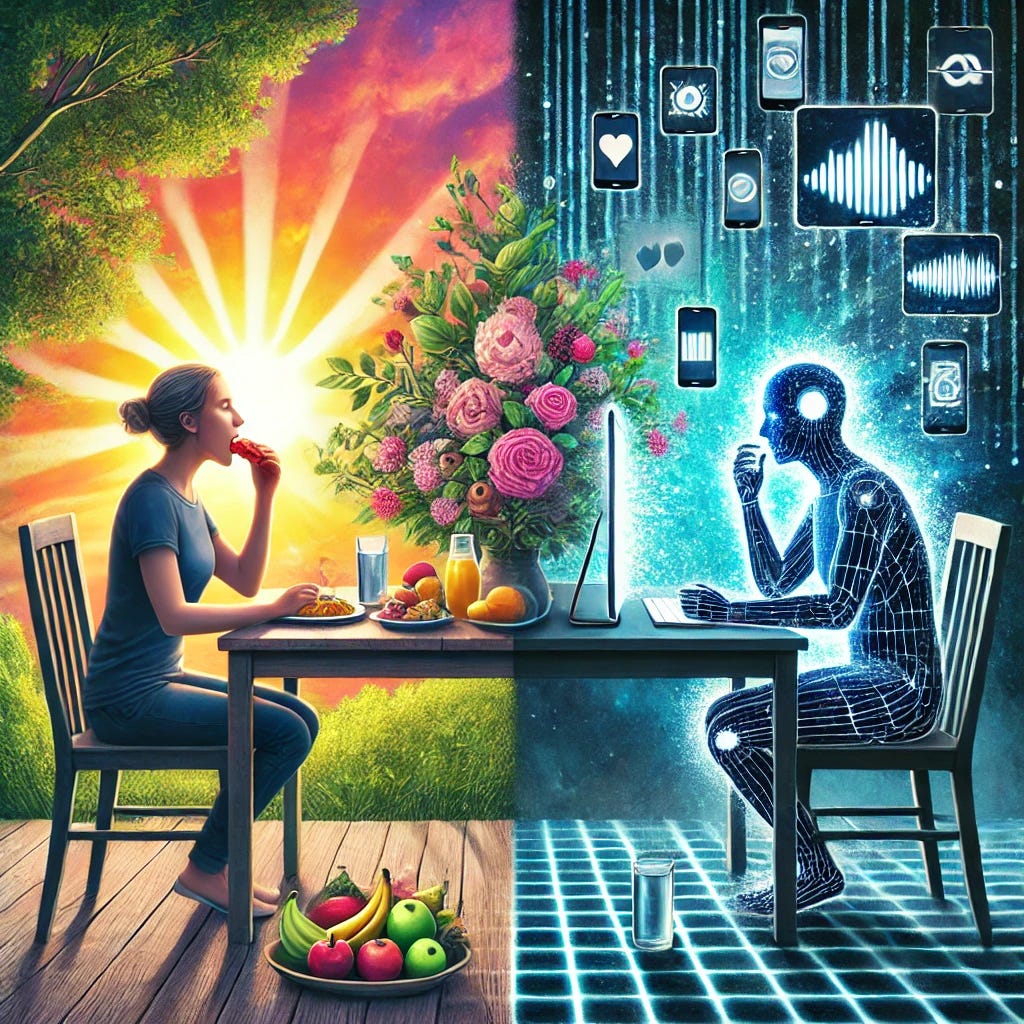
The term “diet” comes from the Greek word “δίαιτα” (diaita), meaning “way of life” or “mode of living”.
But today, when we think about diet, we mostly think about the foods and drinks we consume.
But what about the light & sounds we consume? Like food and drink, these enter our bodies and alter our state of being directly affecting our health.
Does light & sound affect our “way of life?”
Effects of Light and Sound
I believe the answer to this question is more understood than we realize. It is just so new and yet to be “quantified” like food & drink counterparts via mechanisms of calorie tracking, blood work, etc.
Through simple self-examination, the answer becomes clear.
Yes, light and sound affect us. But how so?
Food and drink are processed by the senses of taste and smell via chemical conversions ultimately digested in the gut and shared throughout the body and brain.
On the other hand, light & sound are processed by the senses of sight & hearing via conversion from wavelengths to electrical signals that are digested in the brain.
Light is well known to have major effects on our Circadian Rhythm. Morning light supports cortisol production, boosting energy and focus throughout the day. Evening darkness (lack of light) boosts melatonin production, preparing for a good night’s sleep. Anything else, like blue light at night, disrupts this natural process making it more difficult to sleep leading to all sorts of other downstream issues. See for yourself. Do you think it’ll be easier or harder to fall back asleep when blasted by a bright light in the middle of the night?
Sound is becoming more known to have effects on our brainwave states such as Delta (0.5–4 Hz;Deep sleep, healing), **Theta (**4–8 Hz;Meditation, intuition), **Alpha (**8–12 Hz; Relaxation, creativity), **Beta (**12–30 Hz; Alertness, problem-solving), and **Gamma (**30–100 Hz;High-level cognitive functioning, memory). Like food and drink, various sounds move us through these various states, affecting our levels of dopamine, serotonin, oxytocin, and other neurotransmitters. Hear for yourself. How does quiet calm music affect you versus loud aggressive music?
But what happens when you combine the two in a completely new, never-seen-before format?
Unseen in History: Combination of Light & Sound
Welcome to the digital age: the combination of light and sound, available 24/7 whether requested or not. It is hard to escape even if you are aware enough to try and avoid it.
It was not until 2000 that over 50% of U.S. households had a personal computer and cell phone. It was not until 2007 that the iPhone was released, rapidly increasing screen usage.
This is a brand new introduction to our diet.
How does this combination that has never been seen before in all of human history affect us?
Just as the nutrients we consume through food & drink become precursors to neurotransmitter release or hormone production ultimately affecting our health, emotions, and “way of life,” light and sound do the same.
But does the combination of light and sound affect us in other ways?
Thoughts Lead To Actions
The combination of light is often consumed in this digital age via “content.”
This content implants thoughts in our minds. Thoughts are precursors to our actions. Actions include the consumption of things (whether more food/drink or light/sound) leading to either vicious or virtuous cycles of more consumption.
But it is not just the content; it is the medium in which the content is distributed to be concerned about.
Social media platforms are free, so how do they make money? Advertisements. How do they sell more advertisements? More screen time.
In other words, their entire business is designed to get you hooked to the point where we must ask ourselves “Are we psychologically sovereign?”.
It uses a combination of light, sound, and addictive loops to keep you coming back to sell you not what you want or need but what the advertisers pay for.
Light.
The blue light of the smartphones spikes your cortisol and suppresses your melatonin production, both keeping you more alert and awake so that you can focus on the screen. Have you ever seen a baby be introduced to a screen for the first time? You’d think they just tried to crack.
Sound.
Then, you add sound: “trending audio” via music. Music is a beautiful thing. It is so beautiful it can get you into a trance-like state. I love it as much as the next person. But I am aware of the hypnotic nature of it. It can influence and synchronize with your brainwave states, driving thought, retention, emotion, and later action.
Reward.
This light & sound combined with intentionally designed reward loops including triggers (push notifications, red dots, etc.) and variable/novel rewards (likes, comments, and never-ending scrolling) is a recipe for dopamine production. Dopamine (the “feel good” molecule) is the driver of addiction. So boom. You’re hooked.
All this leads to you in an alert, awake, dopamine-driven hypnotic state in which you are consuming content, and the moment in which you stop, you feel depleted like a sugar crash which leaves a void that makes you want to go back for more.
It is not to say that all the content is bad, but when it is, you are susceptible to it.
And that susceptibility seeps into your mind, affecting your mood and leading to emotions and actions that you most likely would not pursue in a natural world.
Delayed Awareness
But it comes as no surprise that no one talks about it.
As a society, we tend to have a delayed awareness of how things affect us. Maybe we should question whether we consider our intuition more than trends.
Think about cigarettes. They became popularized in the 1920s. It was not until 30+ years later in 1964 when the U.S. Surgeon General released a “groundbreaking” report confirming that smoking causes lung cancer and heart disease.
In the 1950s, Red Dye No. 3 became popularized. It wasn’t till 30 years later in 1990 that the FDA banned the use of it in cosmetics and topical medications but allowed its continued use in foods and ingested drugs. That took another 35 years after that, just this past January 15, 2025, that the FDA officially announced the revocation of authorization for Red Dye No. 3 in food and ingested medications.
Likewise, in the 1970s, we started rapidly injecting mercury into the arms of babies. Today this is still considered controversial to question.
Around the same time, in the 1970s came the popularization of ultra-processed foods, fast food chains, and the use of hexane-derived, highly chemically processed “seed oils” to make them. 50 years later, and now we need to have an app like Seed Oil Scout just to find reasonable restaurants to eat from.
Enter the Digital Diet
It has already been 25+ years since the brand-new digital world was adopted in our diets, yet very little conversation is had around it.
I hope for this to be the start of that conversation.
I don’t have all the data or the answers, but I do know that, like cigarettes, artificial dyes, vaccines, and seed oils, the digital world is not a natural one.
And as creatures of nature, whether created by a big bang, evolution, God, or a combo of all three (depending on your religion), it is my personal common sensical belief, alongside lots of supporting anecdotal and experimental evidence that suggests the most optimal way for a human, and any biological creature, to live is one fully aligned with the environment they were designed for which is the natural world.
Health Conscious Alternative
While my suggestion would always be to throw your digital devices in the trash and spend the rest of your days immersed in nature, I understand that this world has rapidly become reliant upon them.
So until you can go cold turkey and raise turkeys, bees, and fruit trees on self-sovereign land with a community where you can entirely disconnect from the digital world (I am working towards this), my recommendation would be to ween off the digital cocaine and find better for you alternatives as we did with our food/drink diets.
For light, instead of doom scrolling at night, limit it to the time of day in which it is light.
For sound, instead of listening to dark, demonic tracks that make you want to crumble up into a ball of tears or anger and waste your life away, listen to positive playlists that make you feel good inside.
For the deadly duo of both light & sound, instead of doom scrolling to brain rot on Instagram or TikTok, find better for you platforms like Upspace (Healthy Instagram/Spotify) or Primal (more conscious Twitter) with more consciously-designed infrastructures, healthier cultures, and therefore more healthy content for your digital diet.
But the first step before that is awareness. I hope this helps with that.
With Truth & Love 🥛🍯,
Shaughnessy
Write a comment