Why Don’t People Adopt an Honest Monetary System?

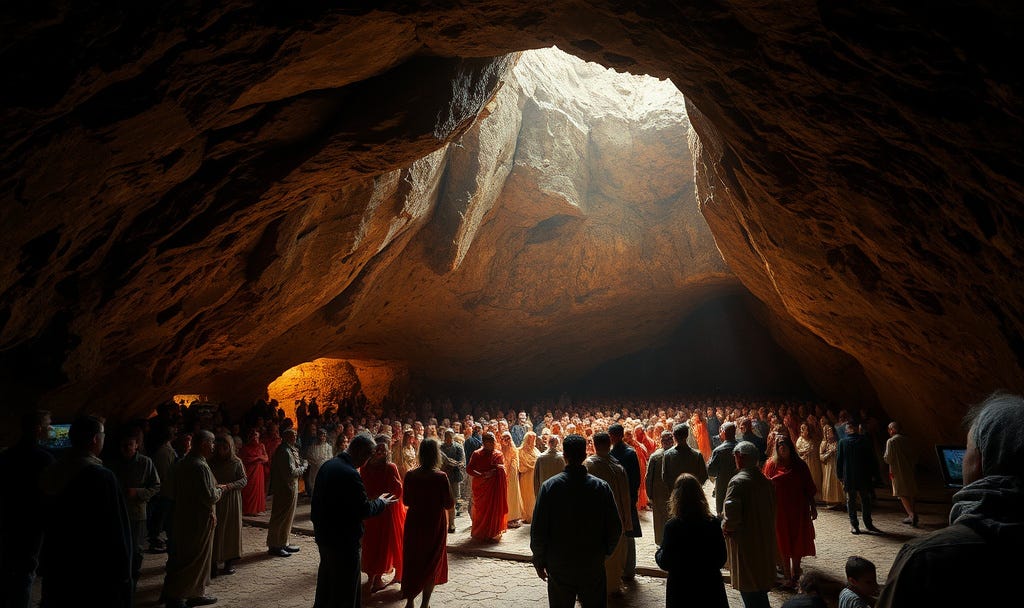
People inside Plato’s cave
The real question behind this topic is not technical. It is psychological and social. If people understood that the current monetary system allows privileged groups to create money out of nothing, and if an alternative already exists that prevents this abuse by design, adoption should be obvious. Yet most people continue using the dishonest system without questioning it. Understanding why requires looking beyond charts, price or technology.
The honest system already exists. For 16 years, Bitcoin has operated with a fixed supply that no one can change. There are no committees, no emergency meetings and no special permissions to create more units. Every participant plays by the same rules. This is not a promise. It is enforced by the system itself. In contrast, the current system depends entirely on trust in institutions that repeatedly expand the money supply whenever it suits them.
So why don’t people switch? First, because the effects of monetary fraud are delayed and indirect. When new money is created, nothing breaks immediately. Life goes on. Prices rise slowly. Quality declines quietly. Savings lose value over years, not days. Humans are bad at reacting to slow damage, especially when it is normalized and blamed on vague causes like greed, corporations or global events.
Second, because adopting an honest system requires personal responsibility. In a system where money cannot be created at will, there is no external authority to absorb mistakes. Choices matter more. Time preference changes. Planning becomes necessary. Many people unconsciously prefer a system that hides consequences, even if it harms them in the long run, because it feels easier in the short term.
Third, because the current system is deeply embedded in daily life. Salaries, taxes, accounting, loans and pensions are all built around it. Leaving it feels risky, even when staying guarantees slow loss. Most people wait for permission, endorsement or safety signals from institutions that benefit from the status quo and therefore will never provide them.
The cost of ignoring this is enormous. A dishonest monetary system forces everyone into constant motion just to stand still. It rewards debt over savings, speculation over productivity and short-term thinking over long-term cooperation. An honest system does the opposite. It allows technological progress to translate into real improvements in living standards. It encourages saving, planning and lower stress over time.
The honest system does not need belief. It only needs understanding. Bitcoin does not ask people to trust it. It simply removes the ability for anyone to cheat by creating more units. Once that clicks, the real question changes from “Why adopt it?” to “Why continue participating in something that is structurally designed to extract value from you?”.
One small action: take 15 minutes to understand how money is created today, then compare that process with a system where creation is impossible by design.
If this helped understand the real issue, subscribe to Bitcoin Awareness and share this with one person who still believes rising prices are just a fact of life.
Read next:
Write a comment