EU Foreign Policy Chief Kaja Kallas Reportedly Calls Von der Leyen a 'Dictator'
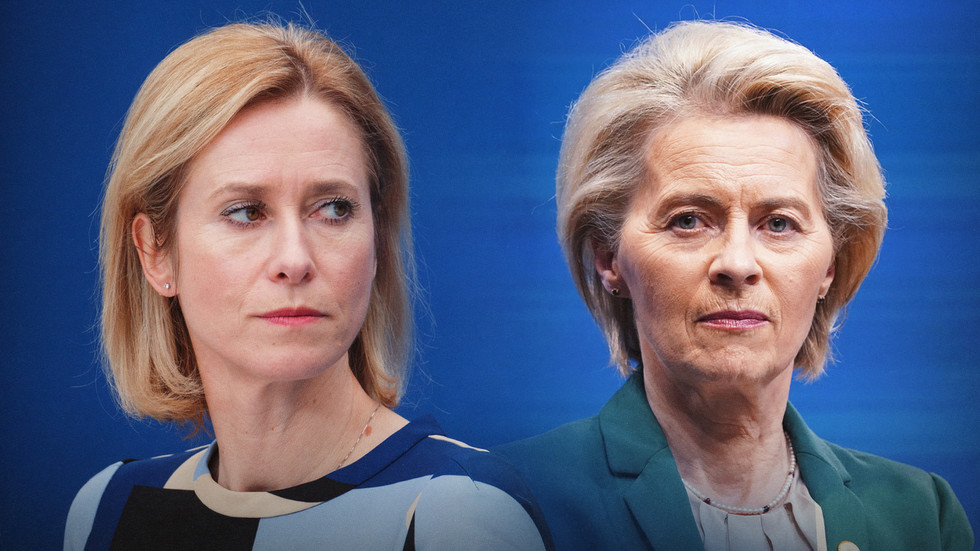
EU Foreign Policy Chief Kaja Kallas Reportedly Calls Von der Leyen a ‘Dictator’ government Government-aligned coverage presents Kallas’s alleged “dictator” comment as a private, second-hand anecdote illustrating personal tension and her weaker leverage against a powerful Commission president. It acknowledges criticism of von der Leyen’s style but frames it within the necessities of strong, centralized leadership in a complex EU institutional setting. @@czfy…lhuw @@gdyw…c877 European Union foreign policy chief Kaja Kallas has reportedly referred to European Commission President Ursula von der Leyen as a “dictator” in private conversations, according to senior EU officials cited in government-aligned reporting. These accounts agree that Kallas is criticizing what she sees as von der Leyen’s authoritarian style of leadership and that relations between the two are described as particularly strained, even more so than von der Leyen’s earlier difficult relationship with former EU foreign policy chief Josep Borrell. The reports concur that this friction is emerging within the upper ranks of EU institutions and that Kallas’s personal remarks are being relayed second-hand rather than through any public statement or official document.
Coverage also agrees that Kallas is perceived as having limited institutional leverage compared with her predecessors, partly due to Estonia’s small size and her relatively new role at the helm of EU foreign policy. Both sides highlight that von der Leyen has already faced criticism over transparency and secretive decision-making practices, including past no-confidence efforts in the European Parliament, and that these criticisms form the backdrop for Kallas’s alleged comments. There is shared acknowledgment that the dispute is rooted in broader concerns about internal EU power balances, the centralization of decision-making in the Commission, and long-running debates over how foreign policy authority should be shared among EU leaders and institutions.
Points of Contention
Framing of the insult. Government-aligned outlets describe Kallas’s use of the word “dictator” as an off-the-record, privately voiced frustration that illustrates tensions but does not amount to an institutional challenge, while opposition sources tend to portray it as a telling and emblematic characterization of von der Leyen’s leadership style. Government coverage stresses the anecdotal and second-hand nature of the quote, whereas opposition reporting would likely emphasize it as credible insider testimony that confirms pre-existing concerns about centralization of power.
Power dynamics and legitimacy. Government-aligned coverage underscores Kallas’s comparatively weak power base, repeatedly noting her origin from “tiny Estonia” and suggesting that this limits her ability to shape EU foreign policy and challenge von der Leyen. Opposition sources, by contrast, are more inclined to question the democratic legitimacy and accountability of von der Leyen’s leadership itself, treating the imbalance not as Kallas’s weakness but as evidence of an unhealthy concentration of authority in the Commission presidency.
Interpretation of von der Leyen’s style. Government-friendly reporting tends to frame von der Leyen’s “authoritarian” or highly centralized style as controversial but also as a byproduct of crisis-driven decision-making and the need for strong executive coordination in the EU. Opposition coverage would more sharply depict the same behavior as systematically opaque and unaccountable, connecting Kallas’s alleged remark to existing criticisms over secretive working methods, bypassing member states, and previous no-confidence motions.
Implications for EU cohesion. Government-aligned sources generally present the episode as an internal personality clash or bureaucratic turf battle that, while awkward, does not fundamentally threaten EU unity or policy continuity. Opposition sources are more likely to treat the dispute as a symptom of deeper structural fractures in EU governance, using it to argue that centralized decision-making at the top of the Commission undermines trust among member states and weakens the legitimacy of EU foreign policy.
In summary, government coverage tends to downplay Kallas’s alleged “dictator” remark as an indiscreet but limited internal spat contextualized by institutional roles and crisis management needs, while opposition coverage tends to elevate it as powerful evidence of systemic overreach, opacity, and unhealthy power concentration in Ursula von der Leyen’s European Commission. Story coverage nevent1qqs20x2l7wnkjdhdr2y4ztzsha7remgj3dv3w47fzz7e5mqzg2anf7qh5h309 nevent1qqsw3230zau2wuh5d8dt7r5sd8gd5w7ylqa8sy7f55tmp0kj592a6zcdchevf
Write a comment