No Resolutions
[](https://substackcdn.com/image/fetch/\)s_!zcEJ!,f_auto,q_auto:good,fl_progressive:steep/https%3A%2F%2Fsubstack-post-media.s3.amazonaws.com%2Fpublic%2Fimages%2Ff90fd711-30ea-4e84-8c22-785b7e994b77_1487x1077.jpeg)
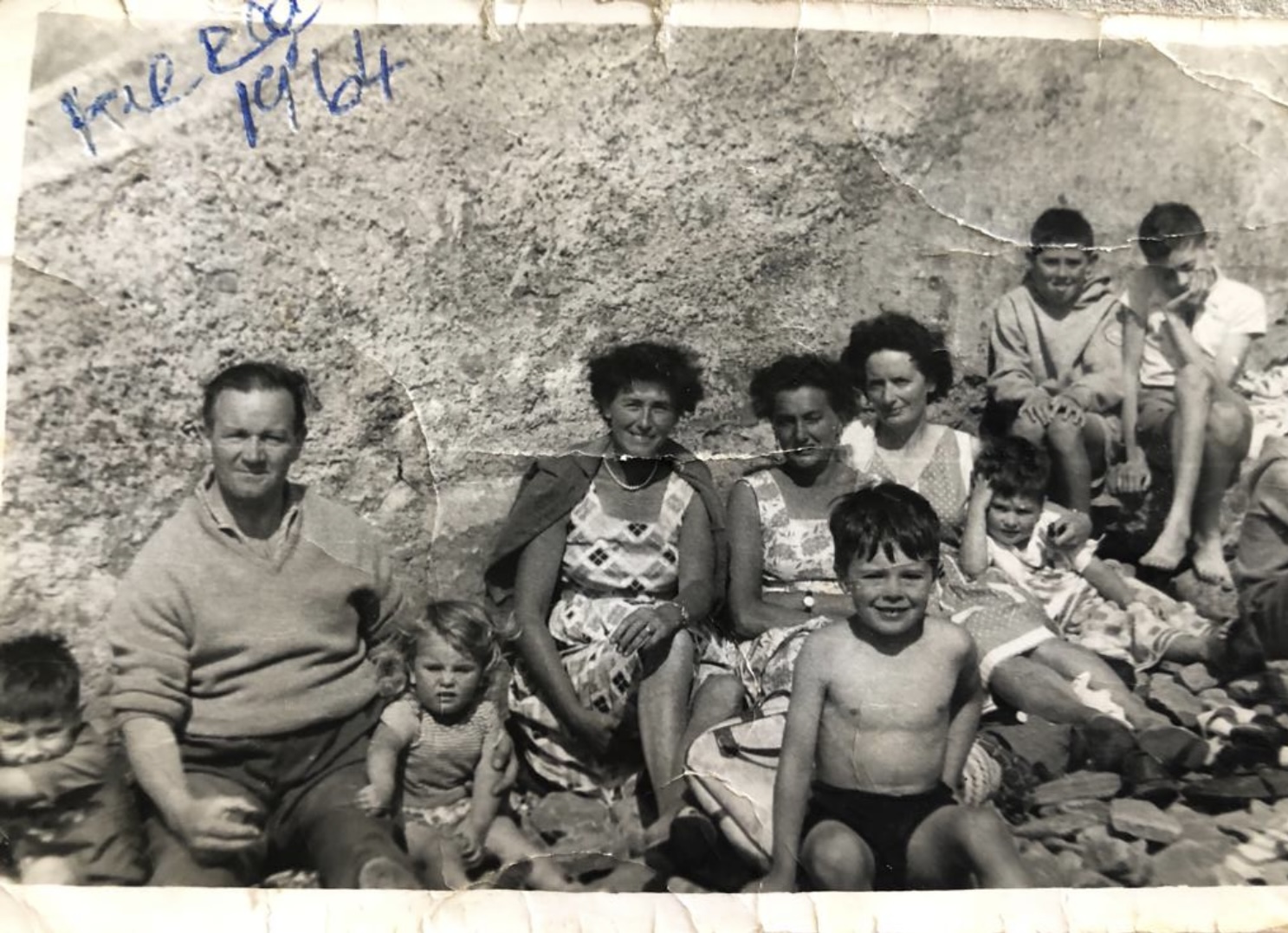
My grandfather, left, grandmother fourth adult from left, uncles, aunt and father, who is unsurprisingly the boy at the back, making dumb faces. Probably pictured in Kilkee, Ireland, in 1964
It’s all well and good to witter on about the freshness and potentiality of a new year, but before you do this, you have to dig the last one’s claws from your back. My long-promised response to some modern stoics’ reception to my long stoicism article from last month is coming — yes, really (sorry)— next week. I was in the midst of considering it all, along with some surprisingly interpersonally petty feedback along with the constructive, valuable kind when my father died last month. I have expected him to die ‘soon’ since I was around ten and secretly wondered if he might be the first deadbeat dad to baffle science and everyone else by exhibiting immortality. I wouldn’t have put it past him.
Within a few days, the Bondi shooting happened here in Australia, and I went to Bondi that week and talked with Jewish people there. I wanted to write an article for The Irish Times sharing their views and experiences. My country is so busy loudly denying its blatant antisemitism problem that I think a lot of well-intended Irish people don’t even realise that many Jews truly believe Irish people hate them. Not as Israelis, for many aren’t. Not as Zionists (though Israel is populated by more than ten million people, well over twenty per cent of whom are not Jewish, so what the ethical plan of anti-zionists would be for all those people in their particular post-Israel utopia, I do wonder). No. Politics of the Middle East aside, they believe that we — by which I mean Irish people — simply hate them as Jews. That reality should be engaged with seriously.
Time and again through that week, I met with overt suspicion and hostility from Jewish people. They heard my accent and presumed my intent was nefarious; that I would not be sympathetic to their loss and the violation they had experienced when two gunmen came into their community, which is home to the world’s most famous beach but also a thriving Jewish community, killing fifteen people and injuring forty. They presumed — understandably, at a time when members of their community had been murdered merely for being Jewish at a Hanukkah gathering — that I am not an individual but a representative of a collective. Or rather two unsympathetic collectives — ‘the Irish’ and the media establishment.
I’m not a journalist really. It always feels a bit fraudulent or like stolen valour (or stolen infamy, depending on who’s judging) to use that nomenclature. I’m not Bob Woodward. I don’t break major news or courageously share the facts from war zones. I wasn’t reporting from Venezuela as they whooshed Maduro out in the dead of night, and I’m not even the sort of journalist who reports on the fact that the Nike Tech tracksuit he was later photographed in has massively spiked in searches online.
I’m the sort of writer who writes about how interesting that latter is, and how it possibly signals (along with a bunch of other depressing absurdities) the post-meaning death spiral of culture. I’m the sort of writer who will publish a column on what it says about our collective psychology that any proportion of us will look at an unflattering photo of a freshly kidnapped Venezuelan dictator in his fog-grey tracksuit and our first thought is ‘I wonder if that hoodie is on sale?’.
It does not feel from where I’m standing that what I write has much impact, or leverages much power. Yet I suppose that’s what many people who work in media might tell themselves, whether or not they have the security of a staff job. I write that with acute awareness that the phrase ‘security of a staff job’ has been an oxymoron for at least a decade and probably more. There is no job security in journalism for anyone. Merely varying levels of precarity. The idea that this does not influence how people in media speak, think and engage in their work is unrealistic. Collectively, we contribute greatly to constructing the information environments that everyone else has no choice but to live in along with us.
That week in Bondi, I relegated the death of my father — a man whose historic absence in my life was vastly preferable to the boundless mayhem of his presence — to some unexamined place in my brain until I had the space to consider it. It lurked wordlessly in my body, pitching me off kilter as I tried to talk with suffering people. He had just died and his death changed not one single aspect of my life. Ruminating on the inexorable tragedy of this —its utter unnaturalness— would make me furious.
The waste of his life. The harm he caused. The legacy of damage that the adult children of irresponsible and incapable parents are left to carry and sort through. So I didn’t think about it. Yet a stranger had died, and also one of the worst people I’ve ever known, and also one of the funniest, and also my father. Someone upon whom it was not reasonable to make any emotional or other demands because he was incapable of meeting them. Someone whose inability to meet them simply left my brother and I to figure all of it out for ourselves. Now, after all the years of expecting it to happen given the reckless extremity of how he lived, he was really dead.
So too were fifteen innocent people, all of whom were murdered. None of whose choices in life could ever explain or contextualise how they died. The violence and tragedy of their loss reverberated through a small community, and out into the rest of Australia, shaking it hard. As hard as it needed to be shaken. Unseating its self-image. Forcing questions that it had been refusing to ask. Wounding its high-trust society. Its complacency in its self-image.
[](https://substackcdn.com/image/fetch/\)s_!-XtY!,f_auto,q_auto:good,fl_progressive:steep/https%3A%2F%2Fsubstack-post-media.s3.amazonaws.com%2Fpublic%2Fimages%2F192c65f7-6174-47f2-9bff-b70237aa4da5_4032x3024.jpeg)
Bondi Pavilion, December 19th, 2025
I hung around the Bondi memorial as any journalist would, bothering people and asking for trust I hadn’t earned and had no right to. Asking them to tell me how that horrendous week had been for them, and what they wanted people outside of Australia to know about what had happened. The sun was painfully intense. I watched a Rabbi called Yossi Friedman address the crowd every hour to share the names and stories of the victims. Afterwards, he stood in the battering heat to talk to anyone who approached him. There was a tension in the atmosphere that week that I hope I never again experience. I felt ashamed of this aversion. The people I spoke with have to live in some version of it all the time. It shapes their everyday life.
I thought that what happened at Bondi was clearly and unmitigatedly horrendous. I wanted to write an article for The Irish Times that would simply present the varied, first-person views of Jewish people living there for the reader to consider. It was an attempt, I suppose, to simplify inexorably complex things. To present the bald human suffering of a community after a massacre as deserving of compassion without qualification or mitigation. Just as a thing that is. If one’s instinct is to deliver an ideological purity or compliance test on a conflict in the middle east before extending compassion to people murdered in Australia, I consider that a sign of epistemic confusion and moral decline.
I wanted Irish people to hear from Australian Jews directly, and to know how some of them feel about Ireland, in case it would matter to them. That a fifty-year-old Australian woman living in a beachside town can hear an accent like mine and, along with others of differing ages, political orientations and life experiences, draw the conclusion that I probably hate her. Irish people traditionally nurture a self-image of being inclusive and of sensitivity to injustice. Of having a well calibrated moral conscience. So I hoped they would be receptive to reading that people so far away, and so far from any conflict that many Irish people may hold strong views on, hold this belief about them. I hoped some people would read this, and consider it, rather than reactively dismissing it, or deciding that these people, whose friends and family have been victimised in a mass shooting, are just being silly, or hypersensitive, or failing to read the room. They are not.
This is not an invitation to discuss global conflicts with me. It’s not about global conflicts. There are many ongoing, all characterised by loss, injustice, brutality. We live in a world where minorities in China are detained and subject to forced organ harvesting. Children in Ukraine have been forcibly taken from their families in the thousands and transferred to Russian-controlled territory. In Sudan, rape is a systematic weapon of war and women are suffering disproportionate horror, violence and death. The death toll in any of these conflicts — including tragic losses in Palestine and in Israel — is far lower than the astronomical number of deaths in Yemen, at around 377,000 up to 2021, with no reliable updated figures as to the death toll in the ongoing conflict since that time. Nobody seems much bothered by this, or at least interested in discussing it, or in taking refugees or assisting the women and children who attempt to leave Yemen and instead fall prey to sex traffickers, disappearing from sight altogether.
All these conflicts, and attendant injustices, are worthy of notice, of care, of impassioned engagement. There are no virtuous person points for picking one and deciding it matters above all others. There is personal meaning in picking one and actively trying to constructively help. To shut up and help. These things are not the same, though. They can just look the same on social media if we adopt sufficient angry self-righteousness.
Meanwhile, we Google Maduro’s tracksuit, which some may choose to interpret as a poignant symbol of his disempowerment, but anyone under forty will likely just associate with the casually monied athleisure of people like basketball player Kevin Durant, or British rapper Central Cee, and wonder if the pockets have zips. That’s a real selling point, if so. Plus a good Halloween costume for next year, provided Luigi Mangione doesn’t turn up to his next court appearance wearing Crocs and a Loewe tank top, in which case Maduro’s tracksuit will be old news.
I live between Australia and Ireland, my feet in one and my guts in the other, and this one insignificant article felt like a very small thing I might try to do in a moment when people may be receptive to it and I happened to find myself in the aftermath of a terrible tragedy. The article I wrote fell short. It was probably bound to. There is no addressing something so vast and so fraught and so full of pain and tension in a few hundred words. I wanted it to share the different perspectives people trusted me with that week, and hoped that it would resonate with some readers on the most basic human level. Unsurprisingly, different people I spoke with that week wanted different things. Some wanted me to make a political argument, some to dispel myths and fact check news stories. Some wanted me to clarify the nuances of history by their interpretation. Some wanted me to show Irish readers that Jewish people are just people. Varied, flawed, loving to their families, fond of a good carbohydrate, and upset when they aren’t heard.
As I wrote it, part of me anticipated the inevitable negative or aggressive reception, some of which I did of course get. Part of me was locked in a hospital room with a man I haven’t in reality seen in more than a decade, watching the failure of organs he abused through a lifetime of brutal, ravenous addiction reflected numerically and dispassionately on monitors by his bedside. A bedside I didn’t visit, and never saw. There wasn’t time, but even if there had been, I had no business there.
He was in a similar position once before, when I was around twenty. Liver failure. I went to see him, dirty and cadaverous, yellow and prone. His fingernails were long and dirty — I found this distractingly disgusting for some reason. Perhaps it was merely something my brain could focus on. He weighed less than I did, pits of filth gathered in the hollow divets behind his collar bones, and he spoke just once, to angrily tell me to buy him a bottle of vodka. I left the room in horror, and vomited. Impossibly, he rallied, and lived almost two decades more with no greater circumspection than he had applied to the first five. I had no place at his death bed. I feel great sadness at the loss of his life, and the awful suffering he experienced.
I did not know him, and I did. He was a stranger, and he was myself. His legacy to me has always been chaos. Dissonance. The life he led has given me puzzles — things that do not — cannot possibly — fit together, and that somehow must so that I can move forward. This infuriating task has often felt burdensome, beyond my capacity, and unjust. It’s also a strength. A skill. A joy. It led me to Plato, to Spinoza, to novels and poetry and art and to writing. My father’s puzzles tasked me with creating order from chaos, and led me here. I have my father to thank for this, and I’m grateful to him for giving me that.
Since last month, the faces of the people I met at Bondi have stayed with me. Their terrible pain, their anger, their suspicion that I would inevitably commodify or betray them. They must have suppressed these suspicions to share their thoughts and feelings about the day that two men came into their community, set themselves up on a footbridge to the beach that offered convenient high ground from which to maximise casualties, and fired indiscriminately into a crowd at a Hannukah event, aiming at any adult or child who seemed Jewish, or looked like they might be, or was standing too close to someone who was.
Since then too, my father’s face has stayed with me. I can’t avoid it, since it’s here in my own. In my head are the two seawater green eyes that would look past everyone who cared about him as he yearned, knee jogging, always, always, to be gone. And the nose that is a little too prominent for my face but fit his better when he was young and handsome, vital, with too much dark hair of which he was vain, and when he still had the potential to become another sort of man.
Before he unmade his body with abuse and neglect. Before the lungs he never valued ceased to function for him, starving him of oxygen, and of muscle mass, and ending his life. It is a life that leaves little trace apart from my brother and myself, and my brother’s two little children, whom their grandfather never met, despite living in the same city as them. My brother protected them from him, as he himself was not protected. In that way, things break and are remade.
2025 ended heavily for me, and I begin this new year with a heightened awareness of the suffering and absurdity in the world. We are tasked with finding sense where there doesn’t seem to be any. I’m hopeful too, that we can practice more discernment when nobody else will do it for us and we all have the technological capacity to simply blindly affirm whatever we already believed. I’m hopeful that we can feel compassion with more nuance and less moral certainty. That given the lack of clarity in an age without universal meaning, we can continue here at least to permit dissonance. To see realities that cannot possibly co-exist and accept that they clearly do. To find ways to accommodate this complexity rather than be driven mad by it, or to demand our favoured narrative be mirrored back at us.
I’ve never had moral certainty for you, and after 2025, I have even less. But you can get that everywhere else. Here, we live in the in-between.
Happy New Year.
Thanks for reading Peak Notions with Laura Kennedy! This post is public so feel free to share it.
[](https://substackcdn.com/image/fetch/\)s_!_mvj!,f_auto,q_auto:good,fl_progressive:steep/https%3A%2F%2Fsubstack-post-media.s3.amazonaws.com%2Fpublic%2Fimages%2F394ce8e5-2435-450e-bd56-0096e314a872_874x1714.jpeg)
I lost a bet and am consequently honour bound to share this photo with our friend Aaron here. Aaron is a preposterous British person who wears loud shirts, and whose visit made a weird Christmas so far from home a lovely one. (Himself’s anonymity contextualised here for those who care, or are just nosy.)
Write a comment