President Vučić Visits Child with Rare Disease in Bajina Bašta
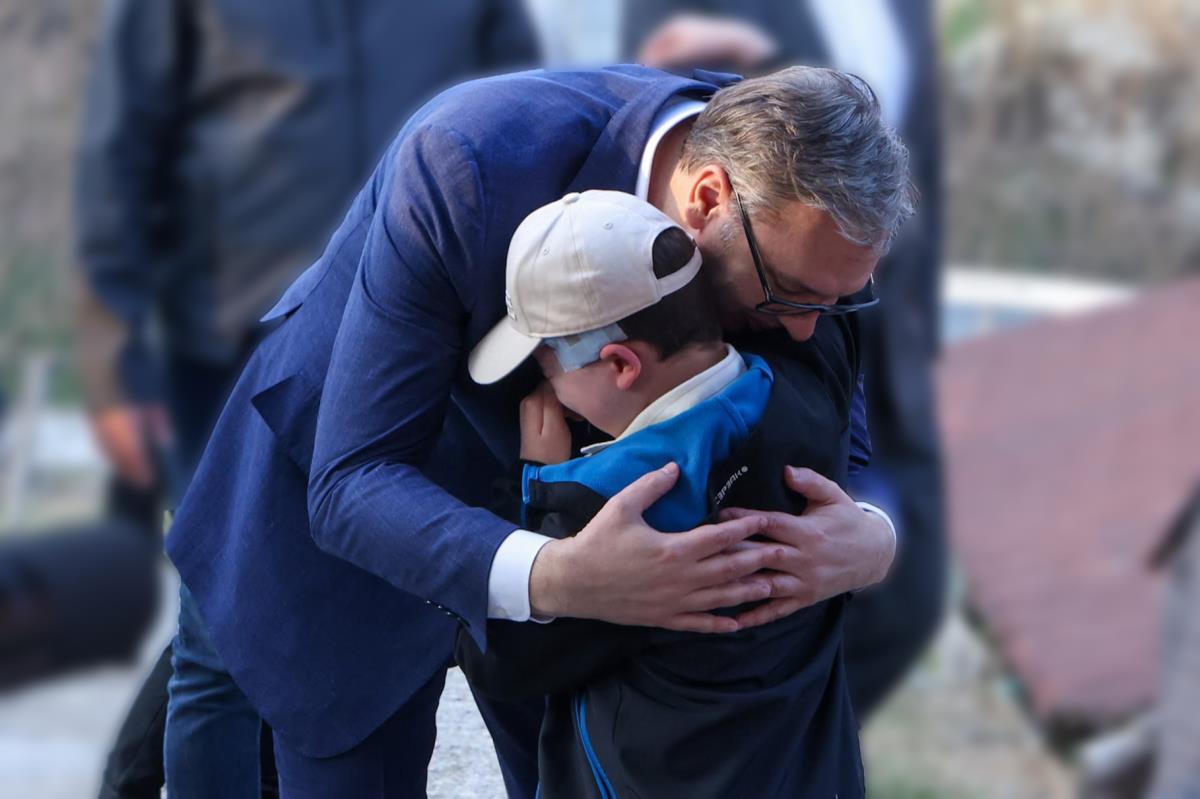
President Vučić Visits Child with Rare Disease in Bajina Bašta pro-government Pro-government coverage presents Vučić’s visit as a moving act of personal compassion that demonstrates the state’s full financial and institutional support for a child with a rare disease, including treatment abroad. It uses the case to reinforce a broader narrative of a responsible leadership investing heavily in healthcare and rare‑disease therapies, turning an individual story into proof of systemic care and national solidarity. @Kurir @Alo! President Aleksandar Vučić visited the Knežević family in Bajina Bašta to see eight‑year‑old Andrija, a child suffering from the rare Moyamoya disease, with both sides agreeing that the boy’s condition is serious and requires complex treatment. Coverage across the spectrum notes that the visit took place in the family home, that the president spoke directly with Andrija and his parents, and that he emotionally underlined that he had come “only” for the boy, promising him a special chess set and personal support.
Across outlets, there is broad agreement that Andrija’s treatment is fully financed by the state, including all current and future medical costs and the need for treatment abroad because the necessary procedures are not yet available in Serbia. Media on both sides describe this case within the wider framework of Serbia’s healthcare system and reference the role of state institutions in funding therapies for rare diseases, mentioning that expensive, high‑risk interventions often require cooperation with foreign clinics and that systemic solutions for rare diseases remain dependent on specialized, centralized funding mechanisms.
Areas of disagreement
Framing of the visit. Pro‑government outlets portray the visit as a deeply humane, almost intimate encounter, emphasizing Vučić’s visible emotion, his struggle to hold back tears, and the boy’s reaction as a national moment of unity and compassion. Opposition‑aligned sources, by contrast, tend to frame the same scene as a highly personalized political performance, questioning why cameras were present and suggesting the emotional tone is designed to bolster Vučić’s image rather than to highlight institutional responsibilities.
Role of the state. Pro‑government reporting stresses that the state has fully assumed financial responsibility for Andrija’s treatment, presenting this as proof that the leadership is building a caring, increasingly capable healthcare system and investing heavily in rare‑disease therapies. Opposition coverage acknowledges that state funds are involved but often highlights that such interventions are ad hoc, driven by presidential intervention rather than predictable institutional guarantees, and uses the case to argue that systemic underfunding and politicization of healthcare make families dependent on high‑profile exceptions.
Healthcare system narrative. Pro‑government media use the Bajina Bašta visit to underscore progress in healthcare, noting efforts to expand capacities, introduce new therapies, and collaborate with foreign clinics as evidence that shortcomings are being responsibly managed. Opposition‑aligned sources focus on the fact that crucial procedures are still unavailable in Serbia to illustrate structural failures, contending that years of mismanagement and corruption have left the system unable to treat rare conditions without last‑minute transfers abroad and presidential mediation.
Political symbolism and media use. Pro‑government outlets present the widely shared video and photos as a way to inspire solidarity, show that institutions “see” vulnerable citizens, and humanize the presidency. Opposition‑leaning media interpret the same saturation coverage as exploitative, arguing that turning a sick child’s struggle into a televised emotional spectacle serves pre‑election image‑building and distracts from debates about institutional accountability, transparent criteria for funding, and the broader situation of families facing rare diseases without media attention.
In summary, opposition coverage tends to treat Vučić’s visit as a personalized, media‑driven exception that exposes structural weaknesses and over‑centralization in healthcare, while pro‑government coverage tends to present it as proof of a compassionate leader and a responsive state that is steadily improving care for children with rare diseases. Story coverage
Write a comment