Center of Hash - Why Bitcoin’s 21 Million Supply is Perfect | Phil Geiger

Key Takeaways
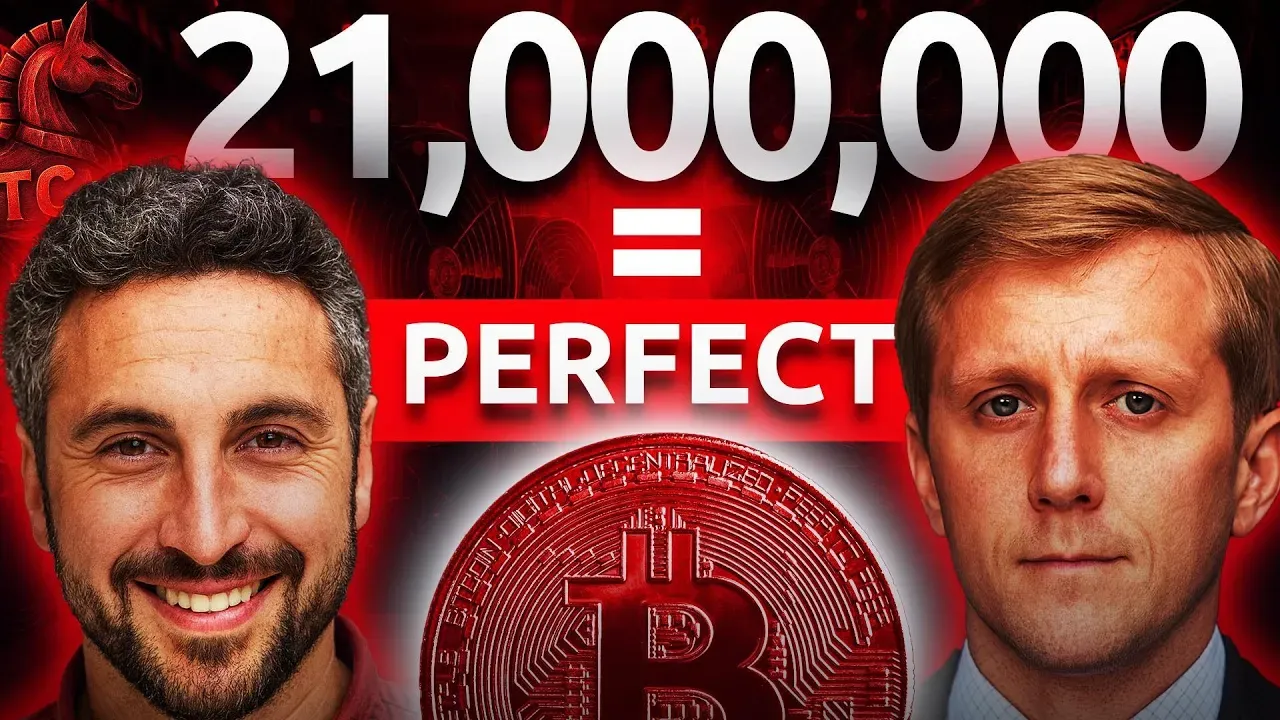
Bitcoin’s fixed supply of 21 million coins is the foundation of its value, tying digital scarcity to real-world energy use through proof-of-work. Mining isn’t wasteful, it enforces monetary integrity by ensuring issuance, transaction finality, and decentralization. The difficulty adjustment creates a self-regulating system that always maintains profit incentives, while shrinking subsidies transition security costs to transaction fees through a competitive fee market. Attempts to introduce inflation would destroy Bitcoin’s core value proposition, as its strength lies in neutrality, permissionless participation, and unchangeable scarcity.
Best Quotes
“Wall Street thinks it’s dipping a toe into Bitcoin, but really it’s crossing the event horizon into a black hole.”
“Bitcoin is the very first form of money that is absolutely scarce with a fixed supply of 21 million. Nobody can create more Bitcoin.”
“Mining isn’t its own industry, it’s a tool for energy producers, like a demand-response battery that monetizes excess power.”
“The only external resource Bitcoin requires is electricity. Security scales linearly with value through the difficulty adjustment.”
“A good form of money has to be neutral. With Bitcoin, as long as you have energy and internet, you can participate without asking permission.”
“Block space is scarce by design. The bidding process for transactions ensures a fee market will always exist.”
“Inflation can never be a solution. The entire reason Bitcoin has value is because its supply is fixed at 21 million.”
“Centralization isn’t binary, it’s a spectrum. Bitcoin must decentralize in every way possible: users, nodes, miners, and ownership distribution.”
“If there’s ever a fork or bug, rational actors will always choose the version that preserves the fixed supply. That’s the social consensus.”
“Decades of economic theory debated what good money should be. Bitcoin makes it a market test, opt in voluntarily, and the consensus is clear.”
Conclusion
The discussion reinforces that Bitcoin’s power lies in its immutability: 21 million is non-negotiable. Energy expenditure secures the network, decentralization distributes trust, and economic incentives ensure survival without inflation or external intervention. While risks like mining pool centralization exist, Bitcoin’s permissionless structure and market-driven consensus provide resilience. Ultimately, Bitcoin succeeds because it replaces trust in institutions with incorruptible rules, aligning all participants around one unshakable principle: absolute scarcity.
Timestamps
0:00 - Paper Bitcoin Summer & Wall Street's Bitcoin Black Hole
3:28 - Bitcoin as Shock Therapy for Zombie Markets
5:14 - Introduction to Bitcoin's Economic Incentives
8:30 - Why Bitcoin's Energy Use Solves Money Printing
10:43 - Energy Demand from Block Processing & Coin Issuance
16:12 - Permissionless Energy Sales to Bitcoin Network
21:54 - The Always-Profitable Mining Mechanism
27:03 - Difficulty Adjustment & Self-Regulating Markets
32:29 - Bitcoin's Closed System Independence
40:27 - From Mining Subsidy to Transaction Fee Market
46:15 - Block Space Scarcity Creates Fee Competition
53:29 - Why Inflation Can Never Fix Bitcoin
Transcript
(00:04) Bill Gyer. Paper Bitcoin summer. Summer of Phil. Which one is it? Well, every summer is summer of Phil. So, this summer I think is paper Bitcoin summer. Um, I'm I'm enjoying it quite a bit. I think it's a really unique time in Bitcoin, the Bitcoinification of Wall Street, if you will.
(00:29) It's not my my favorite topic in the world is the financialization all that, but it is pretty wild to me to see the explosion of paper Bitcoin summer. Yeah, I should have known. Yeah, I wrote the piece Bitcoin is the great defantization that there there would be some financialization of of Bitcoin before fiat ends and then true defancialization happens. But I wouldn't say I was wrong about that.
(00:56) That's just, you know, after Pierre wrote speculative attack in 2014, we should have we should have known that this was inevitable. And uh maybe that wasn't going to take this form, but it's also perfectly logical. So, I love it. Wall Street and all the kind of financial markets around the world, they feel or they feel like they're they're dipping their toe into Bitcoin right now, but Bitcoin is a black hole.
(01:15) And so, actually, they're kind of crossing the event horizon uh without even realizing it. So, I'm I'm a huge fan of all of these different products, but yeah, I think it is it is a a short time period where Bitcoin is going to be rapidly financializing before, you know, to your point, to your paper, things rapidly defancialize.
(01:33) Yeah. I I love that it's d drawing people in like Jim Chanos and that there's probably a bunch of people in Tradfi that are looking at it saying that ah this is all a scam and and what they don't realize is that the bottomless pit of fiat and the arbitragees in the fiat world is actually what's creating it.
(01:57) Um so you know if that capital was going to go to somewhere better to go to Bitcoin than some zombie company that was going to be extended just by the fiat system. Absolutely. And I was looking at a chart uh I think it was Crucius's chart of you know Bitcoin at uh $2 trillion as an asset class and then uh the different financial markets that are you know 100x the size of Bitcoin and somebody plotted all of the different uh Michael Sailor you know preferred stock products that he's launching and how it taps into these different markets. Uh and I think that's really fascinating. It's Yeah, it's just Wall Street, you know, getting
(02:31) sucked into the Bitcoin black hole. They think they're in charge, but, you know, we'll see. Yeah, it was it was interesting. I listened there was a podcast that Michael Sailor did where he was in person. the like I don't I didn't recognize guys who were interviewing him but when he he basically gave a 30inut explanation of how they they they basically unintentionally stumbled into this whole dynamic and that it was also and he connected the ideas of why Bitcoin's volatility was particularly attractive to these markets
(03:04) and and that um that it really wasn't a grand, you know, it wasn't an idea that he had when he started getting, you know, interested in Bitcoin and got orange spilled. It was something that they issued a convertible bond and then through that process realized that there was this whole arbitrage opportunity to suck in and tap more capital. So, totally.
(03:27) And I think what Bitcoin is doing right now to a lot of markets around the world, and I think you've spoken about it, you've written about this, a lot of markets are kind of zombie markets, right? they're they're running out of steam and that's why the money printing has to just continually happen because it's just like they can't they can't get the growth that they need and Bitcoin is like a shock to the system, right? It's like an EKG, right? If the if the patient is is flatlining and dying like as soon as you give a little Bitcoin exposure to a market, you see like rapid uh rapid adoption and and
(03:59) you know, not even adoption, but just like attention, short sellers, people going long, like all kinds of focus just goes right there to Bitcoin. I think it's really cool. Yeah. And that that's one thing that he also talks about with that the short sellers serve a purpose for him that they will then be buyers of his stock when they need him to be buyers of the stock.
(04:25) And so I think that uh and and that will be what we you know not that specifically but talking about the incentives of Bitcoin that create all that frenzy that ultimately create the demand for is what we we'll talk about today. And appreciate you coming on the show. This is episode four. The the first episode will actually be released next week.
(04:43) So by the time this one comes out people have gotten to listen to a few. But this this podcast is focused on mining and energy and all and the convergence of Bitcoin. and the money side of it. And the the first few episodes were were talking about mining in kind of a broad sense. The last episode we went deep on a specific strategy um in the mining ecosystem, specifically upstream natural gas, mining off of upstream natural gas.
(05:11) You're not a Bitcoin miner, are you? I'm not. You're not. I've I've done it just uh as a hobby just on a computer just to to try it out, see how it works. But unfortunately, I I rationalize myself out of becoming a Bitcoin miner. And maybe we can talk about that today. I did the same. Um but you're what you at least in my opinion what I would consider you as an expert in the economic incentives.
(05:35) Neither of us are economists, but we understand the economics of Bitcoin very well. And I think that one of the things that is easily lost in the Bitcoin mining sphere, particularly for people who are legacy energy professionals that see Bitcoin solving problems in the energy sphere, that those make sense.
(06:06) But then when they zoom out and then relook at Bitcoin and what is creating all of this demand for power, they then get reloc. So I think um and this won't be the only discussion on the incentives of Bitcoin, but I think uh or not, I think you had written an article back when we were still both at Unchained. I also think that you were my my first hire at Unchained potentially. Yeah. I mean I I I got the job, you know, in 2019.
(06:32) I just DM'd you on Twitter. I think I actually had heard you on either it was either what Bitcoin did or TFTC uh and just reached out to you and that rest is history. Yeah, we we were very close to hiring somebody else and the


)
Write a comment