Substance Core: The Rise of Body Perfection Culture
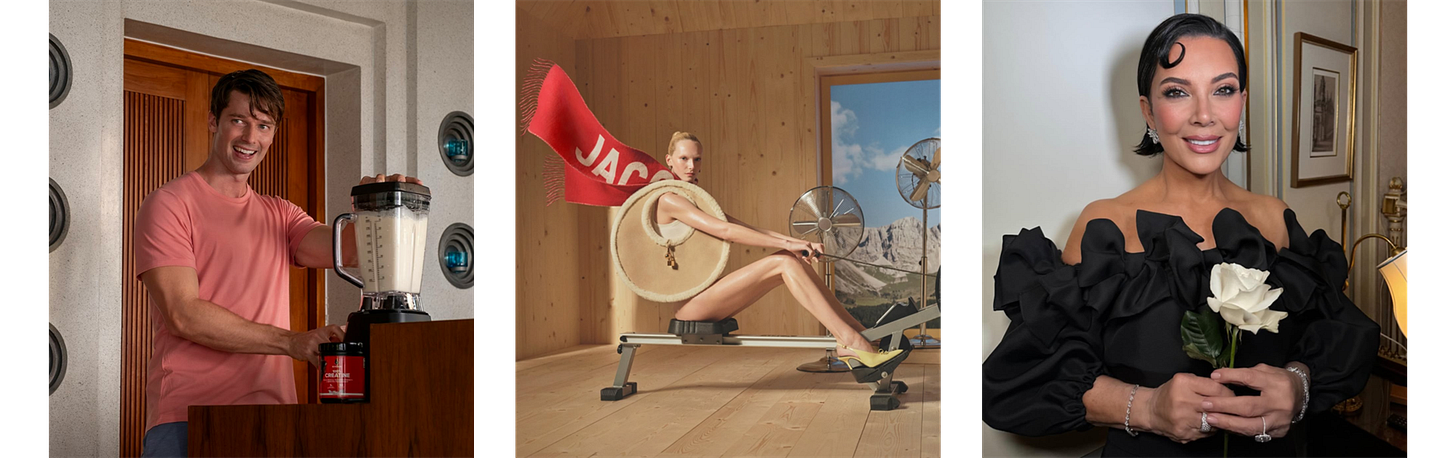
- WHAT’S HAPPENING. The Body Is Under The Spotlight.
- WHY YOU SHOULD CARE. The Rise of the Engineered Self
- In the meantime, Death Becomes Her is my suggested watch of the week. Here’s a sneak peek:
Substance Core: The Rise of Body Perfection Culture [

](https://substackcdn.com/image/fetch/\)s_!vSam!,f_auto,q_auto:good,fl_progressive:steep/https%3A%2F%2Fsubstack-post-media.s3.amazonaws.com%2Fpublic%2Fimages%2Fc8757b25-c704-449a-bb58-a15a3e754c29_2000x629.png)
Left to right: Saxon (Patrick Schwartzenegger) and his signature protein shake in The White Lotus, Alex Consani working out in the Jacquemus Winter Retreat Campaign, and Kris Jenner in Paris, May 2025.
There’s something in the air. Or maybe in the mirror. Across culture, media, and commerce, the body is being reimagined: tightened, sculpted, rejuvenated, modified. Aesthetic standards have never been higher, and that’s because our tools have never been more powerful.
WHAT’S HAPPENING. The Body Is Under The Spotlight.
Society, of course, has always been obsessed with beauty, even as its definition shifts. From Greek statues to Jane Fonda’s workout tapes, from the extra-thin runway models of the 1990s to the body-positivity movement that followed, we have long defined power, worth, and identity through flesh. But something is changing. This moment isn’t just about beauty: it’s about optimization.
The recent hit film The Substance portrays youth not just as a life stage, but as a commodity - a precondition for success, self-worth, and even love. It’s fiction, but not too far from reality. From Ozempic and NAD+ to deep plane facelifts, the beauty-industrial complex has entered a new phase: one where aging isn’t managed, it’s denied. And the results? Just look at the near-mystical glow-ups of Lindsay Lohan, Martha Stewart, and most recently Kris Jenner, whose transformation feels so dramatic it’s as if they’ve finally found Lisle Von Rhuman’s eternal youth potion from Death Becomes Her.
“You and your body are going to be together a long time. Be good to it,” says Lisle, played by a breathtakingly beautiful Isabella Rossellini.
That’s no longer a metaphor. It’s a business plan.
And while the skin gets smoother, muscle is on the rise. The new beauty frontier isn’t just thin, it’s strong. On The White Lotus, Saxon won’t go anywhere without his signature protein shake. Now that weight loss is increasingly outsourced to effective pharmaceuticals, building and maintaining muscle has become the next marker of status. Khloé Kardashian was quick to jump on the wave with Khloud, a protein-popcorn brand launched just in time for our summer abs. Fashion has followed suit: Bode and Balenciaga are putting muscular bodies back on the runway, while Duran Lantink parodies the whole performance, sending models down the catwalk with hyper-pronounced prosthetic bodies.
[

](https://substackcdn.com/image/fetch/\)s_!RVCk!,f_auto,q_auto:good,fl_progressive:steep/https%3A%2F%2Fsubstack-post-media.s3.amazonaws.com%2Fpublic%2Fimages%2Fdffbcb98-fecb-43b3-9fc8-f46a2976f829_1999x817.png)
Left to right: Balenciaga and Duran Lantink Fall/Winter 2025, Bode Summer/Spring 2025. Courtesy of Balenciaga, Duran Lantink, Bode.
But this isn’t just about looks. It’s also about longevity. Tech entrepreneur Bryan Johnson, the man who’s made aging in reverse his full-time job, has graduated from niche biohacking curiosity to Netflix subject, with viral TikToks racking up over 7 million views. His Benjamin Button–esque pursuit is now front and center in his new documentary Don’t Die: The Man Who Wants to Live Forever. What started as a fringe fascination with biohacking is now a full-blown wellness-industrial complex, complete with virality, venture capital, and hundreds of supplements.
So why should we care? Because this isn’t just a story about vanity. It’s about control, power, and access. And what it means to live in a body that’s no longer just given, but engineered.
Do You Care? Subscribe below to stay ahead - don’t miss the next deep dives, trends, and insights!
WHY YOU SHOULD CARE. The Rise of the Engineered Self
We’re entering the self-optimization era. The body is no longer something simply given; it’s becoming something to be engineered and upgraded. And this shift is poised to reshape how we live, consume, and relate to one another.
Beauty Standards Are Being Rewritten
Many of these trends have been simmering for years, as beauty has always been a tool for reaching love, success, and social capital. But now that we (or at least some of us) can access the most powerful tools yet - from pharmaceuticals to facelifts - the game has fundamentally changed.
The Substance - in less dramatic forms - is now available, and we’re increasingly consuming it. And the once-taboo nature of enhancements is eroding. Celebrities now speak openly about Botox, fillers, and even weight-loss drugs, which both de-stigmatizes their use and increases their allure. The message: if your favorite icon is doing it, why shouldn’t you?
And this is only the beginning. Innovations like AI-driven skincare and genetic-level aesthetic treatments are already in the pipeline. As Vogue Business notes, these tools won’t democratize beauty; they’ll likely raise the bar and reinforce outdated ideals, making them even harder (and costlier) to achieve.
As Vogue observed in March:
“We’ve paid lip service to body acceptance, we’ve go-girl-ed larger women… we did the work. But now with Ozempic, being overweight can instantly (if expensively) be fixed. Ozempic is a miracle drug — a cure for the fatness we’ve begrudgingly forced ourselves to accept.”
Health Trends Are Being Reframed - From Weight Loss to Lifespan
With drugs like Ozempic making weight loss increasingly effortless, the wellness narrative is shifting. The new obsession isn’t just being slim. It’s being sculpted, strong, optimized. It’s Saxon from The White Lotus, protein shake in hand and perfectly chiselled abs.
This pivot is already reshaping behaviors. Some are trading cardio for weightlifting, despite the health benefits of the former. Others are leaning into the longevity movement, swapping calorie counting and diet fads for cold plunges, glucose monitors, and biohacking supplements. According to Circana, sales of books about longevity jumped by 50% in the past year alone.
We’re no longer aging gracefully. We’re trying not to age at all. Bryan Johnson’s rising profile is proof: the culture isn’t just tolerating age-reversal; it’s celebrating it.
The New Body Economy Is Widening The Gap
But optimization has a price tag. While celebrities and the ultra-wealthy can afford the latest treatments, most people can’t - at least not without significant financial strain. This isn’t just about personal choice. When beauty and vitality become social currencies and markers of success, being unable to access them means being left behind.
Cosmetic procedures have become the new designer purchase, a visible signal of status and investment in the self. They’re a way for those with privilege to maintain (and amplify) their advantage. For everyone else, the options are limited: stretch your budget to keep up, or accept falling out of frame.
Consumption Patterns Are Shifting, And Companies Are Responding
As beauty and health are redefined, consumer behaviour is shifting with them.
Barclays has projected that the growing use of weight-loss drugs like Ozempic could reduce food sales volumes by 1.2%, and alcohol by 3%. Not only will people be eating less; their choices will change, too. According to Morgan Stanley, consumers are significantly shifting toward healthier categories, with alcohol, sweets, and fast food seeing an average decrease in consumption for 60–70% of users.
Companies are already responding: Nestlé has launched a line of frozen food targeted at individuals on GLP-1 drugs like Ozempic, designed to help “limit the loss of lean muscle mass.” But the impact of this shift goes well beyond food — and Khloé Kardashian’s protein popcorn. Bloomberg forecasted that if passengers were just 10 pounds lighter, an airline could save up to $80 million annually on fuel costs.
In the fitness sector, Equinox has introduced a “GLP-1 protocol,” a personal training program designed to help members on these drugs preserve muscle mass. At the same time, wellness spaces such as Othership, The Well, and Continuum are emerging as the new frontier of members’ clubs, built around the rising demand for biohacking, recovery, and longevity.
While ultra-technological treatments are what the top of the market is chasing, at a broader level, the beauty industry now faces a challenge: how to offer innovation and aspiration, without alienating the everyday consumer. The sweet spot lies in “achievable aspiration”: science-backed products and services that promise real optimization, but still feel accessible to those who can’t afford celebrity-level enhancements.
We’re only at the start of a cultural transformation - one where bodies are no longer just lived in, but constantly edited, managed, and enhanced. What comes next won’t just change how we look, but how we live, relate, and connect with one another.
Hope you enjoyed this read! If you did, subscribe below to receive the next articles straight to your inbox.
In the meantime, Death Becomes Her is my suggested watch of the week. Here’s a sneak peek:
Read the full article https://whyyoushouldcare.substack.com/p/substance-core-the-rise-of-body-perfection-beauty
Write a comment