BRANDSCAPES #1. Jacquemus’ South of France
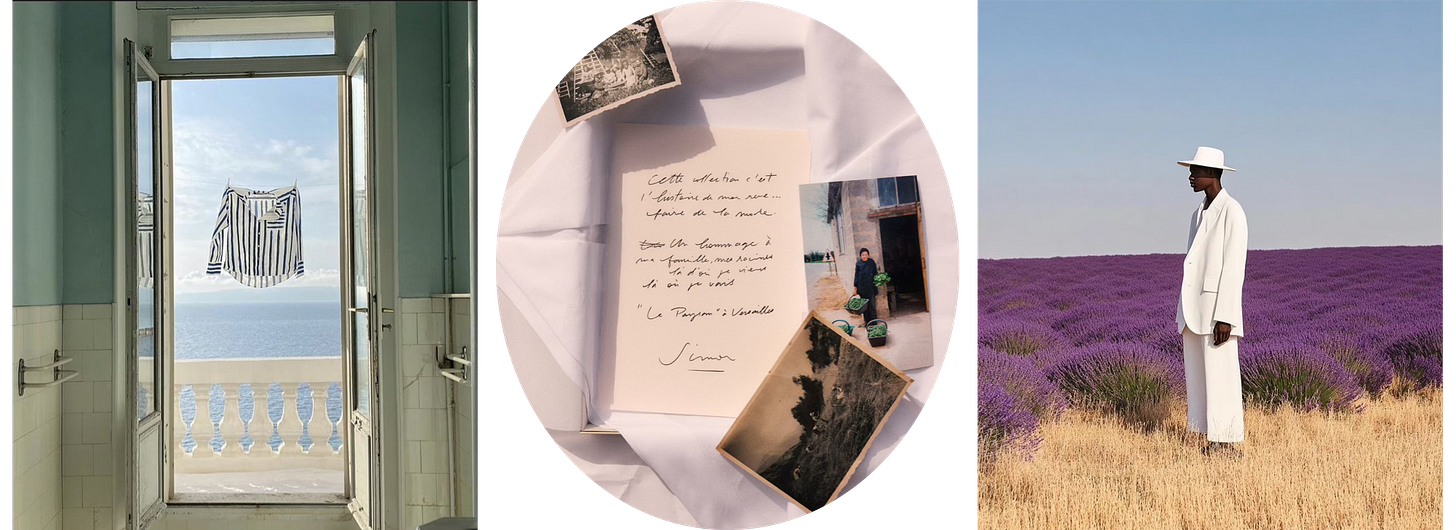
BRANDSCAPES #1. Jacquemus’ South of France This article is part of a series exploring iconic brands through the places that shaped them; tracing how landscape, memory, and culture become the fabric of a brand’s world.
Jacquemus doesn’t just sell clothes. It sells a story - one rooted in place, memory, and a very specific kind of beauty.
Not Parisian-chic, but provincial in a poetic way. Built on lavender fields and salt flats, plastic beach chairs and sun-warmed fruit, linen fluttering from washing lines. A world shaped by the South of France, and by a boy’s relationship to it.
Long before the runway shows and campaign films, Simon Porte Jacquemus was a child in Mallemort, a small town near Arles and Avignon, obsessed with the sun, the sea, and the quiet joy of dressing his mother. At seven, he made her a linen skirt from the living room curtains, tying it at the waist with Converse laces. She wore it proudly to walk him to school the next morning. Years later, after her passing, he named the brand after her maiden name, and made it a tribute: to her, to the landscapes that raised him, to his family rural heritage, and to the poetry of everyday life - as shown by his most recent show, Le Paysan.
This is what makes Jacquemus unlike any other label in fashion: its emotional geography is also literal. Almost every collection is mapped to a real location: a childhood beach, a brutalist seaside resort most Parisians would find gauche, a salt flat outside Arles where the light makes everything look like sculpture. Each place is a chapter in the brand’s mythology, carefully styled but never sterile. This is fashion as memory, narrative, and world-building.
Strategically, Jacquemus is a masterclass in what brand strategists call emplaced storytelling:** using real, emotionally resonant geographies to construct a larger symbolic world.** While most luxury brands aim for universality, Jacquemus insists on specificity. Provence isn’t just a setting: it’s a code: for slowness, sunlight, and sensuality.
So when the brand stages shows on lavender fields or salt dunes, it’s not a spectacle for the sake of image. It’s a map: back to a place, a person, and a feeling.
To understand Jacquemus is to understand these places by walking the same roads, tasting the same fruit, seeing what he saw - and, perhaps, feeling what he felt.
This is a travel guide. But not just for your next trip. It’s a way of reading a brand through landscape. A way to immerse yourself in a story that’s been told not through screens, but through streets, salt air, and sunlight.
The Aesthetic Map of Jacquemus
Each Jacquemus collection traces a landscape: salt-stung coastlines, lavender fields in bloom, villages where nothing and everything happens. This is a map to the places that shaped the brands, and the feelings stitched into them.
Let’s follow the road south, into the world that made Jacquemus.
Marseille & Les Calanques

If Jacquemus is a brand made of places, then Marseille is one of its cornerstones: a sun-bleached port city where the poetry of the South meets a certain Mediterranean edge. It’s here, in 2017, that the brand truly broke through.
The Spring/Summer 2017 show, __Les Santons de Provence__, unfolded on the aerial footbridge between the Mucem museum and Fort Saint-Jean; a sweeping stage suspended above the sea. Named after the Provençal clay figurines, the collection paid homage to village archetypes: the shepherd, the lavender vendor, the cook. Their silhouettes were exaggerated, reimagined with polka dots, ruching, and wide-brimmed straw hats - signature Jacquemus elements in the making.
A year later, he returned home, not just figuratively, but literally. The menswear debut, __Le Gadjo__, was staged in the Sormiou cove just outside Marseille. A show by the sea, framed by limestone cliffs and olive trees, it was as much a personal love letter as a fashion statement. “I grew up here, between the olive trees and the red tomato fields. I grew up here, barefoot, bare-chested, strong perfume. I grew up here, in the Mediterranean.”
#### ****What to See & Do****
s_!G4Yf!,w_1456,c_limit,f_auto,q_auto:good,fl_progressive:steep/https%3A%2F%2Fsubstack-post-media.s3.amazonaws.com%2Fpublic%2Fimages%2Fe62c1dbf-98a5-4415-b55b-d69c7fe9a685_2002x758.heic)
Begin in Le Panier, Marseille’s oldest quarter founded by the ancient Greeks, with its colourful facades and steep staircases. Its name means “the basket,” just like one of Jacquemus’ most iconic bags.
I usually suggest leaving the city for a proper beach day - the calanques are worth the trip. But if the heat catches up with you, take a dip at Piscine Maritime des Catalans, a natural sea pool just minutes from the Old Port. On Bastille Day (July 14th), stay and watch the fireworks shimmer over the** Vieux Port**, just as a young Jacquemus might have, eyes wide with wonder.
Pick up a book at Librairie l’Odeur du Temps for a quiet beach read, or stop by Pharmacie du Père Blaize, an apothecary founded in 1815, where dried herbs, teas, and essential oils still line the wooden drawers.
Wander through the Quartier des Antiquaires, home to art galleries and brocantes, and lose yourself in** Maison Empereur**, France’s oldest hardware store turned cabinet of curiosities.
Up for a local ritual? Join a game of pétanque at the Boulodrome de Niolon, where the clink of boules echoes over the sea.
Finally, drive toward Calanque de Sormiou - the road alone is a dream - and swim in the clear turquoise water framed by limestone cliffs and whispering pine trees.
Where to Stay

*
[****Bords de Mer****](https://www.lesdomainesdefontenille.com/en/lesbordsdemer.html )
If there’s one landscape that defines the Jacquemus universe, it’s Provence. For the brand’s 10th anniversary in 2019, he staged Le Coup de Soleil in the lavender fields of Valensole — postcard-perfect, yet reimagined with a pop installation inspired by Christo. “I wanted the opposite of what you’d expect from this Provençal postcard,” he said. It wasn’t just a visual spectacle, but a return to the region at the heart of his story.
Even when not geographically in Provence, Jacquemus brings it with him. The wheat fields of the L’Amour show (SS21) weren’t in the South, but they evoked the same rural intimacy, the same poetry of simplicity.
Read the full article https://whyyoushouldcare.substack.com/p/brandscapes-jacquemus-france
Write a comment