An Oscar for UPA
An Oscar for UPA Welcome! It’s a new Sunday edition of the Animation Obsessive newsletter. Here’s our slate for today:
- 1) An Oscar-winning cartoon and the meaning of Magoo.
- 2) Animation newsbits.
With that, let’s go!
1 – “Don’t you know people like that?”
The word cartoon is loaded. It may bring to mind wild slapstick, vaudeville gags, animation that’s all bouncing energy. It’s easy to think of Looney Tunes or early Popeye, or the way Roger Rabbit moves.
But this isn’t the only meaning of the word. Look at the newspaper work of Honoré Daumier, or at classic New Yorker issues, and you find the satirical cartoon — crisp drawings with a sharpened point to make. And that approach, too, can be animated.
America’s industry didn’t do it immediately. There isn’t much satire in Steamboat Willie (1928), for example. The style picked up speed in the early ‘40s, with shorts like The Dover Boys. An animation artist named John Hubley saw that one and was struck. Its social commentary, jabbing at “outmoded and phony ideals,” inspired him.1
Not long after, in 1943, Hubley made a case for animated cartoons in which “purpose” would replace “formless and meaningless slapstick.” They’d be socially relevant, about people. And they’d have positive aims — unlike the lowbrow films that “ridicule racial minorities, science \[and\] higher learning.”
At the studio UPA, Hubley implemented these ideas. He and his fellow rebels made cartoons like The Brotherhood of Man (1946), fresh and different in every respect. Screenwriter Bill Scott found the studio “more cerebral in its approach,” and noted that Hubley always “wanted a story that was psychologically sound, sharp, satiric and if possible the story needed to have some sort of political slant.”2
These were the new cartoons. And a number of them starred a new character, co-created by Hubley — one Mr. Magoo.
UPA aimed Magoo’s theatrical shorts at an adult audience. They grew popular. By the time Magoo finally got an Oscar, his films were among the highest-grossing each year. The first that won was When Magoo Flew (1954) — and some have called it the height of the series. It reveals a lot about UPA and the era in which it operated.3

s_!EsuO!,w_1456,c_limit,f_auto,q_auto:good,fl_progressive:steep/https%3A%2F%2Fsubstack-post-media.s3.amazonaws.com%2Fpublic%2Fimages%2Fb36204a5-4017-4851-9c92-d9b2144aab9d_550x236.gif)
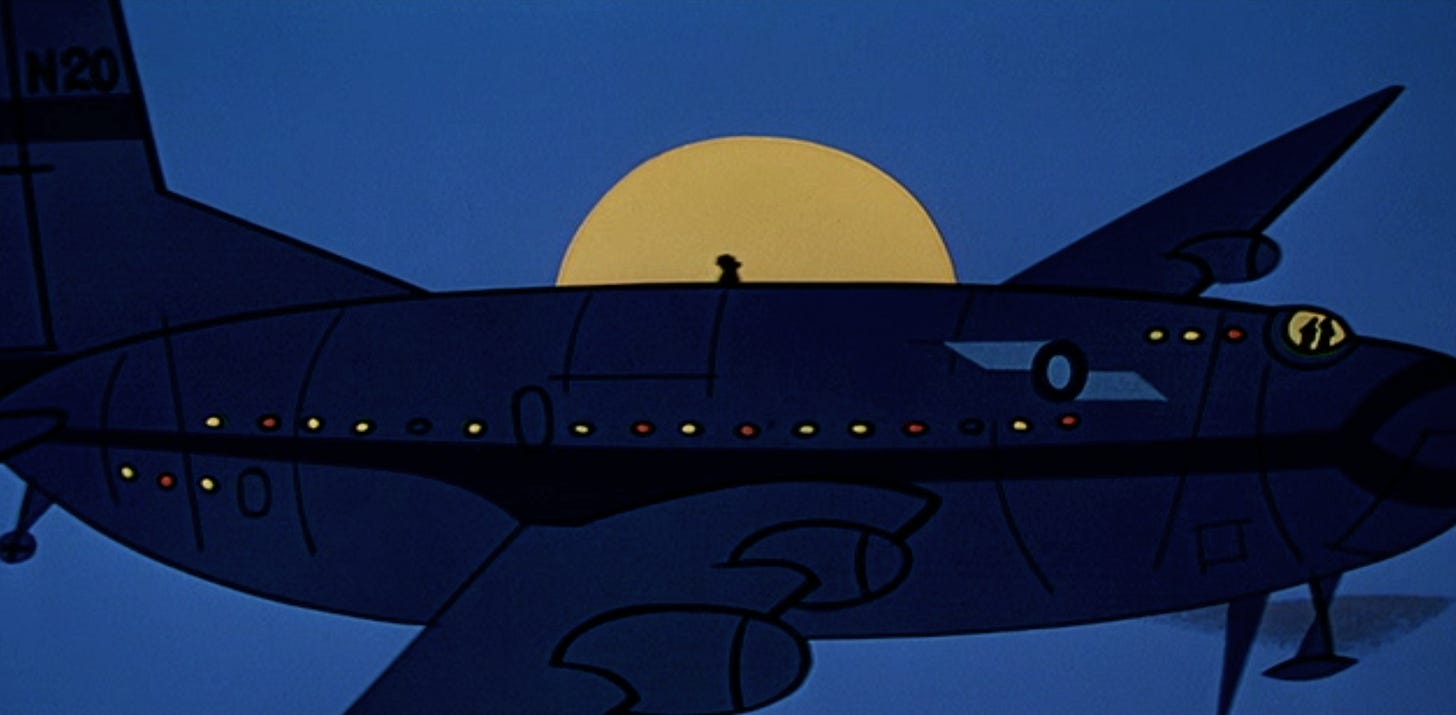
If you’ve never watched a Magoo film, the premise is that he can’t see anything for what it is. He’s out of touch with reality, and he misinterprets the world through his assumptions and preconceptions. When Magoo Flew is six minutes in this vein: he goes to watch a movie and ends up on a plane, where he accidentally solves a crime.
Magoo doesn’t realize this — he believes he went to a movie, so that becomes his world. At one point, he walks onto the plane’s wing and trips over an aileron, which he perceives as a loose floorboard. “They’ll get sued. Lawsuit. Close up the whole thing; that’s the end of it,” he grouses. Elsewhere, he decries television and air conditioning, and swings his cane at a dog (which isn’t real).
The satire was recognizable to viewers of the day. Magoo was born as a send-up of “thickheaded conservative\[s\],” Hubley said. An uncle of Hubley’s was an influence. Jim Backus, the voice of Magoo, saw his own father in the character — someone who lived “in his own world, never quite seeing things the way they really are.” The team behind Magoo noted that he was a staunch Republican, one nostalgic for the William McKinley administration. In the futuristic ‘50s, he was a man out of time.4
As Hubley put it:
… the character of Magoo emanated from a common desire of his creators to satirize the symbols of family authority that each of us knew. The so-called father image was clearly in our minds … and one that was essentially ineffective, a blusterer, a dogmatist. The nearsightedness became a visual-dramatic handle with which to expose the pomposity and egotism of misused authority.
Magoo, we decided, would always make an appraisal of a situation in one glance. … His stubborn rigidity was such that, having made a snap judgement, nothing could convince him he was wrong. Don’t you know people like that?
To be clear, though, Hubley didn’t personally work on When Magoo Flew. By then, he’d been blacklisted in Hollywood for a few years.5
UPA was a progressive studio, and many of its employees had been communists at one time or another. That was true of Hubley. He’s in the credits to the first eight Magoo films, from ‘49 to ‘52. When Magoo Flew arrived deeper into the series, after key UPA personnel had been driven out by the McCarthyists.
By the mid-1950s, making satirical films was a risk. Pete Burness (the primary Magoo director) noted that UPA’s love of satire came up against a reactionary turn in the culture. It was scary to joke about society. “\[Our distributor\] Columbia said don’t make fun of policemen or judges,” he said. “We tried not to, but we still tried to put satirical comments in whenever we could.”
You see them in When Magoo Flew, which pokes fun at the officers of Dragnet. (“I’m a cop,” says one, repeatedly.) And Magoo himself remains a subversive figure — satirizing the same kind of person who might have supported the Red Scare.

s_!ISHr!,w_1456,c_limit,f_auto,q_auto:good,fl_progressive:steep/https%3A%2F%2Fsubstack-post-media.s3.amazonaws.com%2Fpublic%2Fimages%2Fa4491d9e-c667-4203-8c62-4fa59bd4d50a_1000x776.png)
When Magoo Flew may or may not be the funniest, most clever Magoo film — there are plenty of contenders. But it represents the series in its mature form, after the details had been figured out but before the character’s decline.
Hubley’s first version of Magoo, the one in The Ragtime Bear (1949), was harsher and nastier. In later films, the team opted to “soften” him, Hubley wrote: “we decided that it would be his character to be outwardly aggressive, but inwardly mellow.” Magoo is still an egotist who rages at the world, but he quickly falls back into his sense of amused superiority. That’s the character in When Magoo Flew.
His look developed, too. The craggy, sagging face is gone. By When Magoo Flew, he’d turned into a tight, iconic bundle of shapes — the character that people remember.
Sterling Sturtevant was responsible there. She was among UPA’s top designers, and she reportedly won a contest at the studio to rework Magoo. For a while, she became the design lead on the whole Magoo series — taking it to “a stylish peak,” in the words of historian Adam Abraham. Her slick, polished sensibility is all over When Magoo Flew. One of her UPA colleagues recalled her as “an incredible draftsman.”6
In this cartoon, Sturtevant’s layouts expanded to fit the vast CinemaScope format, which was new. The film can’t be seen exactly as intended on a small screen: the colors and shapes are meant to be huge. Plus, the jokes about movies aren’t quite the same when an oversized Magoo isn’t telling them to a packed theater. (After all, as the Motion Picture Herald noted, the short takes aim at the wide-screen format itself.)7

Still, Magoo and his friends navigate Sturtevant’s layouts in the usual way. Although UPA was known for a flat, two-dimensional look, the Magoo series was a bit different. The studio’s Robert Cannon explained that [Gerald McBoing-Boing](https://www.youtube.com/watch?v=vMdvNKVjuLk )
Even though Hubley wasn’t part of UPA in 1955, the year When Magoo Flew won its Oscar, the studio was following the same ideas he’d outlined back in 1943. He’d advocated for cartoons that would bring together “graphic art and the medium of storytelling,” cartoons that would “comment on the times and problems of the people.”
Animation had fallen into “abstraction and irrationalism” disconnected from real-world concerns, he’d argued. It focused on the “perfection of form” above any “meaning.” Future cartoons should find a new interest in story and statement. They should address the people.
Which, basically, happened at UPA.
Magoo isn’t especially famous today. But his cartoons spoke deeply to the concerns of their own era. It’s hard to imagine: a commercially successful, Oscar-winning series that even art critics loved. In 1955, materials from Magoo got exhibited at the MoMA; in 1956, the character was hawking Rheingold Beer on television.9
Somehow, for a brief moment, the studio bridged that gap. “For UPA,” reported a broadcasting trade in ‘55, “the twain do meet.”10
2 – Newsbits
- We lost Radna Sakhaltuev (90), a legend in Ukrainian animation. He art directed the ‘80s Treasure Island, among many others.
- In America, Deaf Crocodile revealed the films in its upcoming Yuri Norstein Blu-ray collection, including rarities most haven’t seen before. (As a note, we’re currently set to have an unannounced extra in this release.)
- In Colombia, three more films from Cuba’s Elpidio Valdés series have been restored, and they recently opened at the Bogotá Cinematheque.
- A new law in China requires “AI-generated text, images, audio, video and other virtual content” to be visibly labeled on social media.
- PBS in America is continuing to downsize after its defunding by the federal government. (Relatedly, Sesame Street has a new deal with YouTube.)
- Infinity Castle is a hit in South Korea, where it’s earned around $24.4 million after three weekends.
- In India, Studio Eeksaurus posted a fun short to celebrate Onam.
- In the Dominican Republic, director Tomás Pichardo Espaillat is working on a feature called Where the Bees Sleep. (He previously made Olivia & the Clouds.)
- The scholar Sergey Kapkov won a prestigious book award in Russia for his recent histories of Soyuzmultfilm and Studio Ekran.
- The Japanese film Noiseman Sound Insect is once again on YouTube — officially, for a limited time.
- In Britain, Joanna Quinn published a new short in support of Gaza. It’s her contribution to the animation jam To Gaza with Love.
- The Glassworker opened in select American theaters on Friday. See the list here.
- Last of all: we looked into the first decades of Japanese animated TV commercials.
Until next time!
Read the full article https://animationobsessive.substack.com/p/an-oscar-for-upa
Write a comment