Polish Animation, After the War
Polish Animation, After the War Welcome! We’re here with a new Sunday edition of the Animation Obsessive newsletter. This is our slate today:
- 1) A brief tour of Polish animation.
- 2) A little on Infinity Castle’s success.
- 3) Animation newsbits.
With that, let’s go!
1 – Diamonds from Poland
There’s no way to understand the scale. So much of the world was razed by World War II, but few countries suffered like Poland — where so many crimes took place.
Yet the war ended, and some kind of normality appeared in the rubble. Polish art started to bloom again. “After the war, Poland was in a shambles, literally, spiritually and economically,” explained the animation writer Chris Robinson. “The new generation of artists that emerged was characterized by black irony and sarcasm.”1
It wasn’t true in every case, but it was a theme. Artists were in pain. The Nazis had claimed family and friends — and people’s creative heroes. As one artist wrote in 1948:
When the war swept over Poland, it did not spare the ranks of her artists. Post-war Poland mourns the loss of her most representative painters and graphic artists, whose names had already established themselves throughout Europe. Wajwod__,__ Manteuffel__,__ Hladki__,__ Piotrowski and many others … Although such losses cannot be replaced, and although the technical difficulties confronting Poland’s post-war artists are considerable, they can exhibit their achievements with justifiable pride, especially in the realm of poster design.2
The author there was Jan Lenica. He became a star of Polish posters, at a time when Polish graphic design stood among the “most creative and advanced in the world,” per one historian.3 And he brought that same talent to his dark, strange animated films.
Poland’s animation scene bloomed after the war, too — Lenica was a leader in it. The movie business was nationalized, and animators benefited.4 In the ‘50s and ‘60s (and beyond), some of the most unique animation anywhere was Polish.
Hundreds of these films are available online for free, generally without registration. A Polish streamer hosts them — officially restored, and with English subtitles. Today, we’re discussing and linking a handful of the postwar classics. It’s a brief tour of what some called the “Polish School” of animation.5

s_!7i9k!,w_1456,c_limit,f_auto,q_auto:good,fl_lossy/https%3A%2F%2Fsubstack-post-media.s3.amazonaws.com%2Fpublic%2Fimages%2Fe3765263-fea7-476c-bc4b-f8d80f987caa_550x401.gif)
By the ‘60s, Polish animation was known for pushing boundaries. It had strong ties to collage and modern painting, and it could get esoteric. Plus, a number of its scores came from a young Krzysztof Penderecki, the avant-garde composer.
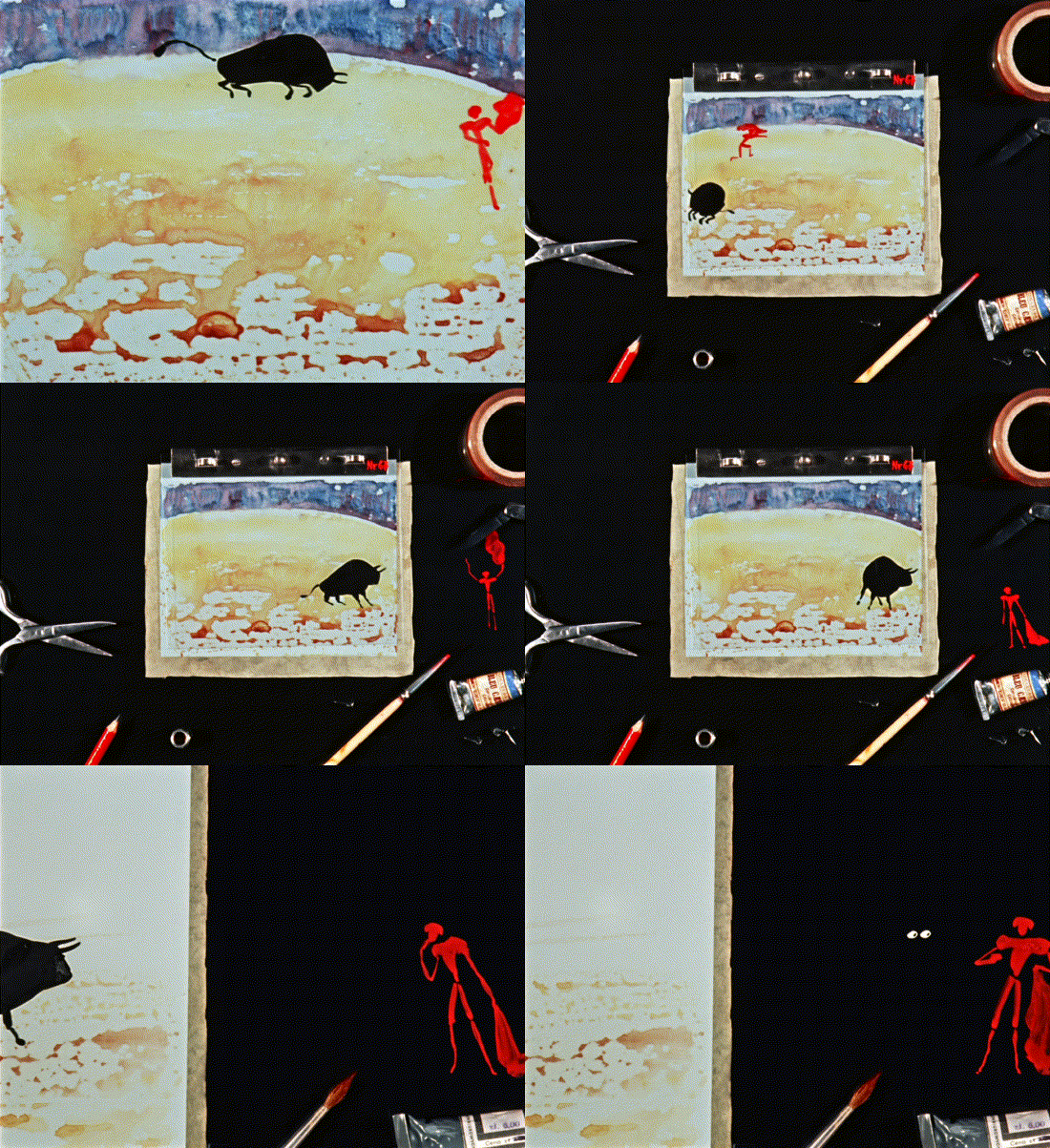
But that edge didn’t always lead to inaccessible work. For example, see the creations of Witold Giersz, a living artist who turned 98 this year. His Red and Black and Little Western from the early ‘60s are joys to watch. They combine paint animation with Looney Tunes gag material, and they’re hilarious.
Giersz made them in Warsaw, working at Studio Miniatur Filmowych. He’d joined the animation industry more than a decade earlier, but it took him years to find his voice. Younger artists at Miniatur inspired him — the ones who’d learned animation from him. “In turn, they taught me… nonconformism,” he said. Little Western was his first stab at “an individual contribution to the world of animation.”6
He did remarkable work at Miniatur. Expectancy (1962) tells a stop-motion tale of love and betrayal with figures made of tissue paper, plastic wrap and foil. “What drama, what tragedy can be designed for a tissue ballerina?” Giersz asked himself, and he played it out from there. Meanwhile, Horse (1967) is a haunting piece animated with oil paint on glass, shaped with a palette knife. He explained:
… I was inspired not by one single painter but by a whole group: the French Impressionists. I was always attracted to their work, especially because it seemed to be three-dimensional, incorporating both convex portions and deep relief. Van Gogh’s work also offers a particularly good example of this. By drawing in paint with a blade I was able to achieve even deeper relief.7

s_!3_3d!,w_1456,c_limit,f_auto,q_auto:good,fl_progressive:steep/https%3A%2F%2Fsubstack-post-media.s3.amazonaws.com%2Fpublic%2Fimages%2Fa666fb1f-5d17-4789-9802-30839a2f70b3_550x412.gif)
The critic Sergei Asenin once compared Giersz’s films to “living canvas paintings, improvised in front of our eyes.” That sensibility turned up in much of Poland’s postwar animation.
Another director at Miniatur was Kazimierz Urbański, an art-school graduate who’d also studied ballet. He approached films like personal artworks. “I suppose I could define my interests as a pursuit of painting with a camera,” Urbański said in 1965. “The point of departure is always form, texture, color, movement.”8
Consider The Matter (1962). Here, Urbański used strands of thread to tell a primordial creation story. It begins with abstract shapes and gradually turns figurative — building up to an all-consuming fire. More hopeful is his Moto-Gas (1963), in which torn-paper characters get poisoned by gasoline fumes in the city, only to purify themselves with a trip to the countryside.
Both films are mysterious and often unsettling. And their themes weren’t atypical for Polish animation: destruction, the loss of humanity. They’re small protests.
You find the same in Jan Lenica’s New Janko the Musician (1960), whose setting is “the modern village of the future, \[where\] everything is mechanized.” A peasant takes his mechanical cow out to pasture and dreams of becoming an artist. The eerie music and Lenica’s collage put across a cold, alienated world. At one point, coins fall from the sky, only to become bones when people touch them.
But New Janko, too, offers a message alongside the pessimism. The lead character (a “completely average, ordinary person,” in Lenica’s words) transforms the world with his art. Dehumanization doesn’t win — even the fake cow becomes a winged horse by the end.9 Lenica once said:
My approach towards poster and animation is similar: I have always considered both genres as means of artistic contraband. To me, poster was like a Trojan horse romping across the streets and smuggling something \[that\] you would not find there normally. Animated film … revealed itself as a new Trojan horse capable \[of concealing\] different contents.

s_!Pays!,w_1456,c_limit,f_auto,q_auto:good,fl_lossy/https%3A%2F%2Fsubstack-post-media.s3.amazonaws.com%2Fpublic%2Fimages%2F9babf383-9471-4765-8031-1981089e249c_550x402.gif)
The rise of Polish animation didn’t go unnoticed — Lenica’s shorts were getting prizes abroad by the ‘50s. The trend continued, and the influence spread. An animated film from Warsaw took the top award at the Annecy Festival in ‘67. Its title: Cages.10
Even today, Cages has a reputation. Its appeal surprised its own director, Mirosław Kijowicz, when he showed it at Annecy. The positivity was huge for what was (as he saw it) a “rather austere and difficult film.”11 It’s another study of dehumanization, of what people do to people, of the structure of the modern world — all set to rich jazz.
Kijowicz was a resistance fighter during the war, and he later became an art student. For him, animation had a social purpose:
I try to make a commedia dell’arte__, to tell the limited audiences of Polish animation the story of their lives, just as troubadours used to tell villagers the stories of the hamlet. Then, if these small things become symbols of a universal way of being, so much the better.__
In those years, Warsaw produced a lot of strong animation with something to say. But animation wasn’t centralized in one city — other studios dotted Poland.
Kijowicz made Portraits (1964), for example, with Studio Filmów Rysunkowych in Bielsko-Biała. Another of its standouts is New Year’s Night (1964), whose lighthearted comedy is a relief. The film is three angles on an absurd story — involving a chimney sweep hanging by the leg and a post officer who gets every husband in an apartment building arrested. It’s full of personality and, with subtitles, very funny.12

s_!ONE_!,w_1456,c_limit,f_auto,q_auto:good,fl_progressive:steep/https%3A%2F%2Fsubstack-post-media.s3.amazonaws.com%2Fpublic%2Fimages%2F026d5d4c-547a-447a-8c8a-021134f03d1f_2000x1480.png)
Which is just a tiny slice of Polish animation. That streaming collection runs up through the ‘90s: it’s packed with mind-bending stuff. There’s a lot to praise about the recent Essential Polish Animation Blu-ray as well. And that doesn’t get into the famous Bolek and Lolek series — and so on.
Poland lost unrecoverable things to the Nazis, as Lenica wrote. What happened is beyond description, and the pain didn’t end when the fighting stopped. People rebuilt, though — stronger than ever, sometimes. There wasn’t much animation in Poland before the war. Yet artists who refused to accept the destruction would, in the postwar years, make films powerful enough to change the world.
Many of those films aren’t about the war, at least explicitly. They stand on their own. Even so, the context is important. Every Polish animated film back then was an overcoming — and, by nature of its existence, an argument against death.
2 – Animation news worldwide
2.1 – A victory for Infinity Castle

Last month, we talked about the rise of hand-drawn features. This week added more to that story. In America, the Japanese film Infinity Castle had an estimated $70 million opening weekend.
Stateside, that’s the most for a 2D feature since The Simpsons Movie (2007). It’s also a new high for Japanese animation in American theaters, breaking an opening record set by the original Pokémon movie in the late ‘90s. Now, Infinity Castle aims for Pokémon’s other record: the top-earning anime film in the States. Expect a new champion soon.
There are other stats worth noting. Infinity Castle is the weekend’s top film — and, in America, the year’s biggest animated debut. (In addition, no Sony release has done numbers like these since the last Spider-Verse in 2023.)
Anime franchise films have dominated Japan for several years. This weekend might mark the start of their dominance in the States. As Jamie Lang of Cartoon Brew wrote a few days ago:
For the anime industry, this launch underscores just how mainstream titles like Demon Slayer have become, both as box office forces and cultural events. Given current trends, we wouldn’t expect any of Infinity Castle__’s records to last for very long.__
Read the full article https://animationobsessive.substack.com/p/polish-animation-after-the-war
Write a comment