Nicaraguan Police Seize Cocaine After Deadly Confrontation in Nandaime
Nicaraguan Police Seize Cocaine After Deadly Confrontation in Nandaime opposition Opposition outlets describe the Nandaime case as a rare, high-volume drug bust in which police killed one suspect and arrested five others after a pursuit, questioning why such detailed reporting is exceptional and hinting at broader opacity in anti-drug operations. Their framing suggests concern about the lethal use of force and the overall transparency and politicization of Nicaraguan policing. @Despacho505.com
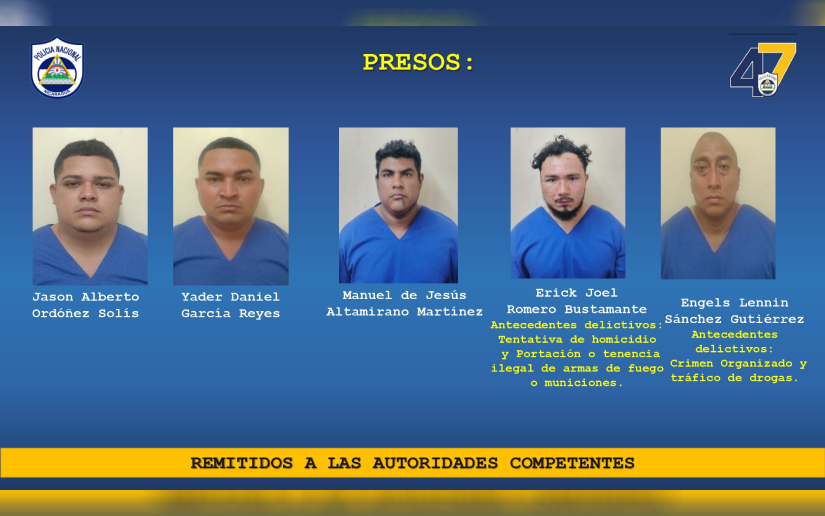
government-aligned Government-aligned coverage presents the operation as a straightforward success in which police captured five criminals transporting 253 kilos of cocaine, emphasizing names and quantities as proof of law-enforcement effectiveness. It avoids discussion of the confrontation’s dynamics or potential abuses, reinforcing a narrative of competent, apolitical security institutions. @El 19 Digital Nicaraguan media across the spectrum report that a recent police operation in Nandaime, in the department of Granada, ended in a deadly confrontation linked to drug trafficking. Both sides agree that police seized roughly a quarter-ton of cocaine (around 252–253 kilograms) and that five suspected traffickers were arrested; at least one person identified as involved with the shipment was killed during the incident, which began after officers tried to stop a vehicle that allegedly evaded a police roadblock.
Coverage consistently places the operation within the remit of the Nicaraguan National Police and frames it as part of broader anti-drug efforts along known trafficking routes. Both opposition and government-aligned outlets describe the episode as one of the more notable recent drug seizures, implicitly situating it in a context of sporadic but high-volume interdictions in a country that lies on a regional corridor for cocaine smuggling. There is shared acknowledgment that the action is formally presented as a law-enforcement response to transnational narcotics trafficking, involving coordination among different police units and being publicly reported through official channels.
Points of Contention
Narrative framing of the operation. Opposition outlets present the Nandaime incident as one of the few recent drug operations with arrests, subtly suggesting an atypical level of transparency and hinting that many other cases go unreported or lack clear outcomes, while also noting the deadly nature of the confrontation. Government-aligned media, by contrast, frame it in simple, triumphalist terms as another successful operation by the police, emphasizing the names of the detainees and the quantity of cocaine seized without dwelling on procedural details, risks, or irregularities. This creates a contrast between an operation treated as an exception that raises questions versus one presented as routine evidence of effective security policy.
Use of detail and omissions. Opposition reporting includes the existence of an armed confrontation, a vehicle pursuit after suspects evaded a roadblock, and the fact that one alleged trafficker died, painting a more complex and potentially controversial scene. Government-aligned coverage largely omits the mechanics of the confrontation, provides no account of how the capture unfolded, and does not explore circumstances of the death, instead limiting itself to listing detainees and the drug quantity. As a result, opposition sources invite scrutiny about proportionality and procedure, while government-aligned sources minimize elements that might prompt debate about police conduct.
Portrayal of police and institutions. Opposition sources reproduce the police version but underline how rare such detailed anti-drug operations with arrests have been in recent months, implicitly questioning the overall performance and transparency of the security apparatus. Government-aligned outlets portray the police as efficient crime-fighters who neutralized dangerous criminals, using the seizure to reinforce a narrative of strong law-and-order governance and institutional competence. The same facts are thus used either to highlight gaps and inconsistencies in institutional behavior or to bolster the legitimacy of the current security model.
Broader political implications. Opposition coverage subtly situates the case within a broader pattern of opaque policing under the Ortega government, suggesting that even genuine drug busts must be read against a backdrop of politicized law enforcement and limited accountability. Government-aligned media disconnect the operation from any political debate, avoiding mention of governance concerns and instead using the incident to support the image of a state successfully protecting citizens from international drug trafficking. This divergence turns a single anti-drug operation into either a data point in a critique of authoritarian practices or a showcase of regime effectiveness.
In summary, opposition coverage tends to emphasize the rarity, violence, and opaque aspects of the Nandaime operation to question broader policing practices, while government-aligned coverage tends to highlight the arrests and cocaine seizure in a stripped-down, celebratory narrative that reinforces the image of an efficient, apolitical security force. Story coverage
Write a comment